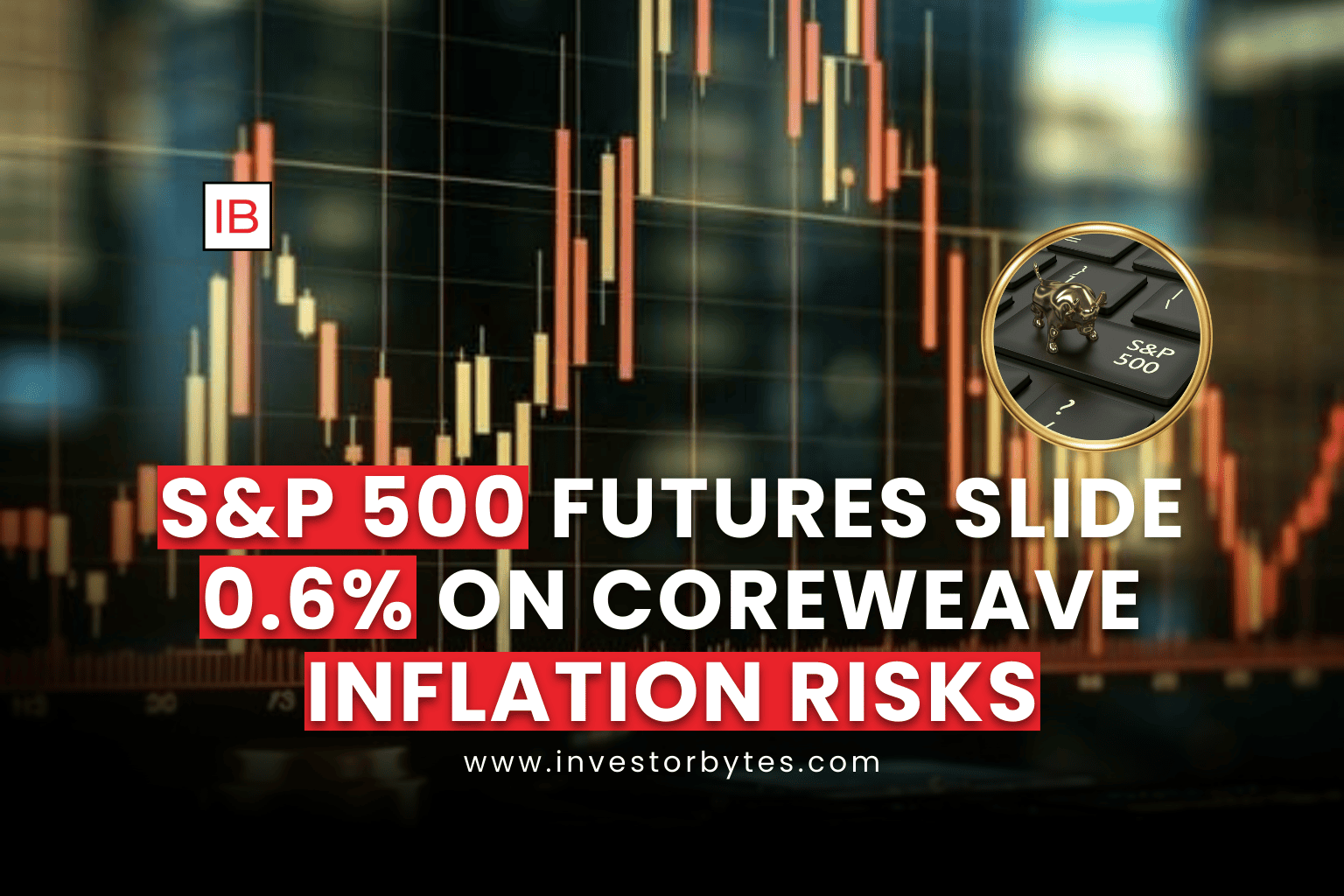
In a volatile start to the week, the global financial landscape is grappling with a “double-whammy” of geopolitical escalation and a fundamental re-rating of the AI sector. On Monday, S&P 500 futures dropped as much as 1.2% before stabilizing with a 0.6% decline heading into the North American session.
The primary catalysts are a “perfect storm” of surging energy prices due to the U.S.-Iran conflict and a staggering 18% collapse in CoreWeave (CRWV) stock following its Q4 earnings report. For investors in 2026, the message is clear: the “AI Honeymoon” has transitioned into a high-stakes era of capital expenditure scrutiny and inflation-driven yield pressure.
The CoreWeave Catalyst: AI Infrastructure Under the Microscope
While the S&P 500 has flirted with the 7,000 mark, the current pullback is heavily influenced by the performance of “neocloud” leaders like CoreWeave. CoreWeave’s recent earnings report has sent shockwaves through growth-heavy indices.
The Spending Paradox
CoreWeave reported impressive revenue growth (up 110% year-over-year to $1.57 billion), yet the stock plummeted because of its massive 2026 Capital Expenditure (Capex) guidance.
The $35 Billion Bet: CoreWeave announced it will spend between $30 billion and $35 billion in 2026 to expand AI data centers. This is double its 2025 spending and nearly matches its entire market cap.
Margin Compression: Gross margins slipped from 73% to 67.6%, signaling that as the AI infrastructure race heats up, the cost of power, chips, and land is eating into the profitability of even the most dominant players.
The Debt Burden: With a debt-to-equity ratio of 6.5x, CoreWeave is being viewed by some analysts as a “financing company” rather than a software firm, making it hyper-sensitive to the rising interest rate environment.
Inflation Risks: The “Higher-for-Longer” Reality
The S&P 500 futures slide is also a reaction to the January Producer Price Index (PPI), which came in “hotter” than expected at 0.8% for services. This suggests that inflation is becoming “sticky” in the 2026 economy, fueled by two main drivers:
Tariff Pass-Through: Corporate America is beginning to pass on the costs of the 15% blanket tariffs introduced earlier this year. Companies from Levi’s to BMW have announced price hikes for 2026, keeping the Federal Reserve in a hawkish stance.
Energy Spike: Following U.S. and Israeli military actions against Iran over the weekend, WTI Crude Oil surged 7% to nearly $73 per barrel. This energy spike is a direct “inflation tax” on the S&P 500, particularly for the transportation, airline, and industrial sectors.
Treasury Yields and the 4.0% Barrier
The 10-Year Treasury Yield is currently testing the 4.0% psychological level. As yields rise, the “discount rate” applied to future earnings of growth companies like Nvidia, Microsoft, and CoreWeave increases, naturally pulling down the valuation of the broader $TECH and S&P 500 indices.
Market Outlook: The North American Session
As the opening bell approaches in New York, traders are bracing for a high-dispersion session. While growth and tech are under pressure, “Defensive” sectors and “Safe Havens” are seeing a professional rotation.
The “Halo” Rotation: Capital is moving out of “capital-light” software and into Energy (Exxon, Chevron) and Defense (Lockheed Martin, Northrop Grumman), both of which are trading in the green this morning.
The VIX Spike: The “Fear Gauge” (VIX) has spiked above 18, indicating that options traders are paying a premium for downside protection.
Support Levels: Technical analysts are watching the 6,830 level (the 100-day moving average) as the critical floor for the S&P 500. A break below this could trigger a wave of algorithmic short-selling.