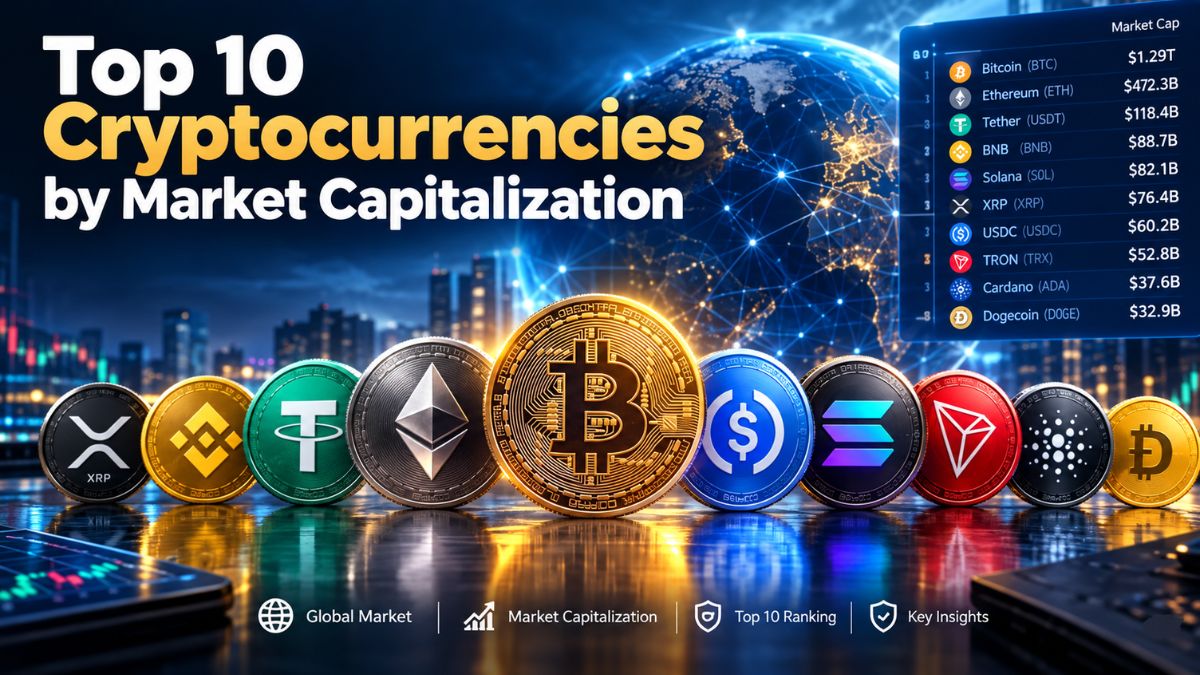
Crypto market capitalization changes continuously, but the largest tokens still reveal how capital is distributed across store-of-value assets, smart-contract networks, exchange ecosystems and stablecoins.
Key Takeaways
- Bitcoin (BTC) leads this ranking based on market capitalization.
- The data snapshot is September 16, 2026; fast-moving values should be verified again before publication.
- Market cap measures network value at current prices, not liquidity, decentralization, cash flow or investment quality.
- The ranking measures one dimension only and should not be treated as personalized financial or investment advice.
How We Ranked the Top 10
Market caps are intraday snapshots and can move materially within hours. Stablecoins are included because they are cryptoassets with large circulating supply even though they target a fixed price.
The primary comparison metric is market capitalization. The ranking is designed to be transparent and reproducible rather than subjective.
Top 10 at a Glance
| Rank | Name | Latest figure / basis |
|---|---|---|
| 1 | Bitcoin (BTC) | about $1.52T |
| 2 | Ethereum (ETH) | about $293B |
| 3 | Tether (USDT) | about $183B |
| 4 | BNB | about $94.6B |
| 5 | XRP | about $81.1B |
| 6 | USDC | about $73.7B |
| 7 | Solana (SOL) | about $57.1B |
| 8 | TRON (TRX) | about $31.8B |
| 9 | Figure Heloc token | about $22.7B |
| 10 | Zcash (ZEC) | about $20.4B |
The Top 10 in Detail
1. Bitcoin (BTC)

At No. 1, Bitcoin (BTC) records about $1.52T on the metric used for this ranking. Crypto values can move rapidly and should be treated as a point-in-time observation. Market capitalization or treasury holdings do not measure liquidity, decentralization, reserve quality or investment suitability. Readers should also consider custody, regulatory exposure, token economics, concentration and the possibility of sharp price moves.
2. Ethereum (ETH)
Ethereum (ETH) takes the No. 2 position, with about $293B in the latest snapshot. Crypto values can move rapidly and should be treated as a point-in-time observation. Market capitalization or treasury holdings do not measure liquidity, decentralization, reserve quality or investment suitability. Readers should also consider custody, regulatory exposure, token economics, concentration and the possibility of sharp price moves.
3. Tether (USDT)
Ranked No. 3, Tether (USDT) stands at about $183B based on the methodology above. Crypto values can move rapidly and should be treated as a point-in-time observation. Market capitalization or treasury holdings do not measure liquidity, decentralization, reserve quality or investment suitability. Readers should also consider custody, regulatory exposure, token economics, concentration and the possibility of sharp price moves.
4. BNB
At No. 4, BNB records about $94.6B on the metric used for this ranking. Crypto values can move rapidly and should be treated as a point-in-time observation. Market capitalization or treasury holdings do not measure liquidity, decentralization, reserve quality or investment suitability. Readers should also consider custody, regulatory exposure, token economics, concentration and the possibility of sharp price moves.
5. XRP
XRP takes the No. 5 position, with about $81.1B in the latest snapshot. Crypto values can move rapidly and should be treated as a point-in-time observation. Market capitalization or treasury holdings do not measure liquidity, decentralization, reserve quality or investment suitability. Readers should also consider custody, regulatory exposure, token economics, concentration and the possibility of sharp price moves.
6. USDC
Ranked No. 6, USDC stands at about $73.7B based on the methodology above. Crypto values can move rapidly and should be treated as a point-in-time observation. Market capitalization or treasury holdings do not measure liquidity, decentralization, reserve quality or investment suitability. Readers should also consider custody, regulatory exposure, token economics, concentration and the possibility of sharp price moves.
7. Solana (SOL)
At No. 7, Solana (SOL) records about $57.1B on the metric used for this ranking. Crypto values can move rapidly and should be treated as a point-in-time observation. Market capitalization or treasury holdings do not measure liquidity, decentralization, reserve quality or investment suitability. Readers should also consider custody, regulatory exposure, token economics, concentration and the possibility of sharp price moves.
8. TRON (TRX)
TRON (TRX) takes the No. 8 position, with about $31.8B in the latest snapshot. Crypto values can move rapidly and should be treated as a point-in-time observation. Market capitalization or treasury holdings do not measure liquidity, decentralization, reserve quality or investment suitability. Readers should also consider custody, regulatory exposure, token economics, concentration and the possibility of sharp price moves.
9. Figure Heloc token
Ranked No. 9, Figure Heloc token stands at about $22.7B based on the methodology above. Crypto values can move rapidly and should be treated as a point-in-time observation. Market capitalization or treasury holdings do not measure liquidity, decentralization, reserve quality or investment suitability. Readers should also consider custody, regulatory exposure, token economics, concentration and the possibility of sharp price moves.
10. Zcash (ZEC)
At No. 10, Zcash (ZEC) records about $20.4B on the metric used for this ranking. Crypto values can move rapidly and should be treated as a point-in-time observation. Market capitalization or treasury holdings do not measure liquidity, decentralization, reserve quality or investment suitability. Readers should also consider custody, regulatory exposure, token economics, concentration and the possibility of sharp price moves.
What This Ranking Tells Us
Market cap measures network value at current prices, not liquidity, decentralization, cash flow or investment quality.
Why crypto rankings move so quickly
Crypto markets trade continuously, and circulating supply can change at the same time as price. That means market capitalization, ETF AUM and corporate treasury values can shift materially between the time an article is researched and the time it is read. A visible ‘data as of’ date is essential.
Risk factors beyond market cap
For tokens, consider custody, smart-contract risk, issuance rules, governance and liquidity. For stablecoins, examine reserve composition, redemption mechanics and issuer transparency. For corporate Bitcoin holders, study debt, share issuance and the relationship between enterprise value and the Bitcoin treasury. Large size does not remove these risks.
Important Limitations
Rankings simplify complex subjects. Market capitalization changes with share prices; earnings can include unusual items; AUM moves with flows and asset prices; bank assets depend on accounting definitions; macroeconomic data can be revised; savings rates can change without notice; and real-estate samples differ by provider. For that reason, InvestorBytes recommends keeping the data date visible and linking to the underlying source.
Financial disclaimer: This content is for general informational and educational purposes only and is not personalized financial, investment, tax or legal advice.
Frequently Asked Questions
Who ranks No. 1 in this list?
Bitcoin (BTC) ranks first based on market capitalization in the September 16, 2026 data snapshot used for this article.
How often can this ranking change?
Fast-moving market, rate and price rankings can change daily. Annual macroeconomic and regulatory datasets usually change less frequently but may still be revised.
Does a higher ranking mean it is a better investment?
No. Size, yield, past return or AUM is not an investment recommendation. Risk, valuation, time horizon and personal financial circumstances matter.
Why might another website show different numbers?
Sources can use different reporting dates, currencies, definitions, data vendors or methods. That is why this article states its metric and data date.
How should this article be updated?
Before a future republish, refresh the comparison table from the cited primary or high-quality data source, change the data-as-of date, and revise any item whose rank moved materially.