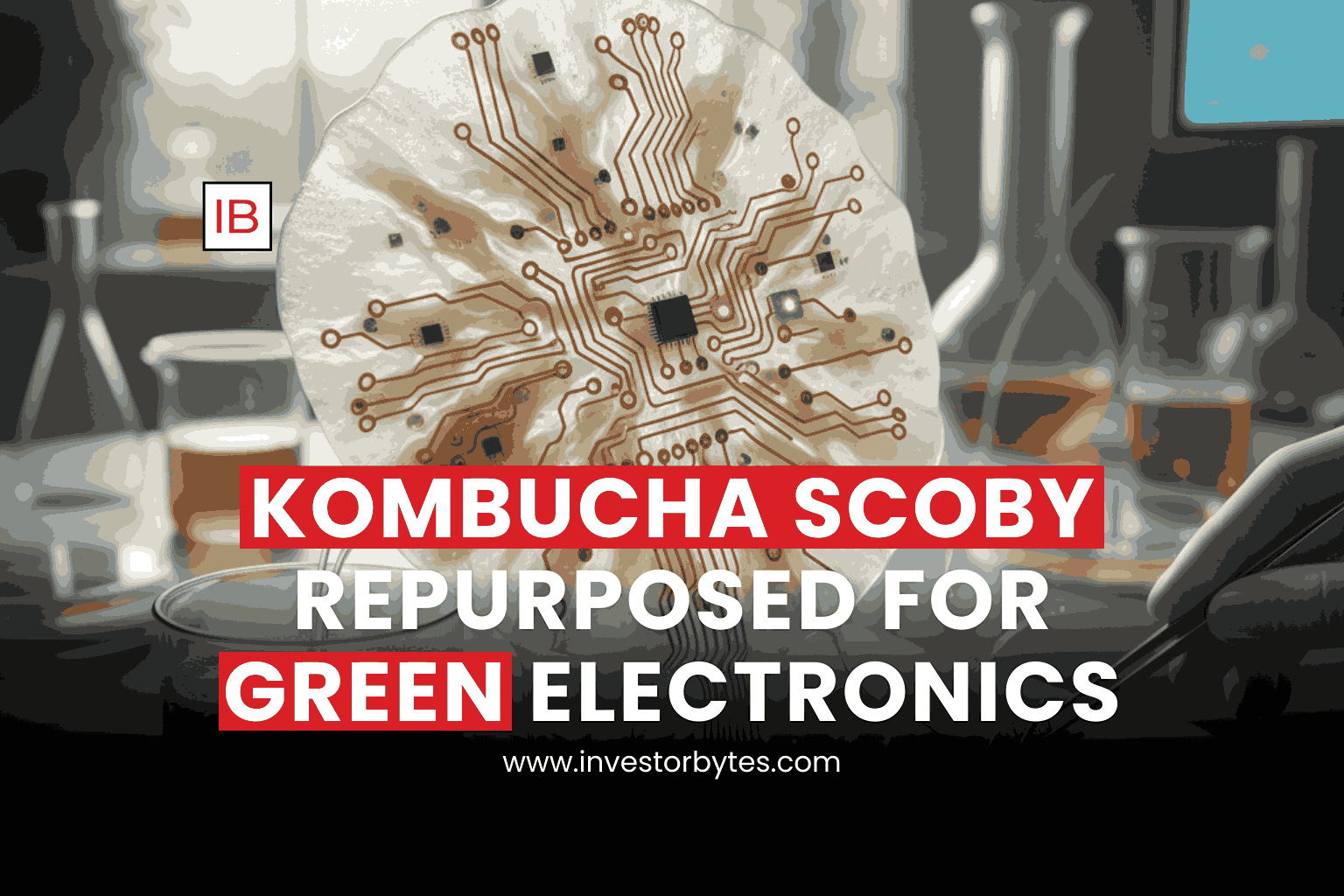
In a breakthrough for “circular electronics,” a research team led by Assistant Professor Tan Yu Jun at the National University of Singapore (NUS) has successfully turned fermentation waste into a high-tech solution. The team has demonstrated that purified SCOBY (Symbiotic Culture of Bacteria and Yeast) can serve as a robust, biodegradable substrate for the next generation of wearable devices.
By stripping away the microbial residues from the kombucha pellicle, scientists have created a material that is not only plastic-free but actually outperforms traditional wood-pulp paper in flexibility and smoothness.
The Science: From Tea Waste to Tech Substrate
The process utilizes the natural nanocellulose fibers produced by bacteria during fermentation. These fibers are roughly 1,000 times thinner than a human hair, creating a dense, durable network.
The “Household” Purification Process
Unlike conventional electronics manufacturing, which often involves toxic chemicals, the team developed a “green” purification method:
Cleaning Agents: Utilizing only baking soda and hydrogen peroxide to remove yeast, sugars, and odors.
The Result: A smooth, white, leather-like film that is naturally non-conductive, making it an ideal “blank canvas” for circuit boards.
Component Integration: Researchers successfully printed gold conductive tracks and mounted LEDs and sensors onto the SCOBY film. Even after repeated bending and folding, the circuits maintained full functionality.
Applications: “Transient” Electronics
The team is focusing on transient electronics—devices designed to work for a specific period and then safely disappear.
| Application | Function |
| Medical Patches | Biodegradable sensors for monitoring heart rate or flatfoot assessment. |
| Environmental Sensors | Monitors for soil health or water quality that can be left to compost. |
| Smart Packaging | Freshness trackers for food that decompose along with the waste. |
| Sustainable Wearables | Lightweight, biocompatible “smart skins” that don’t irritate the wearer. |
The Environmental Impact: Closing the Loop
The primary goal of this research is to tackle the global e-waste crisis. Traditional Printed Circuit Boards (PCBs) are notoriously difficult to recycle due to their complex mix of plastics, resins, and heavy metals.
Rapid Biodegradation: The kombucha-derived material can biodegrade in soil within days, rather than the centuries required for petroleum-based polymers.
Cost Efficiency: Because the raw material is a byproduct of the food and beverage industry, the production cost is significantly lower than that of conventional synthetic polymers.
Carbon Footprint: The process turns a waste product (spent SCOBY) into a value-added resource, promoting a “cradle-to-cradle” manufacturing philosophy.
“Watching the SCOBY grow gave me a first-hand appreciation for how versatile it can be. We are now collaborating to explore 3D printing of conductive traces directly onto these films.” — Asst. Prof. Tan Yu Jun, NUS