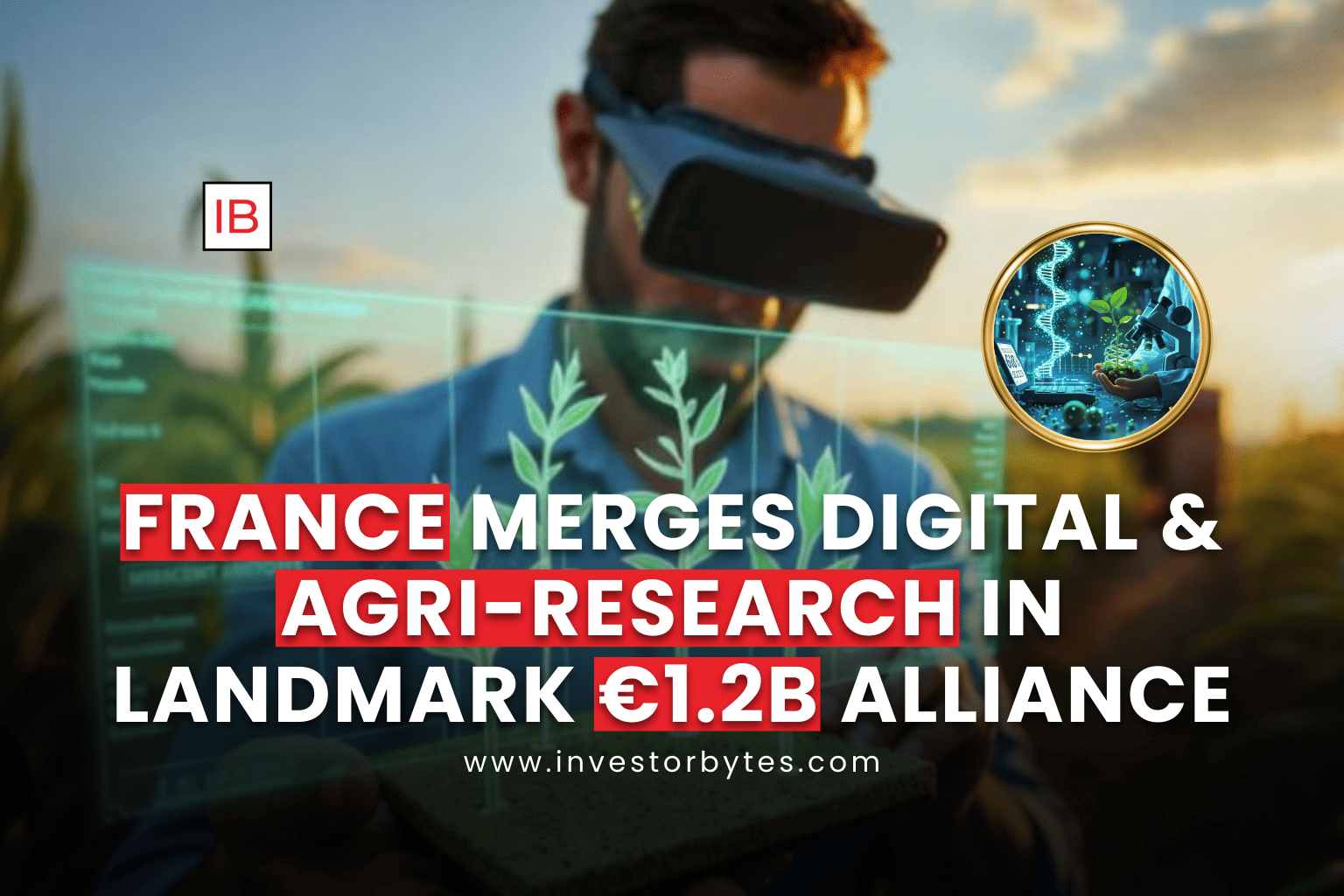
France has officially launched a landmark €1.2 billion alliance merging digital technology with agricultural research. Spearheaded by INRAE and INRIA, this 2026 initiative aims to digitize the “Farm of the Future” through AI, robotics, and carbon-sequestering sensors, securing European food sovereignty and climate resilience.
On Thursday, March 5, 2026, the French government announced a transformative €1.2 billion strategic merger between its premier agricultural research body, INRAE, and the National Institute for Research in Digital Science and Technology, INRIA.
Unveiled at the Paris International Agricultural Show, this alliance represents the largest state-funded AgTech investment in the history of the Eurozone. Dubbed the “Agri-Digital 2030” framework, the project aims to bridge the gap between biological research and silicon-valley-style data processing to solve the “triple threat” of soil depletion, labor shortages, and extreme 2026 climate volatility.
How Will the €1.2B Alliance Impact French Food Sovereignty?
The primary objective of this alliance is to move away from “blind farming” toward a reality-based, data-driven model. By injecting €1.2 billion into joint labs across Montpellier, Rennes, and Toulouse, the French government is betting that AI can predict crop yields with 98% accuracy.
Satellite Integration: Utilizing the Copernicus satellite constellation to monitor soil moisture in real-time.
Precision Robotics: Deploying autonomous fleets to reduce pesticide use by a staggering 70% by 2028.
Genome Mapping: Using INRIA’s high-performance computing (HPC) to simulate climate-resistant wheat strains in months rather than decades.
According to Philippe Mauguin, President of INRAE, “We are no longer just growing crops; we are managing a complex biological data set. This €1.2B investment ensures that France remains the ‘Halo’ of agricultural innovation in Europe.”
What Are the Key Technical Pillars of the Agri-Digital 2030 Deal?
The alliance is built on three “stunning” technical pillars designed to optimize the 2026 agricultural economy:
The Digital Twin Initiative: Creating virtual replicas of entire French vineyards and wheat fields to simulate the impact of heatwaves before they occur.
Edge AI for Livestock: Wearable sensors for cattle that use INRIA-developed algorithms to detect early-stage respiratory illnesses, potentially saving the dairy industry €400M annually.
Blockchain Supply Chains: A transparent, end-to-end ledger to track carbon sequestration, allowing farmers to sell “Carbon Credits” with professional-grade verification.
Why Does This Merger Matter for Global Investors?
For the InvestorBytes community, this €1.2B alliance signals a professional shift in venture capital toward “Sovereign Tech.” France is signaling that it will no longer rely on external AI providers (like those from the U.S. or China) to manage its food security.
| Metric | 2026 Target | 2030 Objective |
| Pesticide Reduction | 25% | 50%+ |
| AI Startups Funded | 45 | 150+ |
| Carbon Sequestration | 2M Tons | 10M Tons |
| Total Investment | €1.2B | €3.5B (Est.) |
Will the French AgTech Merger Influence EU Policy?
Industry analysts suggest that this alliance is a direct response to the 2026 European Green Deal updates. By merging digital and agri-research, France is setting the “reality-based” standard for the rest of the EU.
“The stunning part isn’t the money,” says Bruno Le Maire, French Minister of Finance. “It’s the integration of 2,000 data scientists with 8,000 agronomists. That is the winning formula for 2026.”