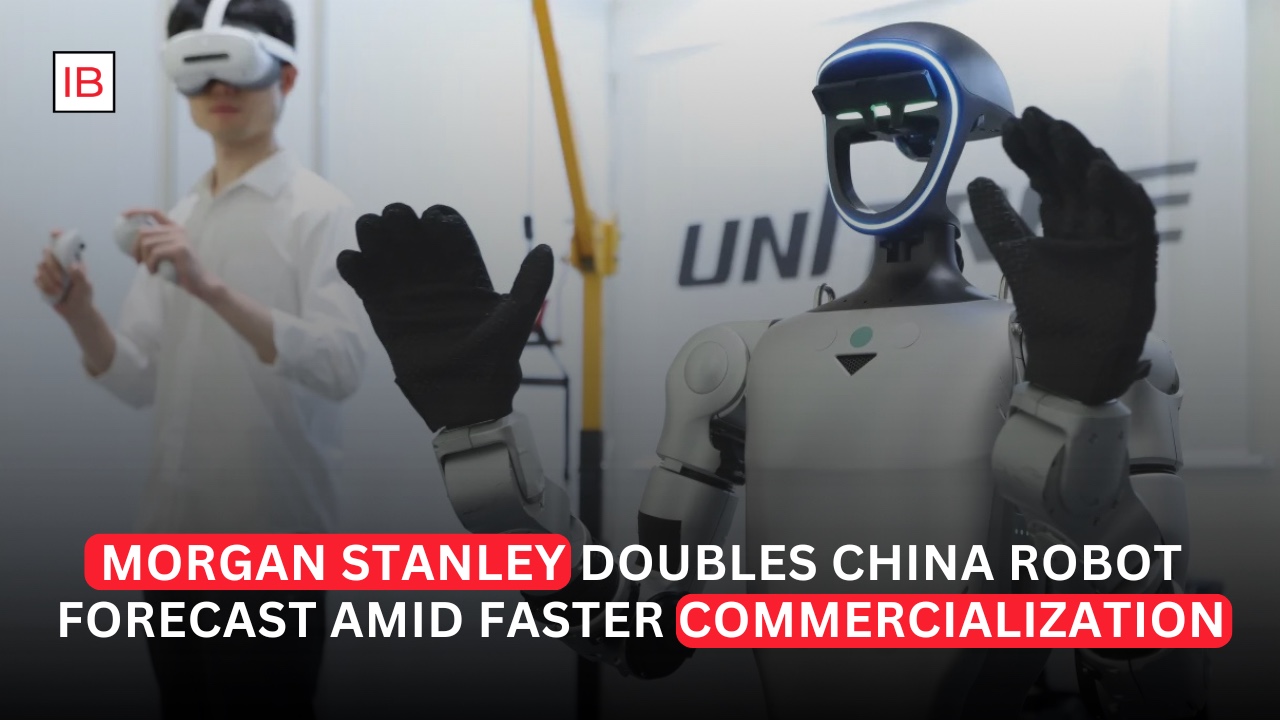
Morgan Stanley has upgraded its outlook for China’s humanoid robot sector, projecting faster-than-expected growth as demand from factories, logistics firms, and government-backed projects expands rapidly. The investment bank says China is set to remain the global leader in humanoid robotics production and deployment as costs fall and adoption widens across industrial sectors.
The revised forecast highlights how humanoid robots are shifting from experimental technology into early-stage commercial deployment, particularly in China, where state support, manufacturing scale, and supply chain integration are accelerating development.
Strong Growth Forecast for Humanoid Robots
Morgan Stanley expects China’s humanoid robot sales to rise sharply in the coming years, with shipments potentially more than doubling in the near term as production scales up and prices decline. The bank also sees long-term global humanoid adoption reaching multi-million-unit levels as automation expands into factories, warehouses, and service industries.
Analysts say the industry could eventually become a multi-trillion-dollar market globally, with China capturing a significant share due to its dominance in hardware manufacturing and robotics supply chains.
China Leads Global Production and Deployment
China already accounts for the majority of humanoid robot manufacturing worldwide, supported by more than a hundred robotics companies and strong government backing under national industrial policy initiatives.
Chinese firms are increasingly deploying humanoids in real-world scenarios such as logistics sorting, factory operations, security patrols, and public demonstrations, although many systems remain limited to structured environments.
Recent industry data suggests China dominates global shipments, while U.S. competitors remain focused on high-end research and AI software development for robotics.
Falling Costs Drive Expansion
A key factor behind the revised forecast is rapidly falling production costs. Morgan Stanley notes that improvements in supply chains, component localization, and mass manufacturing are reducing the price of humanoid robots significantly compared with Western production.
As costs decline, analysts expect robots to move beyond pilot programs and into broader commercial deployment, particularly in labor-intensive sectors facing workforce shortages.
Adoption Still Early but Accelerating
Despite strong growth projections, most humanoid robots today remain in early-stage use. Many systems are still limited to controlled environments and structured tasks, with full general-purpose capability not yet achieved.
Experts say challenges remain in areas such as dexterity, real-world adaptability, battery efficiency, and reliable autonomy in unpredictable settings.
China’s Strategic Push Into Robotics
The forecast also reflects China’s broader strategy to lead advanced manufacturing and artificial intelligence integration. Robotics is a key focus area in national industrial planning, alongside semiconductors and AI systems.
Government-backed investment, combined with a large domestic market and rapid iteration cycles, is helping Chinese companies scale production faster than global rivals.
What Happens Next
Morgan Stanley expects continued rapid expansion over the rest of the decade, with adoption accelerating further in the 2030s as technology improves and prices fall further.
The key question for the industry is whether humanoid robots can move beyond industrial and structured tasks into broader real-world applications, including services and potentially household use.
For now, China remains at the center of the global humanoid robotics race, both as the largest producer and the fastest-growing market.