China has regained the title of home to the world’s fastest supercomputer, according to the latest global rankings, marking the first time since 2017 that a Chinese system has taken the top spot. The development underscores intensifying technological competition between China and the United States in high-performance computing and advanced chip design.
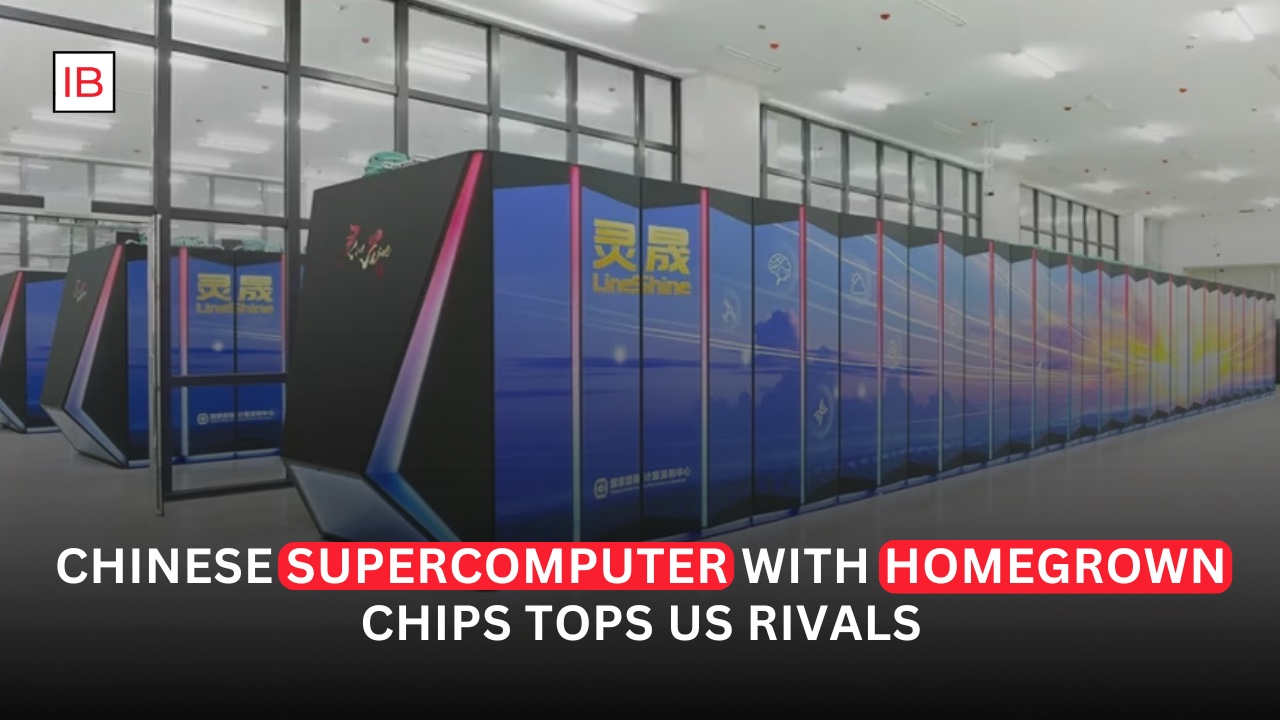
The system, named LineShine, is located at China’s National Supercomputing Center in Shenzhen and has surpassed leading U.S. machines in benchmark performance tests used by the TOP500 project, which tracks the world’s most powerful computing systems.
China’s LineShine Takes First Place
The LineShine supercomputer achieved a performance of about 2.2 exaflops, meaning it can perform more than two quintillion calculations per second, placing it ahead of the United States’ top system, El Capitan. The ranking marks a symbolic shift in leadership in a field long dominated by U.S. national laboratories.
LineShine is unusual among leading systems because it runs entirely on central processing units (CPUs) rather than graphics processing units (GPUs), which are more commonly used in modern AI-focused supercomputers. It also relies on domestically developed chips, reflecting China’s push for technological self-reliance amid ongoing export restrictions on advanced semiconductors.
US Systems Fall to Second and Third Place
The U.S. continues to hold several top positions in the rankings, including multiple exascale machines at national laboratories. However, El Capitan has now been pushed into second place, followed by other American systems, while Germany’s leading supercomputer also remains in the top tier.
Despite the shift at the top, experts note that the TOP500 ranking primarily measures traditional scientific computing performance rather than AI-optimized workloads, which are increasingly important in commercial and research applications.
Not Just an AI Benchmark
While the TOP500 list is widely used as a global reference for computing power, it does not fully capture the capabilities of systems built specifically for artificial intelligence workloads. Many major cloud-based AI systems operated by companies such as Microsoft, Amazon, and Google are not included in the rankings.
Some analysts say that privately operated AI clusters may in practice exceed publicly listed systems in certain tasks, even if they do not appear on the official list.
Strategic Significance for China
China has been investing heavily in supercomputing for more than two decades, using it for applications ranging from climate modeling and materials science to national defense and industrial research.
The latest achievement is being viewed as part of a broader effort to strengthen domestic chip design capabilities and reduce reliance on foreign semiconductor technology, particularly in the face of U.S. export controls.
Global Supercomputing Race Intensifies
The ranking highlights how global competition in computing power is no longer limited to raw speed but also involves architecture choices, energy efficiency, and AI optimization.
While China now leads in this particular benchmark, the United States remains highly competitive across multiple systems, and both countries continue to invest heavily in next-generation computing infrastructure.
What Happens Next
The supercomputing race is expected to continue evolving rapidly as countries and companies develop new architectures designed for artificial intelligence, scientific research, and defense applications.
Future rankings may shift again as new exascale and AI-focused systems come online, reflecting a broader technological competition that extends well beyond traditional performance benchmarks.