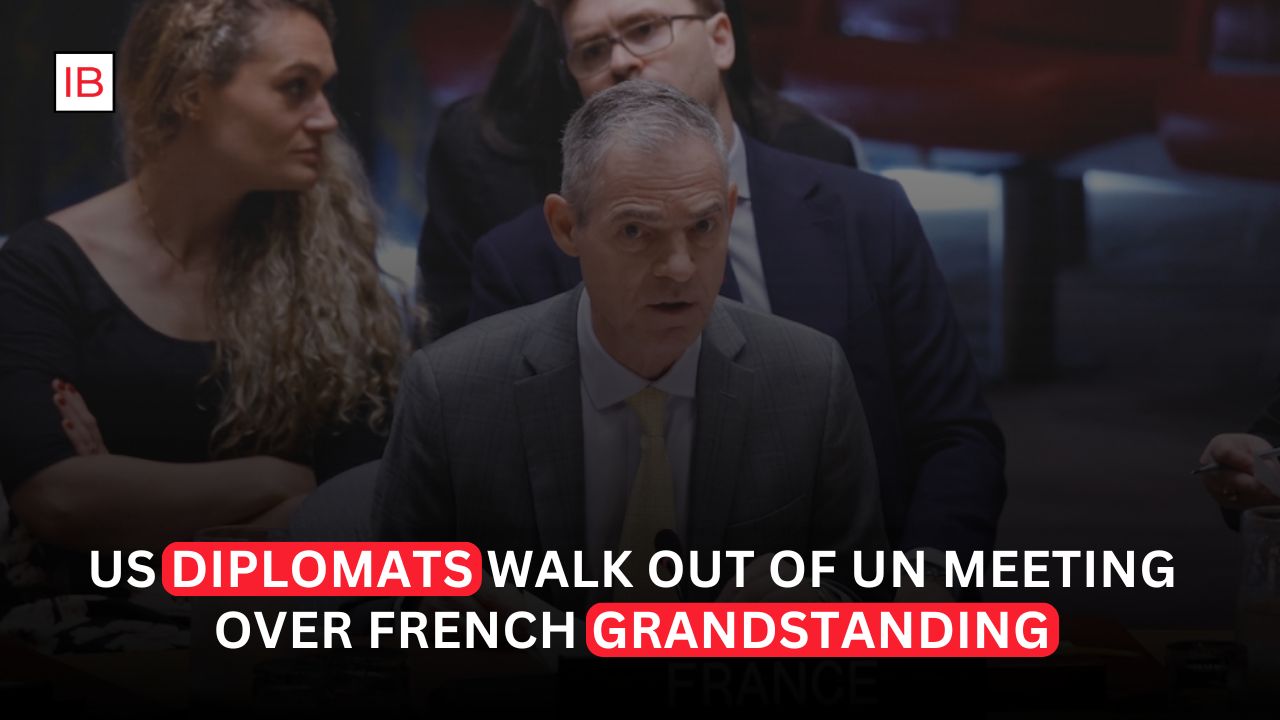
American diplomats staged a dramatic walkout during a UN Security Council meeting on Ukraine this week, exiting the chamber as their French counterparts began speaking, in a public rebuke that has laid bare deepening strains between Washington and one of its oldest allies.
What Triggered the Walkout
The incident unfolded during a Security Council session on Monday, when U.S. diplomats rose and left the room just as France’s representative began addressing the meeting. Speaking afterward, U.S. deputy ambassador Dan Negrea accused France of “disingenuous grandstanding,” telling the council that while Washington had stood by Paris in every conflict where its freedom had been threatened, and had long tolerated French posturing out of a sense of camaraderie, that patience had now run out.
The immediate spark for the walkout traced back to a social media post from France’s UN Mission in Geneva the previous Friday, which criticized the United States for opposing a second term for UN human rights chief Volker Türk. The post argued pointedly that the U.S. was no longer a beacon of human rights, and suggested that it now stood isolated alongside countries such as North Korea, Nicaragua, Mali, and Russia on the issue, warning that the world no longer listened to Washington on such matters.
Türk’s Reappointment and the Vote Split
The underlying dispute centered on the UN General Assembly’s vote on Türk’s reappointment as human rights chief, which passed overwhelmingly on Friday with 144 votes in favor, 10 against, and 13 abstentions. France was among the large majority backing Türk’s second term, while the United States was one of only ten countries to vote no. U.S. Ambassador to the UN Mike Waltz responded sharply on social media, accusing France of coddling some of the world’s worst human rights abusers while simultaneously lecturing free and sovereign democracies including the United States, the United Kingdom, and Israel.
A Sign of Broader US-Europe Strain
While the walkout itself was brief, analysts say it reflects tensions that extend well beyond a single personnel vote at the UN. Relations between President Donald Trump and French President Emmanuel Macron have grown noticeably more strained in recent months, part of a wider pattern of friction between Washington and its European allies. Among the issues fueling that broader rift are lingering questions over Trump’s commitment to NATO, potential changes to the U.S. troop presence in Europe, and Trump’s continued interest in asserting control over Greenland, an autonomous territory belonging to Denmark, a fellow NATO member.
The Security Council meeting itself was called to address the ongoing war in Ukraine, adding another layer of significance to the moment, given that unified Western messaging on Russia’s invasion has long depended on close coordination between Washington, Paris, and other European capitals.
Part of a Pattern of US-France Friction
Monday’s walkout is not an isolated incident in what has become an increasingly tense diplomatic relationship between the two countries. Earlier this year, a separate dispute erupted after France’s foreign ministry summoned U.S. Ambassador to Paris Charles Kushner over comments made by the Trump administration regarding political violence in France, only for Kushner to skip the scheduled meeting entirely. French officials subsequently moved to restrict Kushner’s access to French government ministers until he responded to the summons, describing his absence as a breach of basic diplomatic protocol.
What Comes Next
With tensions simmering across multiple fronts — from human rights disagreements at the UN to unresolved diplomatic disputes in Paris — the relationship between Washington and one of its most historically significant alliances appears increasingly fragile. How both governments choose to manage these frictions in the coming weeks, particularly as the Security Council continues grappling with the war in Ukraine, will likely offer further signals about the durability of the broader transatlantic partnership under the current administrations in both countries.