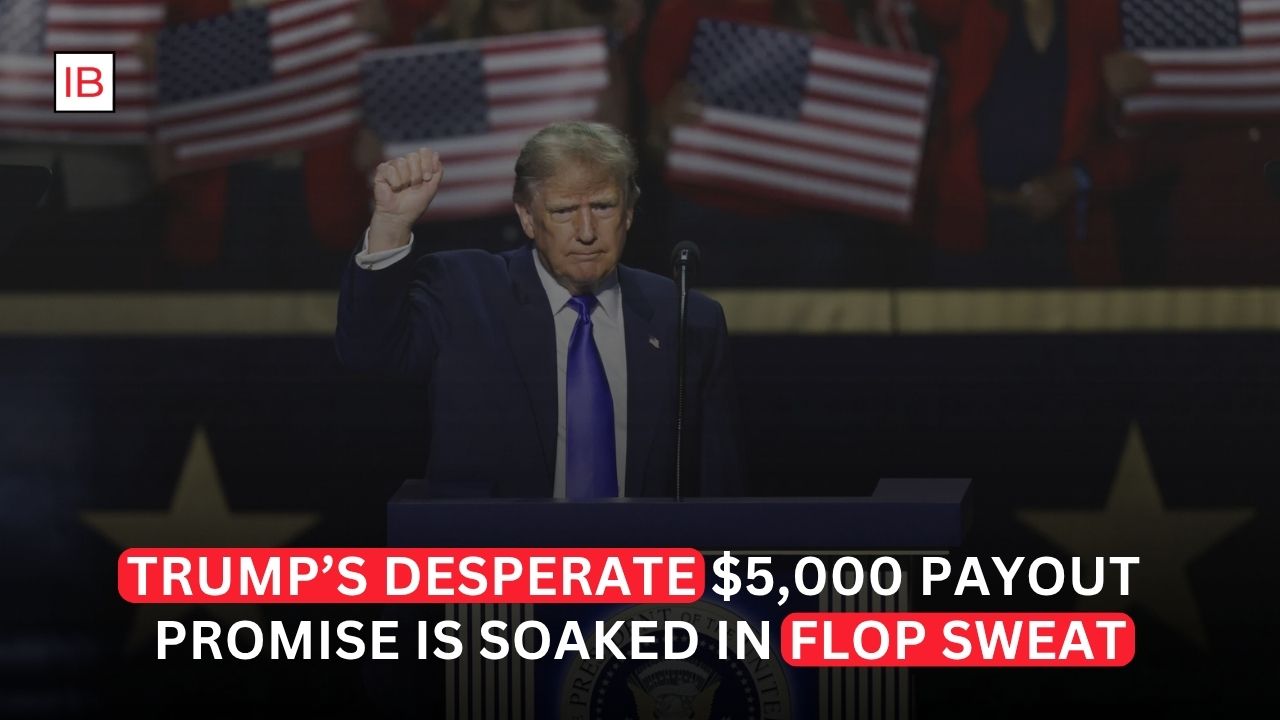
Donald Trump’s promise to give every American adult a $5,000 “Trump dividend” if Republicans retain control of Congress has created an immediate political spectacle, but the proposal may do little to solve the economic problems that are threatening the GOP ahead of the November midterm elections.
Trump unveiled the proposal at the Republican Party’s first midterm convention in Dallas, telling supporters that Americans would receive the payment if Republicans win both chambers of Congress. He said the money would have to be spent in the United States, but offered few details about how the program would be financed or how it would be implemented.
The scale of the proposal is enormous. Depending on eligibility, analysts estimate that sending $5,000 to every adult could cost well above $1 trillion, with some estimates reaching roughly $1.35 trillion. That would represent a substantial new federal commitment at a time when the US government is already running an annual deficit of around $1.8 trillion and carrying more than $40 trillion in national debt.
That arithmetic is the central weakness of Trump’s proposal. The president has suggested that the payments could be supported by the revenue generated from tariffs, but tariff collections are unlikely to provide enough money to finance a program of this magnitude without additional borrowing or other sources of federal funding.
Vice President JD Vance has also suggested that wealthier Americans might be excluded from the payment, potentially reducing the overall cost. But that qualification highlights another unresolved question: who exactly would qualify, and how much would the government ultimately have to spend?
Those uncertainties make the proposal difficult to treat as an established economic program. Congress would have to authorize the payments, meaning Trump’s announcement alone cannot create a new federal benefit.
The timing, however, is easier to understand.
Republicans are facing a difficult midterm environment, and Trump has made clear that he wants voters to treat the election as another referendum on his presidency. At the Dallas convention, he urged Republicans to think of him as being on the ballot even though he is not running for office in the 2026 elections. The strategy is designed to mobilize voters who are highly motivated by Trump but may be less likely to participate in a midterm election.
The $5,000 promise fits directly into that strategy. Rather than presenting the midterms as a choice between individual congressional candidates, Trump is attempting to make the election a direct contest over the continuation of his economic agenda.
But the approach carries a serious risk: it could distract from the affordability problems that voters actually care about.
Inflation, gasoline prices and the cost of everyday goods remain major political issues. The continuing conflict involving Iran has pushed oil prices sharply higher, creating additional pressure on American households. Trump has promised that energy prices will fall, but voters are still dealing with expensive fuel and uncertainty about future costs.
A one-time $5,000 payment could provide a significant short-term benefit to many households, but economists warn that injecting more than $1 trillion into an already heavily indebted economy could increase inflationary pressure if it is financed through additional borrowing. Critics also argue that using scarce federal resources for checks would be less effective than reducing the deficit or addressing the structural causes of high costs.
The proposal is also politically complicated because it resembles earlier Trump ideas that failed to become policy. Trump previously promoted the concept of a “tariff dividend,” suggesting that Americans could receive payments funded by tariff revenue. That proposal never materialized. The new $5,000 plan therefore faces an immediate credibility problem: voters have to decide whether this promise is a serious legislative objective or primarily a campaign message.
Even some Republicans have expressed reservations. Fiscal conservatives have questioned why the government should distribute money while simultaneously running enormous deficits. Rep. Thomas Massie has criticized the proposal, while other Republicans have warned that a new spending program would undermine the party’s traditional message of fiscal restraint.
For Democrats, the proposal offers an easy line of attack. They can argue that Trump is attempting to buy political enthusiasm with a payment that Congress has not approved and that taxpayers would ultimately finance through higher debt, taxes or inflation.
For Republicans, the calculation is more complicated. The promise could energize working-class voters who are struggling with household expenses and make the midterms feel more personally relevant. But it could also reinforce the impression that the party is relying on Trump’s personality and headline-grabbing announcements rather than a detailed economic program.
That distinction matters because the GOP’s midterm challenge is not simply turnout. Republicans also need to defend vulnerable House and Senate seats in competitive states and districts where voters may be more concerned about inflation, healthcare, energy prices and economic stability than about Trump’s broader political battles.
The $5,000 dividend therefore represents both an opportunity and a trap. If it becomes a serious legislative proposal with a credible funding mechanism, Republicans could use it as a centerpiece of their economic message. If the details remain unclear, however, the announcement could become exactly what critics fear: a political distraction from the harder questions facing the US economy.
Trump has succeeded in putting the proposal at the center of the midterm conversation. Whether that helps Republicans will depend less on the size of the promised check than on whether voters believe the check can actually arrive without creating an even larger bill for the country.