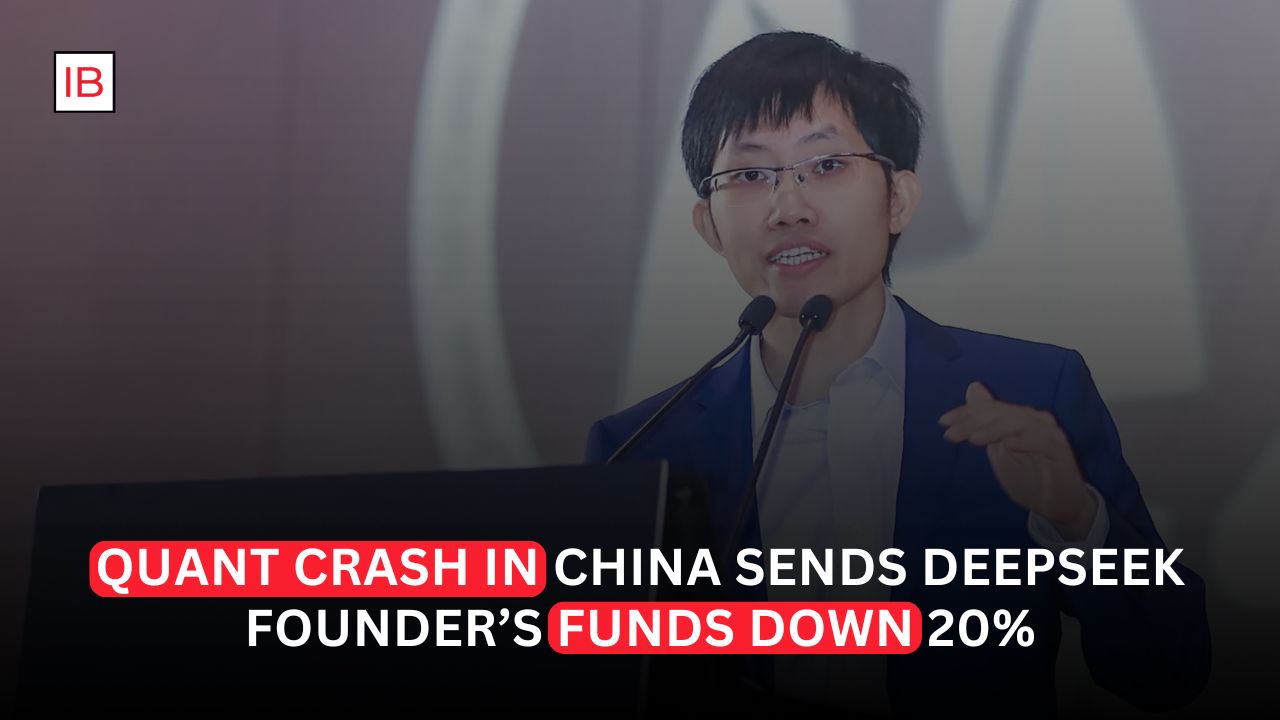
Funds run by DeepSeek founder Liang Wenfeng’s quantitative investment firm have fallen as much as 20% over the course of July, as a brutal selloff in AI-linked stocks pushed some of China’s most prominent quant strategies into the red for the year and exposed how crowded the industry’s positioning had become.
From a Single Bad Week to a Losing Month
The scale of July’s damage becomes clearer when viewed across the full month rather than any single week. Liang’s Zhejiang High-Flyer Asset Management, which oversees more than 70 billion yuan, or roughly $10 billion, saw one of its funds tracking the CSI 1000 Index slump 15.7% in the single week ended July 17 alone. Extended across the full month, losses at High-Flyer’s funds reached as much as 20%, pushing some products into negative territory for the year after a strong first half and leaving others barely able to keep pace with the benchmarks they were designed to beat.
Other Major Names Hit Just as Hard
High-Flyer was far from alone in absorbing steep losses. HanTak Investment Management, a Beijing-based firm managing more than five billion yuan, lost an estimated 16.1% on a similar CSI 1000-tracking strategy during the same week, cutting its year-to-date excess return down to just 7.1 percentage points, while a separate strategy tracking the CSI 500 Index dropped 14.3%. BlackWing’s stock strategy fared even worse, shedding 19.39% in a single week, its steepest decline since the fund’s launch. Across the broader industry, 73 quant products seeking to beat the CSI 1000 Index of small-cap Chinese stocks fell an average of 14% during the worst week alone, trailing their own benchmark by an average of 1.9 percentage points.
What Triggered the Rout
The selloff traced back to a sharp reversal in market trends beginning around June 29, as high-momentum growth stocks that had led gains through the first half of the year were suddenly and aggressively sold off. According to Li Minghong, investment director at E Tiger Private Fund Partners, momentum and beta factors had pushed both traditional and machine-learning-driven quant models into increasingly similar positions within the same AI-linked small-cap stocks since early 2026, creating a dangerously crowded trade. As valuations climbed, fresh inflows from wealthy investors began drying up, and a sharp drop in overseas AI shares became the final straw, triggering redemptions that forced quant managers to unwind positions simultaneously.
Compounding factors included falling margin-financing balances across Chinese markets, liquidity concerns tied to large IPOs draining capital from the broader market, and a wave of deleveraging that added to overall risk aversion during the worst stretch of trading.
A Painful Reversal for Strategies Once Seen as “Safe”
The scale of the reversal has been particularly jarring given how these funds had been marketed and perceived by investors. Some of the affected managers had returned north of 50% the previous year, a track record that drew a rush of affluent Chinese investors during a period marked by a prolonged property slump and broader equity market malaise. High-Flyer’s CSI 1000 Quant Multi-Strategy fund specifically had beaten its benchmark by an annualized 24 percentage points since its inception nearly eight years ago, according to data from Shenzhen PaiPaiWang Investment & Management, a track record that made July’s drawdown feel especially severe by comparison.
Even before this drawdown, the broader quant industry had already been showing signs of strain, with average excess returns across Chinese quant funds shrinking more than 10 percentage points year-on-year to just 3.5% in the first half of 2026, as the AI rally itself made it increasingly difficult for diversified quant portfolios to outperform the market.
Firms Moving to Restore Confidence
In response to the turmoil, more than ten Chinese hedge funds, spanning both quantitative and discretionary strategies, have announced plans to invest their own proprietary capital into their funds as a way of rebuilding investor trust. Ningbo Lingjun Investment Management Partnership pledged 200 million yuan, while Ningbo Alpha2Fund Investment Management Partnership Enterprise committed 100 million yuan, according to separate company statements, with the pace of such announcements accelerating through July as losses mounted. Neither High-Flyer nor HanTak provided detailed public comment beyond acknowledging the drawdowns in investor communications.
What Comes Next
With some of China’s most prominent quant funds now sitting in negative territory for the year after a month that erased months of prior gains, the industry faces a genuine test of investor confidence heading into the second half of 2026. Whether firms can successfully rebuild trust through proprietary capital injections and improved risk management, or whether this episode marks a more lasting reckoning for an industry that grew increasingly concentrated in the same crowded AI-linked trades, will likely shape the trajectory of China’s quantitative hedge fund sector for months to come.