Artificial Intelligence Is Creating a New Wave of Demand for Foreign Goods, Equipment and Components
The rapid expansion of artificial intelligence is beginning to reshape the US economy in a way that extends far beyond software and technology companies. As businesses pour billions of dollars into data centers, computing infrastructure and AI systems, the United States is increasingly turning to foreign suppliers for the equipment and materials needed to build this new digital economy.
The result is a growing wave of imports tied directly or indirectly to AI investment.
AI Requires a Massive Physical Infrastructure
Artificial intelligence may appear to be a digital industry, but its expansion depends on enormous physical infrastructure.
AI data centers require:
- Advanced semiconductors.
- Servers.
- Networking equipment.
- Electrical systems.
- Cooling equipment.
- Power infrastructure.
- Construction materials.
- Storage systems.
Much of this equipment is manufactured outside the United States, meaning the country’s investment boom is creating additional demand for imported goods.
Data Centers Become a Major Source of Demand
The rapid construction of AI-focused data centers has become one of the clearest examples of this trend.
Technology companies and cloud providers are investing heavily in new facilities to support increasingly powerful AI models.
Those facilities require enormous amounts of hardware, including specialized processors and networking equipment.
Even when a data center is physically built in the US, a significant portion of the equipment inside it may come from overseas manufacturers.
This creates a direct connection between AI investment and US import demand.
Semiconductors Are at the Center
Advanced chips are perhaps the most important component of the AI infrastructure boom.
The world’s leading semiconductor supply chains remain highly internationalized.
Companies across Asia and other regions produce critical components used in AI servers, including processors, memory, and specialized electronic equipment.
As US companies expand AI capacity, demand for these components rises.
That can increase imports even as the US government seeks to encourage more domestic semiconductor manufacturing.
AI Could Change the Trade Balance
The surge in AI-related investment creates an interesting economic dynamic.
The US is investing heavily in domestic infrastructure, but some of the spending immediately generates demand for foreign products.
This means a large increase in capital investment can initially increase imports rather than reduce them.
The effect can be summarized simply:
AI investment → data-center construction → equipment demand → higher imports
Over time, however, the economic impact could become more complicated as domestic production capacity expands.
Manufacturing Investment Takes Time
Building factories in the United States is a long process.
Semiconductor plants, electrical equipment factories, and other industrial facilities require years of planning and billions of dollars of investment.
As a result, domestic manufacturing may not be able to immediately satisfy the sudden increase in demand created by AI.
Imports can fill that gap.
This allows companies to expand infrastructure faster while domestic suppliers work to increase capacity.
Electricity Infrastructure Is Another Factor
AI data centers consume enormous amounts of electricity.
That is creating additional demand for transformers, power-management equipment, generators, and other electrical infrastructure.
Some of these products are also sourced internationally.
The AI boom therefore affects trade not only through computers and chips but also through the energy infrastructure needed to keep those computers running.
Construction Materials Add to Import Demand
Data-center construction can also increase demand for physical materials.
Large facilities require:
- Steel.
- Electrical cables.
- Cooling systems.
- Construction machinery.
- Specialized building components.
While much of the construction activity occurs domestically, supply chains remain international.
The result is another channel through which AI investment can increase imports.
The New Economy Is More Physical Than It Looks
The development of AI is often described as a transition toward a digital economy.
But the current investment cycle shows that AI is deeply dependent on physical infrastructure.
The technology requires factories, power plants, transmission networks, data centers, and global supply chains.
That means the AI economy is simultaneously becoming a major driver of industrial investment and international trade.
Tariffs Create a Complicated Picture
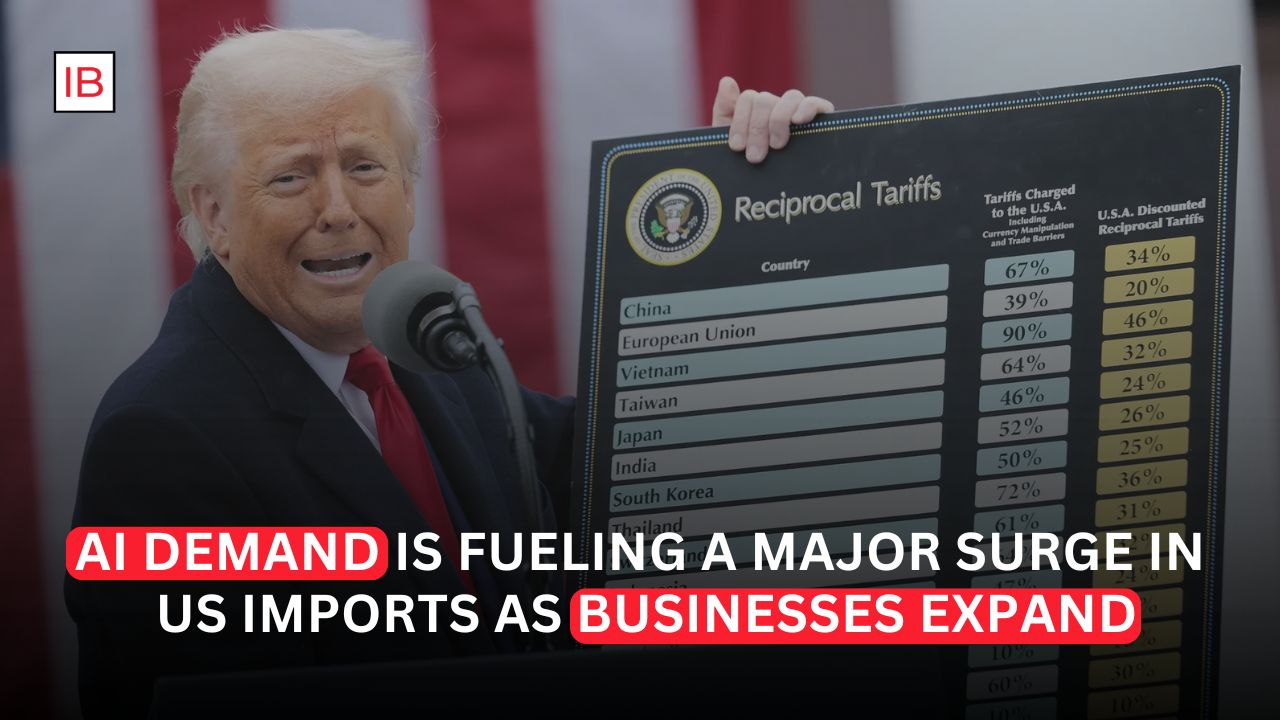
The increase in AI-related imports also comes at a time when US policymakers are increasingly focused on tariffs and trade restrictions.
Government efforts to reduce dependence on foreign suppliers could increase the cost of imported AI equipment.
Companies may respond by:
- Building more domestic factories.
- Diversifying suppliers.
- Moving production to alternative countries.
- Holding larger inventories.
- Passing higher costs to customers.
This could gradually reshape global technology supply chains.
AI Investment Could Eventually Support US Manufacturing
The current rise in imports does not necessarily mean that the US will remain permanently dependent on foreign suppliers.
The massive economic opportunity created by AI could encourage companies to build new manufacturing capacity domestically.
As demand becomes large enough, investments in semiconductor fabrication, electrical equipment, and other industrial sectors may become economically attractive.
That could eventually replace some imports with domestic production.
However, such changes take time.
Global Suppliers Benefit From the AI Boom
For manufacturers outside the US, the American AI investment cycle represents a major commercial opportunity.
Companies producing chips, memory, networking equipment, cooling systems and electrical infrastructure can benefit from rapidly increasing demand.
Countries with established technology manufacturing ecosystems are particularly well positioned to capture this spending.
This means the US AI boom is simultaneously supporting industrial activity abroad.
A New Trade Pattern Emerges
The relationship between AI and trade could become one of the defining economic trends of the next decade.
The US may remain the world’s leading center for AI research, software development, and investment while relying on a global network of manufacturers to supply the physical infrastructure required to operate advanced systems.
That could produce a new form of economic interdependence.
Looking Ahead
The AI revolution is creating a new kind of US economic expansion—one that is simultaneously digital and intensely physical. Billions of dollars in spending on data centers and computing infrastructure are generating demand for imported chips, servers, electrical equipment, cooling systems, and construction components.
For the US economy, that means AI investment can initially increase imports even as policymakers pursue greater domestic manufacturing capacity.
The longer-term outcome will depend on how quickly American factories can expand, how global supply chains evolve and how trade policy affects the cost of imported technology.
What is increasingly clear is that AI is becoming a major force in global trade. The technology may run on algorithms and data, but its economic footprint depends on a vast physical supply chain stretching across the United States and the rest of the world.