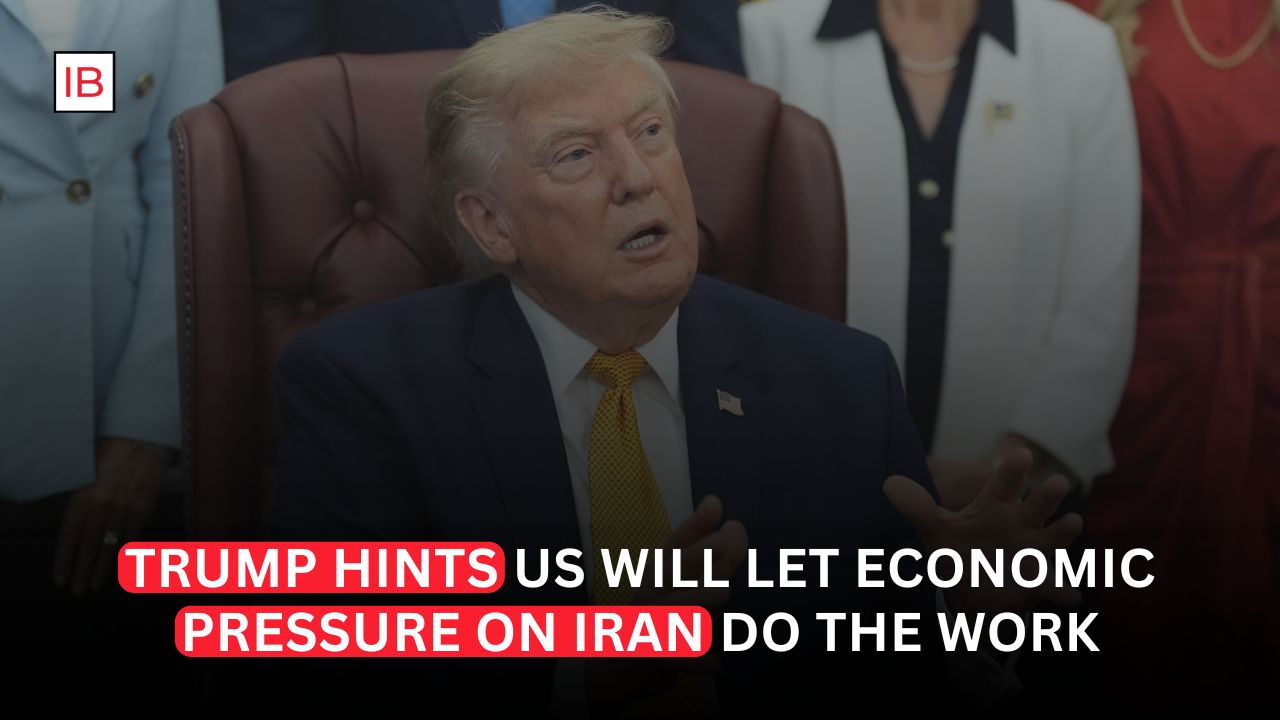
President Donald Trump signaled Sunday that Washington is stepping back from renewed military strikes on Iran, opting instead to let mounting economic pressure squeeze Tehran into a deal, even as Iran continues to defy US demands over reopening the Strait of Hormuz.
What Trump Said
“We are low-keying it,” Trump told Axios in a brief phone interview, adding that the US is “only semi-negotiating” with Iran while monitoring the toll the war has taken on its economy. “We are just watching Iran with its huge inflation and the fact they have no money,” he said. Trump described Iran as being “in very bad shape” financially, claiming Tehran lacks the funds to pay its own troops, and credited the US naval blockade in place since April with deepening that economic strain. He also noted that oil prices have eased to just above $75 a barrel, easing the burden on American consumers even as the conflict continues. “It will work out. It always works out. It’s like a chess game,” Trump said.
A Notable Shift From Days Earlier
The comments mark a striking change in tone from just a week earlier, when Trump appeared on the verge of ordering a return to major combat operations against Iran. Rather than expressing frustration over the stalled negotiations, Trump’s Sunday remarks notably avoided any new military threats, even as Iran has continued to hold up a formal announcement on a deal with Oman to reopen the Strait of Hormuz. On Saturday, just before Trump’s interview, Iran issued a fresh list of demands as a condition for allowing shipping through the strait to resume.
The State of Hormuz Negotiations
Talks mediated by Oman over reopening the strait appear to be nearing a breakthrough, according to Iran’s foreign ministry, which said this month that negotiations had reached their “final” stages, with both sides close to agreement on coordinates for a new shipping corridor through the waterway. Tehran has maintained it will not fully reopen the strait until the United States “corrects its behaviour,” a list of conditions that includes lifting the naval blockade, halting military action, and paying war damages. A ceasefire reached in June collapsed weeks later amid disputes over control of the strait, and fighting resumed shortly after.
Vance Signals Continued Multi-Pronged Pressure
Vice President JD Vance reinforced the administration’s posture, describing the broader confrontation with Iran as still very much unresolved. “This thing is not over. It’s obviously not at the beginning. We’re in the middle of the game, and we’re applying a whole host of tools, diplomatic, economic, military tools, to ensure that we get the best outcome for the American people,” Vance said, suggesting the shift toward economic pressure does not represent an abandonment of military options entirely, but rather a recalibrated emphasis for the current phase of the standoff.
China’s Role in the Pressure Campaign
Part of the administration’s economic strategy has centered on reducing Iran’s oil exports to China, which account for more than 80% of Iran’s total crude exports. Trump and Israeli Prime Minister Benjamin Netanyahu reportedly agreed during a recent White House meeting that the US would work to increase pressure specifically on that channel, given that any meaningful reduction in Chinese purchases of Iranian oil would significantly deepen the economic strain already facing Tehran.
A Conflict Nearing Six Months With No Clear End
Trump’s comments come as the war approaches its six-month mark since US and Israeli forces launched strikes on Iran in late February. Since the collapsed June ceasefire, Iran has continued intermittent strikes on US bases in Kuwait, Bahrain, and Jordan, while Yemen’s Iran-aligned Houthi rebels separately declared a naval blockade against Saudi Arabia last month, adding further complexity to an already volatile regional picture even as Washington signals a preference for economic rather than renewed military escalation.
What Comes Next
With Oman-mediated talks reportedly in their final stages and Trump signaling patience rather than an imminent return to major combat operations, the coming weeks will test whether economic pressure alone proves sufficient to bring Iran back to the negotiating table on terms acceptable to Washington. Whether Tehran’s economic distress ultimately forces the concessions Trump is betting on, or whether the standoff over Hormuz continues dragging into a seventh month and beyond, remains one of the central open questions shaping the conflict’s next phase.