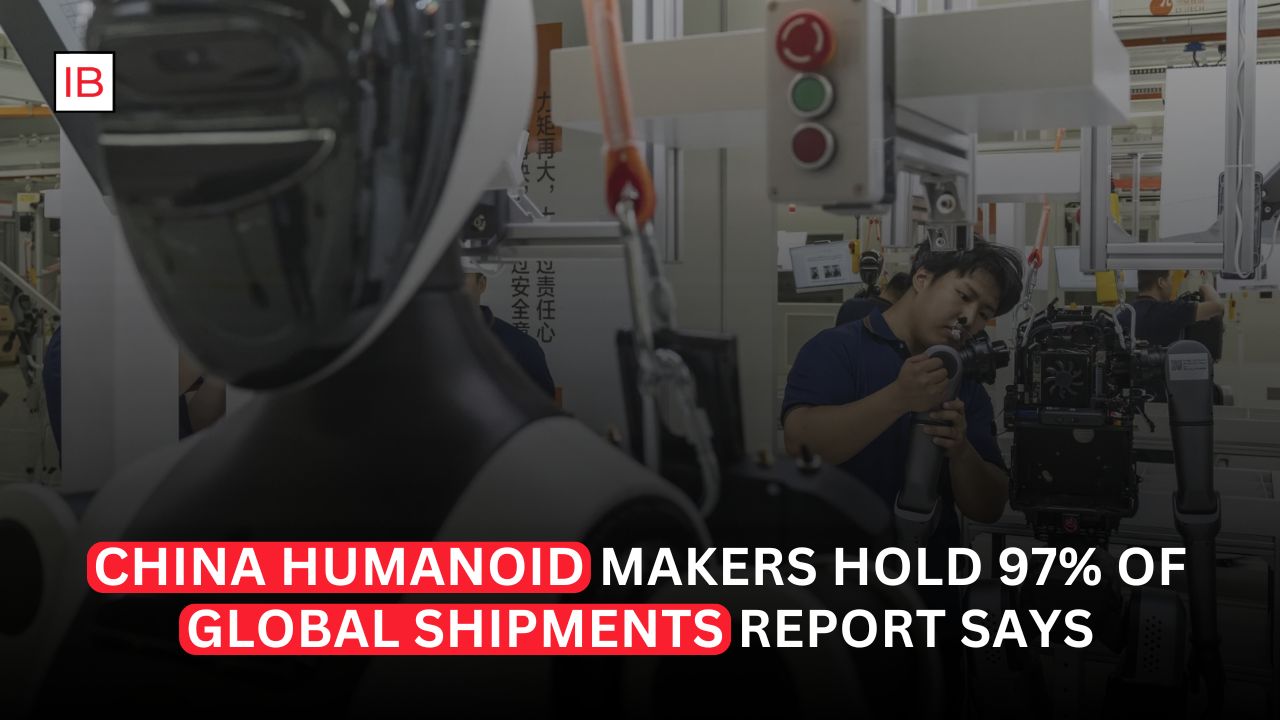
Chinese robotics companies are rapidly expanding their lead in humanoid robots, highlighting the country’s growing dominance in manufacturing, supply chains, and embodied artificial intelligence.
Chinese humanoid robot makers accounted for more than 97% of global shipments during the first half of 2026, according to new industry data, underlining how quickly the country’s robotics sector has moved from experimental development toward commercial production. The figures show that Chinese manufacturers are dominating a market that is still relatively young but expected to expand rapidly as companies begin deploying humanoid machines in factories, logistics, research, and other workplaces.
The scale of China’s lead is particularly notable because major technology companies in the US and other countries are also investing heavily in humanoid robots. Companies such as Tesla and other Western robotics firms are developing systems designed to perform physical tasks alongside or instead of human workers. However, Chinese manufacturers have moved faster in producing and shipping robots at commercial volumes.
Chinese Companies Expand Their Lead
The latest shipment figures demonstrate the strength of China’s domestic robotics ecosystem.
Chinese companies including AgiBot and Unitree have emerged as major players, with the two firms together shipping more than 10,000 humanoid robots in the first half of the year, according to industry data reported by Bloomberg. Global shipments reached roughly 19,100 units during the period, meaning Chinese manufacturers accounted for the overwhelming majority of machines entering the market.
The numbers reflect a broader shift in China’s robotics industry. Manufacturers are increasingly moving beyond prototypes and demonstrations toward larger-scale production, allowing companies to reduce costs and improve hardware through faster manufacturing cycles.
Manufacturing Strength Gives China an Advantage
China’s advantage is not limited to individual robot makers.
The country has built extensive supply chains for batteries, motors, sensors, electronics, precision components, and other technologies that are essential for humanoid robots. Many of these capabilities were developed through China’s electric-vehicle, consumer-electronics, and industrial-robot industries.
That manufacturing infrastructure allows robotics companies to source components domestically and move from design to production relatively quickly. Chinese companies are also competing aggressively on price, making their robots more accessible to universities, factories, research institutions, and other early customers.
Earlier industry research showed that China produced about 12,800 humanoid robots in 2025, representing around 90% of global production at the time.
Humanoid Robots Enter a New Phase
The latest shipment figures suggest that humanoid robotics is beginning to move into a different stage of development.
For years, humanoid robots were primarily demonstrated at technology exhibitions and research facilities. Companies are now attempting to deploy them in real-world environments where they can perform repetitive physical tasks.
Factories are among the most closely watched applications. Robots capable of moving, lifting objects, carrying materials, and performing basic assembly tasks could eventually help manufacturers deal with labor shortages while increasing production efficiency.
Logistics is another potential growth area, particularly for tasks that require moving goods through warehouses or distribution centers.
However, widespread commercial deployment remains at an early stage. Many humanoid robots still require supervision, controlled environments, and extensive training before they can reliably perform complex tasks.
Global Competition Is Intensifying
China’s dominance is creating increasing pressure on companies in the United States, Europe, and other markets.
Western companies have invested heavily in developing advanced humanoid systems, with the goal of combining artificial intelligence with machines capable of operating in environments designed for humans. The challenge is not simply building a robot that can walk or manipulate objects, but producing machines cheaply and reliably enough for mass deployment.
China’s manufacturing scale could become a major advantage if humanoid robots become a mainstream industrial technology.
The country already has one of the world’s largest industrial robotics markets and a deep network of component suppliers. That ecosystem could allow Chinese manufacturers to improve their products while lowering production costs as shipment volumes rise.
AI Becomes Central to Robotics
The rise of humanoid robots is also closely connected to advances in artificial intelligence.
Unlike traditional industrial robots designed for a limited number of predefined movements, humanoid systems are intended to operate in changing environments and respond to different tasks. This requires sophisticated vision systems, machine-learning models, motion planning, and increasingly capable AI systems.
China has been investing heavily in what policymakers describe as “embodied intelligence,” combining artificial intelligence with physical machines. The country’s robotics companies are therefore competing not only on hardware but also on the software and AI systems needed to make robots useful.
Commercialization Still Faces Obstacles
Despite China’s shipment advantage, the industry still faces major challenges.
Humanoid robots remain expensive relative to many conventional machines, while their reliability and ability to perform complicated tasks without human intervention are still developing. Businesses will need to determine whether the productivity gains justify the costs of purchasing and operating the robots.
Safety is another major concern. Robots working alongside humans must be able to respond predictably to unexpected movements, obstacles, and equipment failures.
There is also uncertainty over how quickly demand will grow outside research and demonstration projects. High shipment numbers are important, but long-term success will ultimately depend on whether companies can deploy robots at scale and generate sustainable returns.
Looking Ahead
China’s 97% share of global humanoid robot shipments during the first half of 2026 demonstrates how quickly the country’s robotics industry has established a leading position. The combination of manufacturing capacity, domestic supply chains, aggressive pricing, and large-scale investment has given Chinese companies a significant head start in the emerging market.
The next stage will be more difficult. Chinese manufacturers must demonstrate that their robots can move beyond early deployments and become reliable tools for factories, warehouses, and other commercial environments.
If that transition succeeds, China’s existing manufacturing advantage could translate into long-term leadership in humanoid robotics. For global competitors, the challenge will be not only matching China’s advances in artificial intelligence and robot design, but also competing with the manufacturing ecosystem that allows Chinese companies to produce and ship humanoid machines at a rapidly increasing scale.