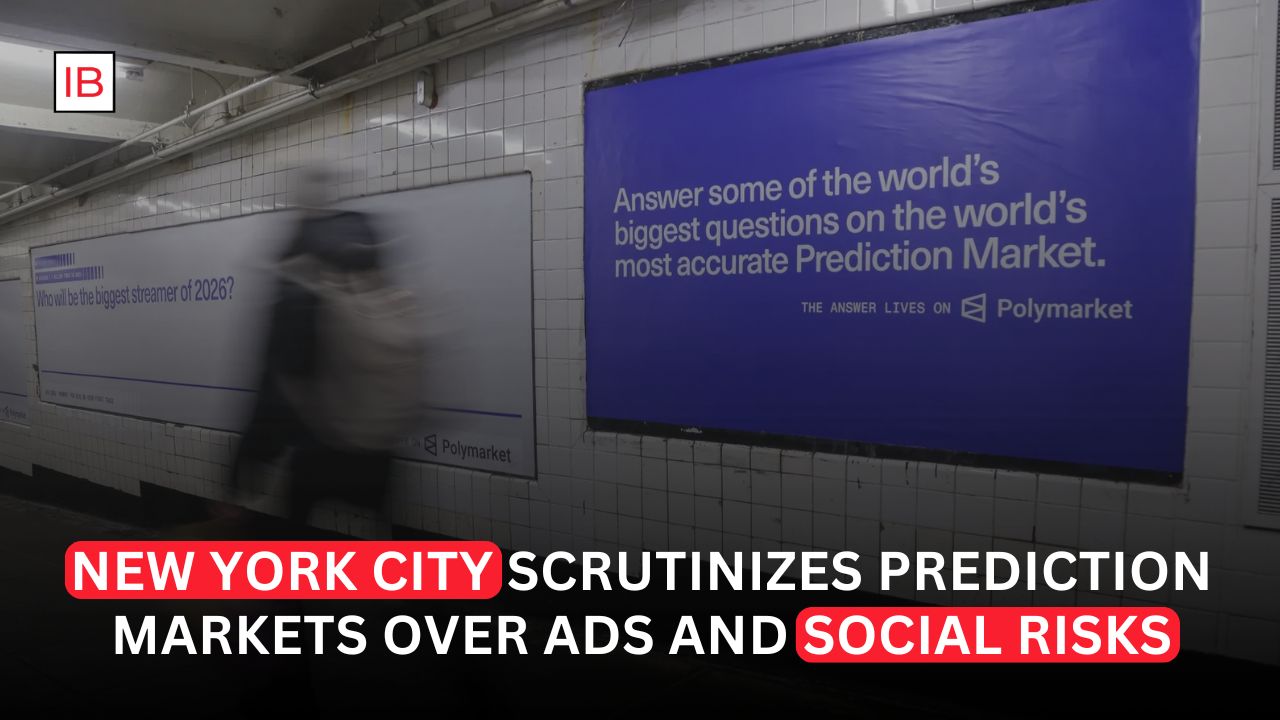
City Council Targets Polymarket, Kalshi and Other Platforms as Rapid Growth Raises Concerns About Young Users and Deceptive Marketing
New York City officials are investigating the advertising practices of major prediction-market platforms, escalating scrutiny of an industry that has expanded rapidly as consumers increasingly use event contracts to wager on sports, politics, economics and other real-world outcomes.
The New York City Council has launched a probe into four major platforms, including Polymarket, Kalshi, Coinbase and Gemini Titan, focusing on how they market their products and whether their advertising practices could expose young people to potentially harmful or misleading content.
The investigation adds another layer of pressure to prediction markets, which are already facing legal and regulatory battles across the US over whether their event contracts should be treated primarily as financial products or as a form of gambling.
Council Examines Prediction Market Advertising
The inquiry centers on how prediction-market companies promote their platforms, particularly through social media and influencer marketing.
New York City Council Speaker Julie Menin sent a letter to Polymarket on Aug. 11 raising concerns about marketing practices that allegedly targeted young adults and potentially minors.
The letter questioned the use of influencers, sponsored content and promotional material that may not clearly disclose commercial relationships. The Council has given the companies a limited period to respond to questions about their marketing and social-media strategies.
For city officials, the concern extends beyond ordinary advertising standards.
They are examining whether prediction markets are being promoted in ways that could encourage risky financial behavior among younger users.
Polymarket Faces Particular Scrutiny
Polymarket has become one of the most recognizable prediction-market platforms in the world.
Users can trade contracts tied to potential outcomes, with market prices representing the collective expectations of participants.
The platform has grown rapidly as interest in event-based trading has expanded.
But its growth has also attracted criticism.
The New York City investigation follows allegations that some promotional content presented unrealistic examples of trading success or failed to make clear when creators had been paid to promote prediction markets.
The controversy is significant because social-media marketing can reach large numbers of younger consumers quickly.
Kalshi Also Under the Microscope
Kalshi, another major prediction-market platform, is also included in the city’s investigation.
Kalshi has positioned itself as a regulated financial exchange rather than a conventional sportsbook, arguing that its event contracts fall under federal commodities regulation.
That distinction has become increasingly important as prediction markets have expanded into sports.
The platforms argue that their products allow users to trade contracts based on future events, while critics contend that many sports-related contracts function similarly to traditional betting.
The disagreement has produced lawsuits and regulatory conflicts between prediction-market companies, states and federal authorities.
Coinbase and Gemini Enter a Growing Market
The New York probe also includes Coinbase and Gemini Titan, highlighting how the prediction-market business is spreading beyond its original specialists.
Both companies have significant experience in cryptocurrency and financial markets.
Their participation demonstrates the growing commercial appeal of event contracts.
As prediction markets become more mainstream, established financial and cryptocurrency companies are seeking ways to participate in the sector.
That expansion could bring more users and liquidity to the market but may also increase pressure on regulators to establish clear rules governing advertising and consumer protection.
Social Media Becomes a Major Marketing Channel
Social platforms have become a particularly important distribution channel for prediction markets.
Companies can use influencers and creators to demonstrate how markets work, discuss potential trades and promote the idea of making money from correctly anticipating events.
Critics argue that this approach can blur the distinction between financial education and advertising.
A Wall Street Journal investigation previously reported that prediction markets had used paid creators to produce promotional videos, including content that allegedly showed misleading or fabricated trading successes.
The concerns raised by New York officials therefore reflect a broader debate about whether financial products should be promoted through social-media personalities in the same way as ordinary consumer products.
Young Users Are a Central Concern
One of the biggest issues in the investigation is the potential exposure of young people to prediction-market advertising.
Regulators and consumer advocates have raised concerns that sports-focused event contracts can appeal particularly strongly to younger users who are already familiar with online sports betting.
A 2026 regulatory filing highlighted concerns about prediction-market marketing aimed at college-age users, including campaigns involving student influencers, athletes and organizations.
The concern is that prediction markets could normalize wagering behavior while presenting it as financial trading.
That distinction can become especially complicated when platforms offer contracts tied to sports outcomes.
Sports Have Become a Major Driver
Sports are increasingly important to the prediction-market industry.
Users can trade contracts tied to the winners of games, player performances and other sporting outcomes.
The rapid expansion of sports-related contracts has brought prediction markets into direct competition with traditional online sportsbooks.
This has also increased concerns about gambling-related harms.
A legal filing in 2026 cited estimates that sports represented a large share of trading activity on major prediction platforms and argued that sports contracts could create risks associated with problem gambling.
For prediction-market operators, however, sports also represent one of the largest opportunities to expand their user base.
Legal Battle Over Regulation Continues
The New York investigation arrives as prediction markets face a broader legal fight over regulatory authority.
The central question is whether states can regulate or restrict prediction-market contracts when the platforms are operating under federal oversight.
Kalshi has challenged state efforts to restrict its activities, arguing that federal commodities law gives the federal government primary authority over its event contracts.
New York has become one of the key battlegrounds in that dispute.
The conflict could ultimately determine how much authority states have over the rapidly expanding industry.
Federal Regulators Are Also Examining Risks
Prediction markets are attracting attention in Washington as well.
The House Committee on Oversight and Government Reform has examined potential insider-trading risks involving prediction platforms.
A May 2026 letter to Kalshi requested information about identity verification, geographic restrictions and systems designed to detect unusual trading activity.
The concern is particularly important for markets involving politics, government decisions and other sensitive events.
If people with access to confidential information can trade contracts based on that information, prediction markets could face serious questions about market integrity.
Insider Trading Adds Another Challenge
The possibility of insider trading has become a significant concern as prediction markets expand into political and geopolitical events.
Federal lawmakers have pointed to cases involving political candidates and other individuals who allegedly traded contracts connected to events in which they had direct knowledge or interests.
Such cases raise questions about whether existing safeguards are strong enough to prevent participants from exploiting private information.
For prediction-market companies seeking mainstream acceptance, demonstrating strong compliance systems will be increasingly important.
Prediction Markets Argue They Provide Useful Information
The industry maintains that prediction markets can serve a legitimate purpose by aggregating information from large numbers of participants.
Prices on these markets can be interpreted as collective expectations about future events.
Academic research has examined the accuracy and limitations of prediction-market prices, finding that their usefulness as probabilities can vary depending on the market, timing and trading structure.
That argument is central to the industry’s effort to distinguish prediction markets from conventional gambling.
Operators say their platforms can provide valuable information about what participants collectively expect to happen.
Critics, however, argue that the financial incentives involved can encourage speculation and risky behavior.
New York’s Investigation Could Have Wider Consequences
The New York City Council’s investigation could have implications beyond the city.
If officials determine that prediction-market companies are using misleading or predatory advertising, other cities and states could adopt similar approaches.
That could force platforms to change how they work with influencers, advertise on social media and communicate potential financial returns.
It could also encourage stronger age-verification and consumer-protection measures.
The outcome may therefore influence the industry’s marketing standards nationwide.
A Rapidly Growing Industry Faces Its First Major Test
Prediction markets have grown from a niche financial product into a rapidly expanding industry.
Platforms such as Polymarket and Kalshi have benefited from growing interest in real-time event trading, while established companies including Coinbase and Gemini are entering the market.
But rapid growth brings regulatory challenges.
The industry must now demonstrate that it can protect users, prevent manipulation and insider trading, and market its products responsibly.
Looking Ahead
New York City’s investigation into prediction-market advertising represents another important test for an industry attempting to establish itself within the US financial system.
The Council’s focus on Polymarket, Kalshi, Coinbase and Gemini Titan reflects growing concern over how event contracts are promoted and how social-media advertising may affect younger consumers.
The investigation also comes as prediction markets face broader questions about gambling, financial regulation, insider trading and consumer protection.
For companies in the sector, the challenge is no longer simply attracting users and increasing trading volume.
They must also convince regulators and the public that their products can operate responsibly in a rapidly changing digital financial environment.
If cities and states impose stricter advertising and consumer-protection requirements, prediction-market companies may have to rethink how aggressively they market their platforms.
At the same time, continued growth could make the industry increasingly difficult for regulators to ignore.
The New York investigation could ultimately become an important test of how prediction markets balance innovation, financial participation and consumer protection as they move deeper into mainstream finance and digital entertainment.