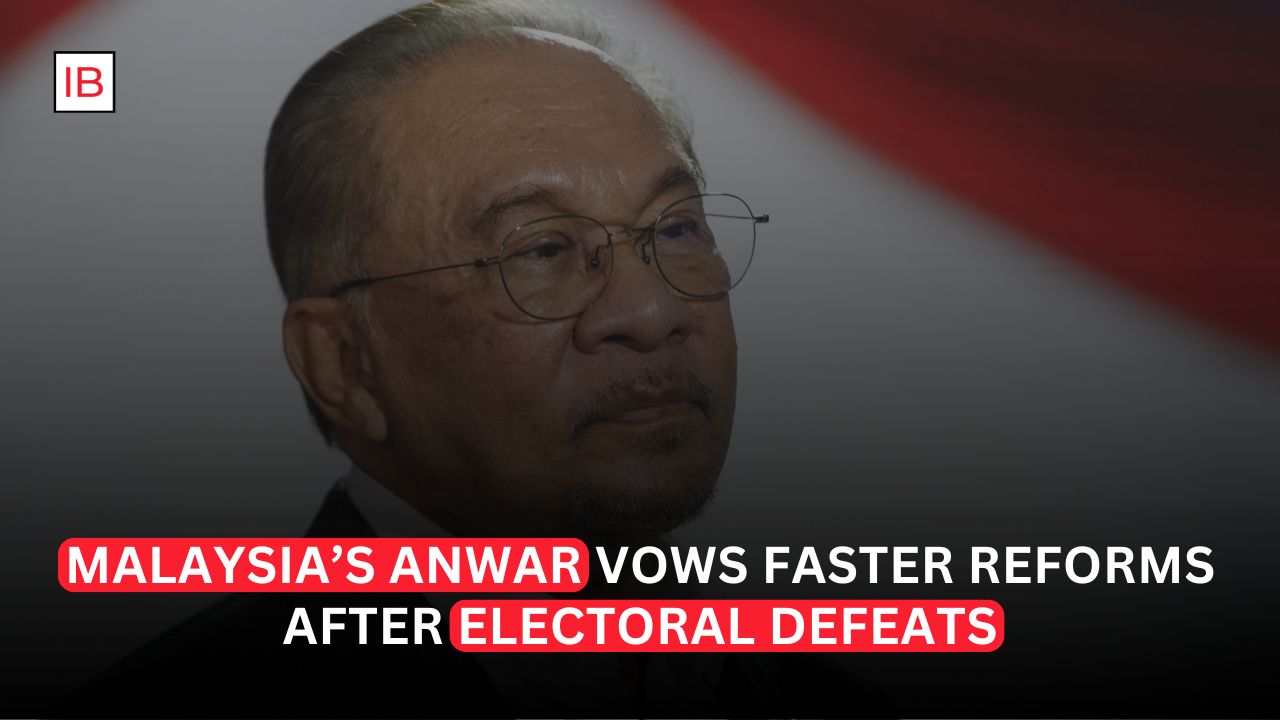
Malaysia’s Prime Minister Anwar Ibrahim is under growing political pressure after a string of state-level defeats, and his response is to accelerate reforms before his coalition’s losses become a broader national trend.
The problem is that promising faster reform is easier than delivering it. Anwar’s government has already struggled to turn its reform agenda into legislation, including a proposed 10-year limit on prime-ministerial terms that failed in Parliament by just two votes earlier this year.
The Electoral Warning Is Getting Harder to Ignore
Anwar’s Pakatan Harapan coalition has suffered major setbacks in several states.
After a poor result in Sabah, PH lost heavily in Johor and then lost control of Negeri Sembilan on Aug. 1. The latter is particularly damaging because Negeri Sembilan had been governed by PH for two terms.
That creates a pattern rather than an isolated defeat.
The next general election does not have to occur immediately, but Parliament’s current term runs toward a latest possible election date in early 2028.
Anwar therefore has a limited window to change voters’ perception of his government.
The Core Political Problem
Anwar came to power in 2022 largely as the face of reformasi — institutional reform, anti-corruption efforts and a more inclusive political system.
But three years into government, the political dynamic has flipped.
He is no longer the opposition challenging the establishment.
He is the establishment.
That makes it much harder to campaign simply on the promise of change.
The Straits Times put the problem bluntly: Malaysian voters still appear to want change, but PH is increasingly struggling to convince them that it remains the vehicle for that change.
Malay Voters Are the Immediate Battlefield
The recent state results highlight a major weakness for PH: its difficulty maintaining support among Malay voters.
UMNO-led Barisan Nasional and PAS-led Perikatan Nasional have increasingly benefited from a stronger Malay-unity narrative, while PH has struggled to articulate an equally clear message.
That matters because Anwar’s coalition is inherently complicated.
It combines:
- PKR
- DAP
- UMNO/Barisan Nasional
- Other regional and coalition partners
Those parties represent different voter bases and sometimes competing political priorities.
A reform agenda that appeals to urban voters may not necessarily strengthen Anwar among conservative Malay voters.
Reform Could Be the Wrong Political Fix — If It’s Too Abstract
This is the biggest weakness in Anwar’s response.
Institutional reforms are important, but voters rarely reward governments simply because they pass technical legislation.
They care about:
Prices.
Jobs.
Wages.
Subsidies.
Corruption.
Public services.
Housing.
If Anwar accelerates reforms that feel distant from everyday life while household economic pressures remain unresolved, the political benefit may be limited.
His government has already pursued fiscal reforms such as subsidy rationalization, but some measures have generated public backlash.
The Failed Term-Limit Bill Is a Warning
Anwar’s proposed constitutional amendment to limit a prime minister’s tenure to 10 years failed to obtain the required two-thirds majority by only two votes.
That is embarrassing for a government that has often been described as having a parliamentary supermajority.
More importantly, it demonstrated that Anwar cannot simply announce reforms and assume his coalition will deliver them.
Coalition discipline is a real constraint.
Why Faster Reform Could Actually Make Things Harder
There’s an obvious political temptation:
Bad election result → announce more reforms → demonstrate action → recover support.
But reforms create winners and losers.
Subsidy reform, tax reform, institutional reform and changes to government-linked companies can all generate resistance from groups that benefit from the existing system.
Anwar therefore faces a sequencing problem.
Move too slowly and voters conclude that reformasi was empty rhetoric.
Move too quickly and powerful interests inside his own coalition can turn against him.
The Coalition Is the Real Constraint
Anwar’s government exists because of political compromise.
That compromise brought together forces that were previously opponents.
The arrangement provides stability, but it also limits how aggressively Anwar can pursue reforms that threaten coalition interests.
This is why the failed constitutional amendment is more revealing than the vote itself.
The problem isn’t necessarily that Anwar lacks reform ideas. It’s that his political coalition may not be sufficiently unified to implement them.
The Economic Reform Question
The political pressure also intersects with fiscal policy.
Anwar has attempted to reduce costly blanket subsidies and improve Malaysia’s fiscal position. Government debt reached roughly RM1.3 trillion by the end of 2025, according to available reporting.
The logic is economically defensible:
reduce inefficient subsidies → improve fiscal space → redirect spending → strengthen long-term growth.
But the political problem is immediate.
Consumers feel the loss of subsidies before they feel the benefits of better fiscal management.
That creates a classic reform dilemma:
The costs arrive now. The benefits arrive later.
Investors Should Watch the Reform Pipeline
The important question isn’t whether Anwar says reforms will accelerate.
Watch whether legislation actually moves.
Key areas include:
Anti-Corruption
Whether enforcement becomes more institutionally independent and consistent.
Governance
Whether promised institutional reforms survive coalition negotiations.
Fiscal Consolidation
Whether subsidy reform continues without creating a major political backlash.
Government-Linked Companies
Whether Malaysia reduces political influence over state-linked businesses and improves capital allocation.
Investment Climate
Whether reforms make Malaysia more attractive to foreign investors relative to Indonesia, Vietnam and Thailand.
Malaysia Still Has an Economic Advantage
The political turmoil shouldn’t obscure the fact that Malaysia remains strategically important to global investors.
The country benefits from:
- Semiconductor investment
- Data-center development
- Manufacturing diversification
- ASEAN integration
- Strong links with China and the US
- Commodity resources
- A relatively developed financial system
That means political uncertainty doesn’t automatically translate into an economic crisis.
The bigger risk is reform paralysis.
If investors conclude that Anwar’s coalition cannot implement difficult structural changes, Malaysia could lose some of the momentum generated by its investment boom.
The Bigger Political Test
Anwar’s challenge isn’t simply to win the next election.
He needs to answer a more fundamental question:
What does Pakatan Harapan stand for now that it is the government?
Opposition parties have a simple advantage: they can promise change.
Governments have to demonstrate it.
Recent electoral defeats suggest that voters aren’t convinced PH has done enough. Analysts cited by The Straits Times argue that the coalition needs stronger local leadership, clearer political messaging and fresh candidates before the next national election.
The Bigger Picture
Anwar still has time to change the trajectory.
But the recent defeats make one thing clear: the reform window is narrowing.
Accelerating legislation could restore some credibility, particularly if reforms produce visible improvements in governance and the economy.
But announcing another batch of reforms won’t solve the underlying political problem.
Anwar has to turn reformasi from a historical identity into measurable results.
If he can do that, the recent state defeats may become a warning shot.
If he can’t, they may be an early indicator of a much larger national realignment.