Interoceanic Corridor of the Isthmus of Tehuantepec Offers a Land-Based Link Between the Pacific and Atlantic
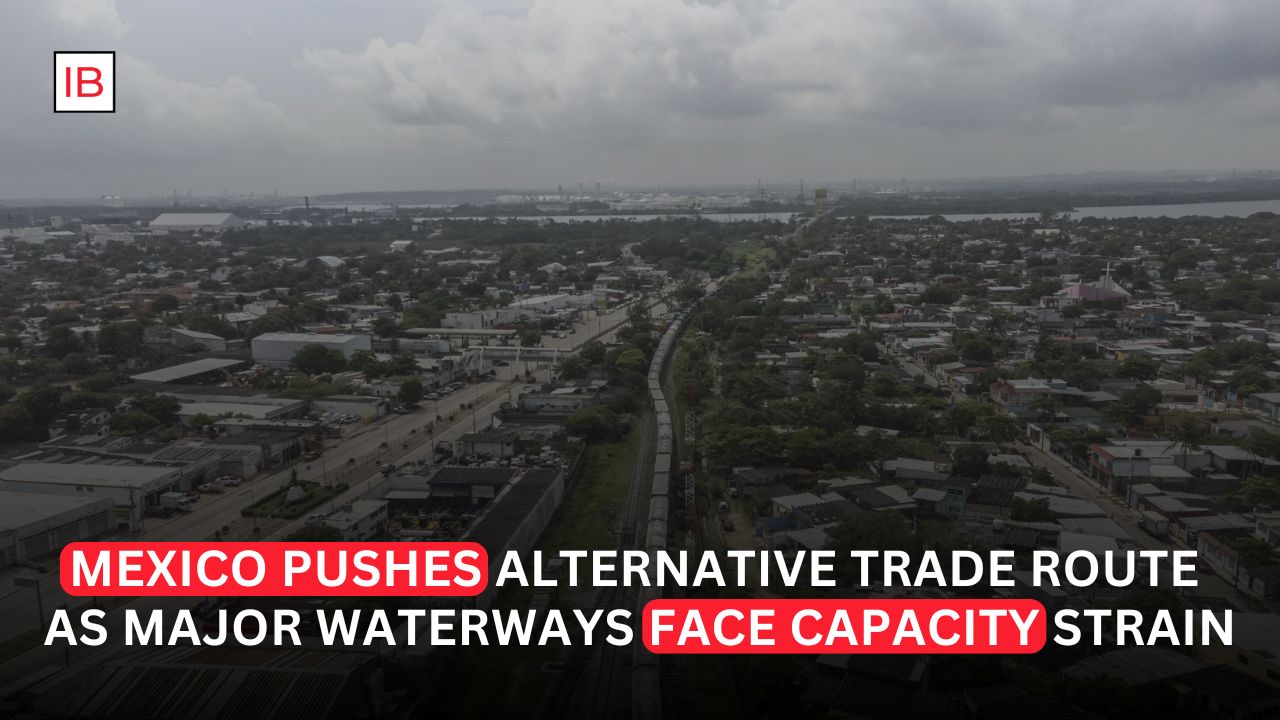
Mexico is positioning its Interoceanic Corridor of the Isthmus of Tehuantepec, or CIIT, as an alternative route for global trade as disruptions, congestion and climate-related pressures expose vulnerabilities in some of the world’s most important shipping waterways.
The project connects Mexico’s Pacific and Atlantic coasts through a combination of railways, ports and road infrastructure. Rather than requiring ships to pass through a canal, cargo can be unloaded at one coast, transported across the Isthmus of Tehuantepec by rail and then loaded onto another vessel on the opposite coast. Bloomberg describes the system as a potential “dry canal” for companies seeking alternatives when maritime chokepoints become unreliable.
The corridor is becoming more relevant as global trade faces increasing pressure from geopolitical conflicts, water shortages and congestion at major maritime routes.
A Different Model From the Panama Canal
The CIIT is not a traditional canal.
Instead, it is a multimodal transportation corridor linking the Pacific port of Salina Cruz with Coatzacoalcos on the Gulf of Mexico. The main route crosses approximately 300 kilometers of the Isthmus of Tehuantepec.
Cargo arriving on one side of Mexico can be transferred between ships and trains before continuing its journey from the other coast.
That creates additional handling compared with a conventional canal, but it also removes dependence on water levels inside a canal.
That distinction could become increasingly valuable as climate change affects water availability in major shipping corridors.
Panama Canal Vulnerability Highlights the Opportunity
The Panama Canal remains one of the world’s most important trade routes, but drought has demonstrated the vulnerability of water-dependent infrastructure.
Lower water levels have previously forced restrictions on vessel traffic and cargo loads.
Mexico sees an opportunity in that vulnerability.
The CIIT could provide shipping companies with another option when the Panama Canal is congested, disrupted or operating under restrictions.
Officials have emphasized that the Mexican corridor is not necessarily intended to replace Panama, but rather to provide another option when global supply chains face disruptions.
Geopolitical Disruptions Are Changing Shipping
The timing of Mexico’s push is particularly significant.
Global shipping has increasingly been affected by geopolitical crises.
Attacks around the Red Sea have forced many vessels to take longer routes around Africa, while instability around the Strait of Hormuz has created additional uncertainty for energy and commodity shipments.
These disruptions have demonstrated how quickly a single chokepoint can affect transportation costs and delivery times around the world.
For companies, having alternative routes can therefore be worth paying for even if the alternative is not always the cheapest option.
Resilience Is Becoming More Important
For decades, global supply chains were optimized largely around efficiency.
Companies sought the lowest transportation costs and relied heavily on a relatively small number of major ports and maritime routes.
That model is changing.
Businesses are increasingly willing to pay more for resilience.
A second route may not handle the same volume as the primary route, but it can provide insurance when the main route becomes unavailable.
That is the role Mexico hopes the CIIT can play.
Mexico’s Geographic Advantage
The corridor has an important geographic advantage.
The Isthmus of Tehuantepec is one of the narrowest points between the Pacific and Atlantic in Mexico.
The route also places cargo relatively close to the United States, the world’s largest economy and one of the most important destinations for global manufactured goods.
That could make the corridor particularly useful for North American supply chains rather than attempting to compete directly with the Panama Canal for every type of global shipment.
Designed for More Than Transit
The CIIT is not simply a railway.
Mexico is developing ports and industrial infrastructure around the corridor as part of a broader economic-development strategy.
The project includes industrial parks intended to attract manufacturing investment and encourage companies to locate production along the route.
That could transform the corridor from a simple transportation shortcut into a regional manufacturing and logistics network.
The broader project is therefore closely connected with Mexico’s push to benefit from nearshoring, as companies seek production locations closer to the US market.
Nearshoring Could Boost Demand
Mexico has become an increasingly important destination for manufacturers seeking to shorten supply chains.
Companies producing automobiles, electronics, machinery and other goods can manufacture in Mexico and reach the US market relatively quickly.
The CIIT could complement that trend by connecting manufacturing facilities and ports on both Mexican coasts.
Instead of simply moving foreign cargo across Mexico, the corridor could eventually help create new industrial clusters around the route.
The Capacity Challenge
The biggest question is whether the corridor can handle enough cargo to become a meaningful global alternative.
The CIIT has been described as capable of eventually moving around 1.4 million containers annually.
That is significant, but still far below the scale required to replace the Panama Canal’s role in global shipping.
This means the CIIT is better understood as a complementary route and contingency option rather than a second Panama Canal.
Its value could come from handling specific cargo flows and providing additional capacity during periods of disruption.
Infrastructure Still Matters
The success of the project depends heavily on infrastructure beyond the railway.
Ports need sufficient capacity to receive, unload and reload ships.
Railways need to handle large volumes reliably.
Customs procedures must be efficient, and cargo transfers need to occur quickly enough to make the route economically competitive.
The corridor’s infrastructure has been developed in stages, with port modernization forming a particularly important part of the project.
Any bottleneck at either end could reduce the value of the entire system.
A Challenge for Panama—and a Potential Partner
Mexico’s project is often described as a competitor to the Panama Canal, but officials in both countries have suggested a different relationship.
Panama’s ambassador to Mexico previously described the CIIT as potentially complementary to the canal rather than a direct competitor.
That view reflects the reality of global shipping.
The world economy does not necessarily need one route to replace another.
It needs enough routes to prevent a disruption at one chokepoint from paralyzing international trade.
Climate Change Strengthens the Case
Climate change may become one of the strongest arguments for land-based alternatives.
Canals depend on enormous quantities of water.
Railways do not.
If drought becomes more frequent or severe, water-dependent shipping routes could face increasing restrictions.
A land corridor across Mexico could therefore provide a form of climate resilience that traditional canals cannot easily offer.
That does not make the CIIT immune to climate risks—railways, ports and roads can also be affected by extreme weather—but its core transportation model does not depend on maintaining a large reservoir of freshwater.
Mexico Wants Economic Benefits Too
For Mexico, the project is about much more than international shipping.
The government hopes the corridor will stimulate economic development in southern Mexico, a region that has historically lagged behind the country’s northern industrial centers.
New industrial parks could attract factories, logistics companies and energy projects.
That would create jobs and potentially increase investment in states such as Oaxaca and Veracruz.
The corridor therefore combines infrastructure policy with regional-development ambitions.
A Test for Mexico’s Logistics Strategy
The project’s success will ultimately depend on whether private companies actually choose to use it.
Government investment can build railways and ports, but shipping companies and manufacturers will determine whether the route becomes commercially important.
They will compare the CIIT with the Panama Canal and other options based on cost, reliability, transit time, capacity and political risk.
If the corridor can provide reliable service during major disruptions, companies may be willing to maintain it as part of their supply-chain contingency plans.
Looking Ahead
Mexico’s CIIT arrives at a time when the traditional assumptions behind global shipping are being challenged.
The Panama Canal has demonstrated the risks created by water shortages, while geopolitical conflicts have shown how quickly attacks or instability can disrupt major maritime corridors.
The result is growing demand for alternative transportation routes.
The Interoceanic Corridor of the Isthmus of Tehuantepec provides Mexico with one such option.
Its combination of railways and ports can move cargo between the Pacific and Atlantic without requiring ships to pass through a canal.
But the CIIT is unlikely to replace the Panama Canal outright.
Its capacity remains much smaller, and moving containers between ships and trains introduces additional handling and coordination.
Instead, its greatest value may be as a strategic backup.
When a major shipping route is operating normally, companies may continue to favor the most efficient option.
When that route faces drought, congestion, conflict or other disruptions, however, a second corridor can become extremely valuable.
That is the logic behind Mexico’s pitch.
The CIIT does not need to dominate global shipping to succeed.
It only needs to provide enough capacity and reliability to become an important alternative when the established routes are under pressure.
Mexico also has a larger economic ambition.
By combining transportation infrastructure with industrial parks and manufacturing investment, the government hopes the corridor will encourage companies to produce goods in southern Mexico rather than simply pass through the region.
Nearshoring could make that strategy particularly attractive.
Manufacturers seeking closer access to US consumers could use Mexico as both a production base and a logistics hub.
The corridor could therefore become part of a broader North American supply-chain network rather than simply a competitor to Panama.
The biggest challenges will be capacity, reliability and cost.
Ports must operate efficiently, rail infrastructure must handle growing volumes, and cargo transfers must be fast enough to justify the additional logistical steps.
If Mexico can solve those problems, the CIIT could become one of the world’s most useful contingency routes for global trade.
Its importance may become even greater as climate change and geopolitical tensions make traditional shipping chokepoints less predictable.
The future of global trade may not depend on finding one replacement for every major waterway. It may depend on building a network of alternatives that can keep goods moving when one route fails.
For Mexico, the CIIT is an ambitious attempt to become part of that new network.