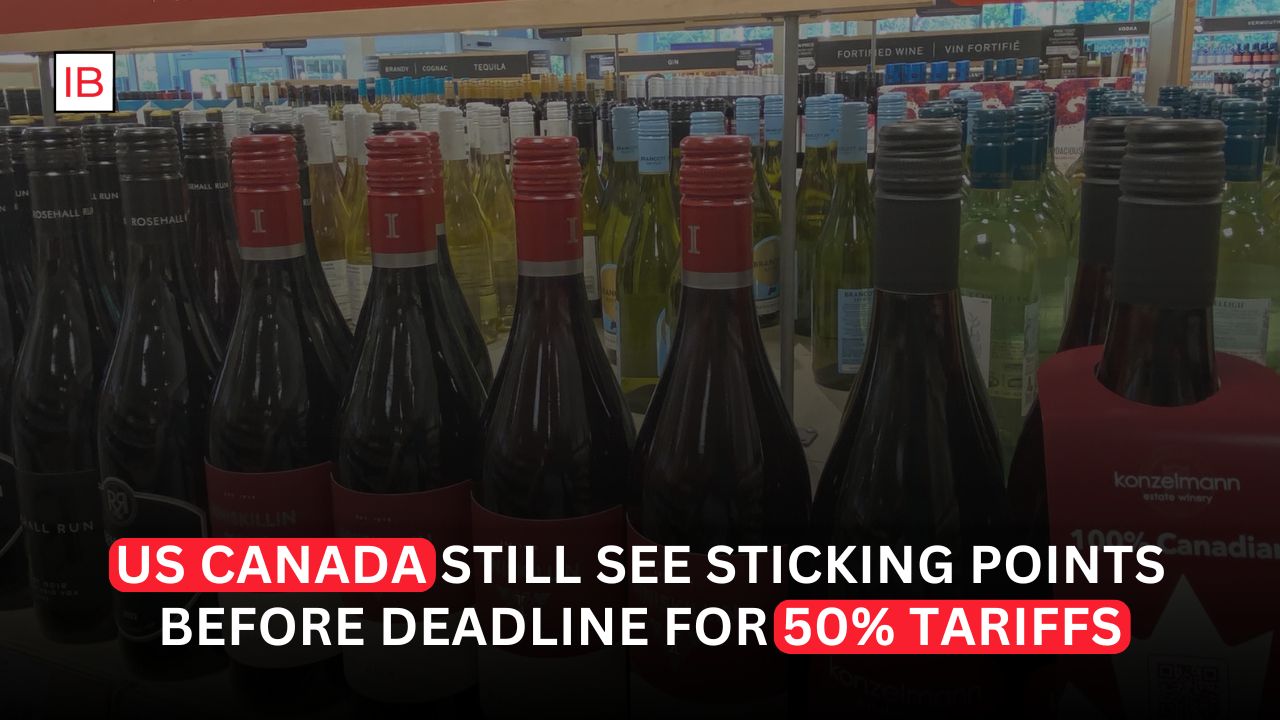
The US and Canada are still struggling to resolve several major trade disputes as a deadline approaches for potential 50% tariffs, raising the risk of another escalation in the North American trade relationship.
The key issue is that this is no longer simply about tariff rates.
The Bigger Fight Is Over Trade Rules
Washington and Ottawa still have disagreements over issues including:
- Tariff levels
- Market access
- Canadian trade policies
- Rules governing cross-border commerce
- Sector-specific protections
That makes a last-minute agreement harder than simply negotiating a percentage.
A deal would need to resolve several separate disputes at once.
The 50% Tariff Threat Is the Real Pressure Point
A potential 50% tariff would be economically significant for both countries.
The US and Canada have deeply integrated supply chains, particularly in:
- Automobiles
- Energy
- Metals
- Agriculture
- Manufacturing
- Industrial equipment
A sharp tariff increase could therefore raise costs well beyond the companies directly targeted.
The biggest danger is that tariffs imposed on Canadian goods could eventually feed into higher prices for US businesses and consumers.
Canada Has More to Lose From a Trade War
Canada is heavily dependent on the US market.
The US is by far Canada’s most important trading partner, meaning Ottawa has fewer alternatives if negotiations deteriorate.
But Washington also has something to lose.
American manufacturers depend heavily on Canadian inputs, especially energy, minerals, metals and industrial components.
That makes the relationship unusually interconnected.
The Auto Industry Is Especially Vulnerable
North American automobile production operates across the US-Canada-Mexico border.
A component can cross the border multiple times before a finished vehicle reaches consumers.
A 50% tariff imposed on one stage of that supply chain doesn’t simply affect the Canadian exporter.
It can raise the cost of the entire production process.
That is why automakers have historically pushed governments toward exemptions and special treatment.
Energy Creates Another Complication
Canada is one of America’s most important energy suppliers.
Tariffs on Canadian energy could therefore create an unusual situation:
The US taxes an input that American companies and consumers already rely on.
That doesn’t necessarily mean the full tariff would be passed through to consumers, but it increases the risk of higher costs for refiners and other energy users.
Canada Could Retaliate
Ottawa’s leverage comes partly from the ability to impose retaliatory tariffs.
That creates the classic trade-war cycle:
US tariff → Canadian retaliation → US retaliation → higher costs on both sides.
The initial tariff may therefore be only the beginning.
Businesses are often more concerned about this escalation risk than about the first tariff itself.
The Economic Impact Could Be Larger Than the Headline Suggests
A 50% tariff doesn’t mean every Canadian product suddenly becomes 50% more expensive in the US.
Companies can respond by:
- Absorbing part of the cost
- Raising prices
- Switching suppliers
- Redesigning supply chains
- Moving production
- Negotiating exemptions
But the adjustment itself is costly.
And uncertainty can delay investment even before tariffs are implemented.
The Biggest Risk Is Uncertainty
Businesses don’t need tariffs to be imposed to feel their effects.
If companies don’t know whether a tariff will be:
10% → 25% → 50% → suspended → reinstated
they have difficulty making long-term decisions.
That can lead to:
- Delayed factory investment
- Larger inventories
- Supplier diversification
- Higher working-capital requirements
- More expensive contracts
So even a last-minute deal could leave some economic damage behind if businesses have already spent months preparing for disruption.
Why a Deal Is Still Possible
The economic costs give both governments an incentive to compromise.
The US wants to avoid unnecessarily disrupting North American supply chains.
Canada wants to preserve access to its largest export market.
That creates room for a negotiated solution involving:
Targeted exemptions + lower effective tariffs + commitments on specific trade issues.
The closer the deadline gets, the stronger the incentive for both sides to find a face-saving compromise.
What Businesses Should Watch
Tariff Exemptions
The most important details may be which industries are excluded.
Energy
Canadian oil and other energy exports could be especially sensitive.
Automobiles
Any disruption here could spread through the integrated North American manufacturing network.
Retaliation
Canadian countermeasures could determine how quickly the dispute escalates.
Deadline Extensions
An extension would reduce immediate risk but wouldn’t necessarily resolve the underlying disagreements.
The Bigger Picture
The US-Canada dispute shows how difficult it has become to separate trade policy from domestic politics and industrial strategy.
A 50% tariff would be an extreme measure, but the more important question is whether Washington and Ottawa can establish a stable framework that businesses can actually plan around.
The real economic cost isn’t just the tariff.
It’s the possibility that North American companies begin treating the US-Canada border as a permanent source of trade risk.
That would encourage companies to redesign supply chains that have taken decades to build.