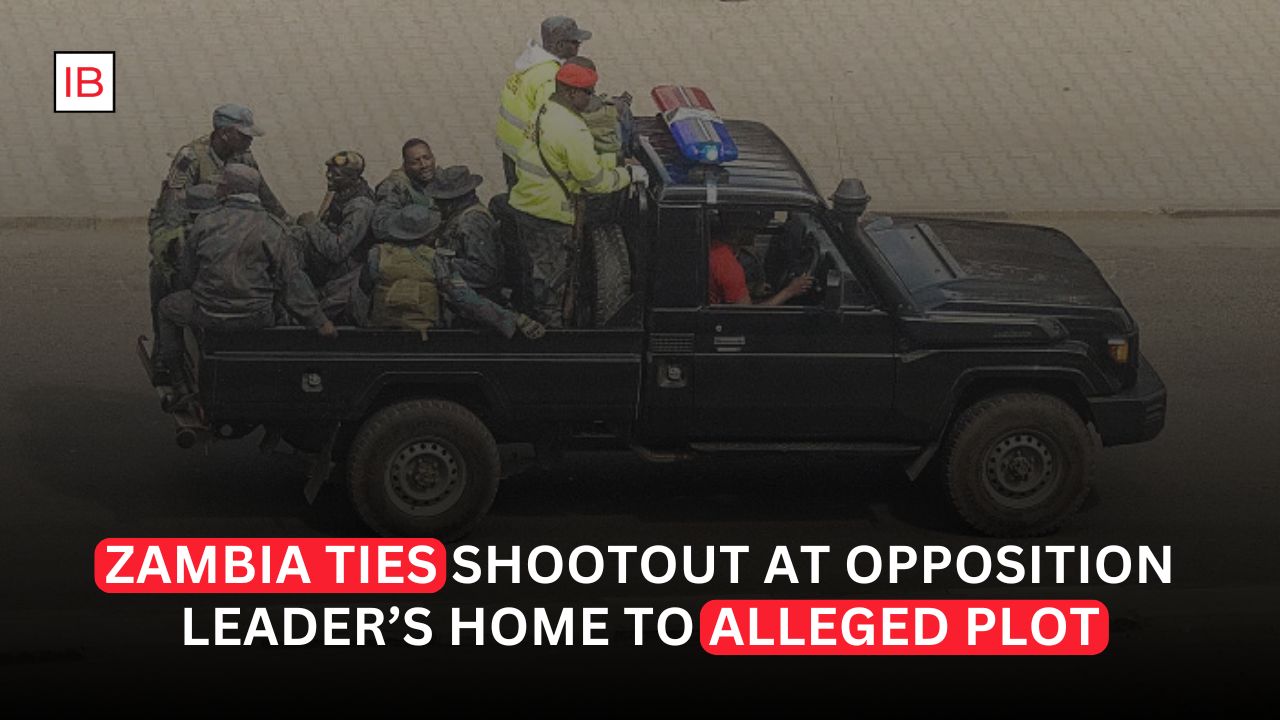
Zambia is facing renewed political tensions after authorities linked a shooting at the home of an opposition leader to an alleged plot, raising concerns about political stability ahead of the country’s next electoral cycle.
The incident adds another layer of uncertainty to Zambia’s already tense political environment, where disputes between the government and opposition have increasingly focused on allegations of intimidation, political interference and the treatment of opposition figures.
According to Bloomberg’s report, the authorities are investigating the shooting as part of a suspected broader plan rather than treating it as an isolated security incident.
A Serious Escalation in Political Tensions
Any armed confrontation involving a senior opposition figure is politically sensitive, particularly in a country approaching an election.
Zambia has traditionally been viewed as one of the more stable democracies in southern Africa. The country has experienced peaceful transfers of power, including the opposition’s victory over long-time ruling party Patriotic Front in the 2021 election.
That history makes the latest developments particularly significant.
Political violence can quickly undermine confidence in democratic institutions, especially when accusations begin circulating before an investigation has established responsibility.
The central question now is whether the shooting represents an isolated criminal incident or part of a politically motivated operation.
Opposition Figures Face Greater Pressure
Zambia’s opposition has increasingly accused the government of using state institutions to constrain political competition.
The government, meanwhile, has rejected accusations that it is deliberately targeting political opponents and has argued that security and law-enforcement measures are necessary to maintain public order.
That creates a familiar problem in politically divided countries:
Every security incident can become a political event.
If authorities describe an incident as part of an opposition-linked plot, opposition supporters may interpret the investigation as an attempt to discredit or weaken their movement.
If authorities fail to investigate aggressively, critics may accuse the government of allowing political violence to go unchecked.
Either way, trust becomes harder to maintain.
The Election Makes the Timing More Important
Zambia’s next general election is scheduled for Aug. 6, 2026, making political developments in the months leading up to the vote especially important.
President Hakainde Hichilema is seeking another term, while opposition parties are preparing to challenge the ruling United Party for National Development.
The political environment has already become more contentious as parties position themselves for the election.
A security incident involving an opposition leader could therefore have consequences far beyond the immediate investigation.
It could influence campaign rhetoric, voter perceptions and international assessments of Zambia’s democratic trajectory.
Zambia Has an Important Democratic Reputation
Zambia’s political stability has long been an important asset.
The peaceful transfer of power in 2021 was widely viewed as a positive sign for democratic governance in Africa.
Hichilema defeated incumbent Edgar Lungu by a wide margin, and Lungu conceded the result.
That transition strengthened Zambia’s reputation as a country where political competition could take place without a major breakdown in stability.
A deterioration in that environment would therefore carry reputational and economic costs.
Investors tend to place a premium on countries where political institutions are predictable and changes in government occur peacefully.
Investors Are Watching More Than Politics
Political instability can affect financial markets through several channels.
The first is the currency.
Zambia’s kwacha has experienced significant volatility in recent years as investors have reacted to debt negotiations, commodity prices and domestic economic developments.
Political uncertainty can add another source of pressure.
The second is government borrowing.
Investors purchasing Zambian bonds need confidence that the government will maintain fiscal discipline and honor its financial commitments.
Political disruption can raise the perceived risk premium.
The third is foreign investment.
Mining companies and other international businesses make long-term decisions based partly on political stability.
If investors begin to believe that elections could trigger unrest or institutional uncertainty, investment decisions may be delayed.
Copper Makes Zambia Especially Important
Zambia is one of Africa’s major copper producers.
Copper accounts for a substantial share of the country’s export earnings and plays a central role in government revenue and foreign-exchange generation.
That makes political stability particularly important for the mining sector.
Mining projects require billions of dollars in long-term capital.
Companies need confidence that tax rules, licensing arrangements and property rights will remain predictable across political cycles.
Any perception of rising political risk could therefore affect investment decisions even if mining operations themselves are not directly disrupted.
The Government Has Economic Incentives to Preserve Stability
President Hichilema’s government has been trying to stabilize Zambia’s economy following years of debt problems.
Zambia became the first African sovereign to default during the Covid-era debt crisis, and restructuring its obligations has taken years.
The country has since made progress with creditors and international institutions, but its fiscal position remains fragile.
That means political instability would come at a particularly bad time.
The government needs foreign investment, access to international capital and continued support from multilateral lenders.
A prolonged political crisis could complicate all three.
The Biggest Risk Is Escalation
The shooting itself is not necessarily evidence of a wider political breakdown.
That distinction matters.
Authorities still need to establish who was responsible, what motivated the incident and whether the alleged plot actually existed.
Jumping from a shooting to a conclusion about systematic political violence would be premature.
But ignoring the incident would be equally dangerous.
The risk is that competing political narratives develop faster than investigators can establish the facts.
Once that happens, every subsequent event can be interpreted through a political lens.
What to Watch
The investigation: Evidence linking the shooting to an organized political plot would significantly raise the stakes.
Opposition reaction: Statements from opposition leaders could determine whether tensions escalate.
Government response: Heavy-handed security measures could generate additional political controversy.
Election preparations: Any disruption to campaigning or electoral institutions would be a major warning sign.
Currency markets: Political uncertainty could increase pressure on the kwacha.
Mining investment: Copper producers and foreign investors will be watching the stability of the operating environment.
The Bigger Picture
Zambia is at an important political and economic crossroads.
The country has worked hard to preserve its reputation for peaceful political transitions while simultaneously dealing with debt restructuring, economic reforms and the need to attract investment.
The shooting at an opposition leader’s home now introduces another variable.
The key issue is not simply who fired the shots.
It is whether Zambia’s political institutions can handle a potentially explosive allegation without allowing the situation to become a broader confrontation between the government and opposition.
If the investigation is transparent and political actors remain restrained, the incident may remain a contained security case. If accusations escalate into broader claims of political violence or intimidation, the consequences could extend into the election, financial markets and Zambia’s reputation as one of Africa’s more stable democracies.