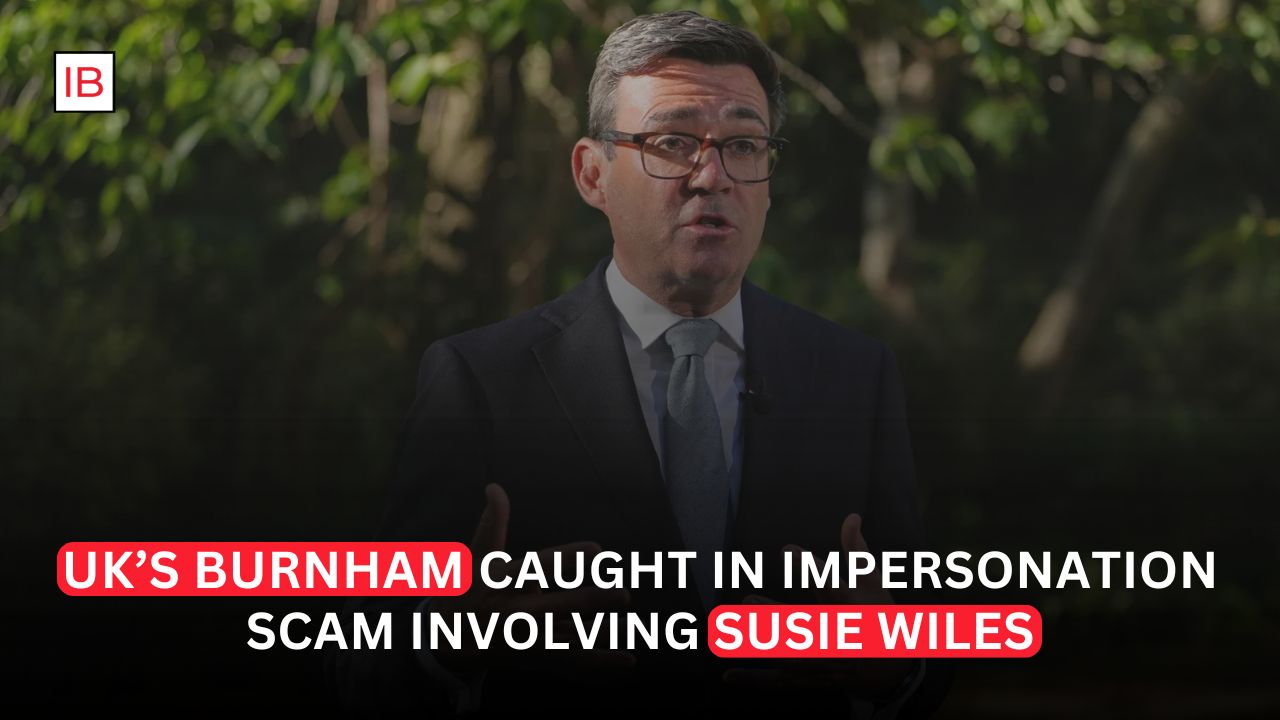
Security Concerns Rise After Britain’s New Prime Minister Was Contacted by Someone Posing as Trump’s White House Chief of Staff
British Prime Minister Andy Burnham exchanged messages with an individual impersonating Susie Wiles, US President Donald Trump’s chief of staff, in a security incident that has prompted concerns in both London and Washington.
The episode was particularly notable because Burnham became prime minister only weeks ago, taking office on July 20. The messages were reportedly exchanged before and after he entered Downing Street, according to reports citing people familiar with the matter. Officials have said the communications were not significant, but the incident was quickly reported to authorities.
The British Embassy in Washington was sufficiently concerned that it raised the matter with the White House, highlighting the sensitivity surrounding communications between senior British and American officials.
Impersonator Posed as Susie Wiles
The individual communicating with Burnham claimed to be Wiles, one of the most influential figures in Trump’s administration.
It remains unclear exactly how the impersonator established contact with Burnham or what method was used to convince him that he was communicating with Wiles.
Reports indicate that Burnham exchanged a limited number of messages with the person. The content has not been publicly disclosed, and British officials have stressed that nothing of significance was communicated.
Downing Street has declined to provide further details, saying it does not comment on national security matters.
Timing Adds to the Concern
The incident comes at a particularly sensitive moment for UK-US relations.
Burnham became Britain’s prime minister on July 20 after winning the Labour leadership contest and succeeding Keir Starmer. His government is therefore still establishing relationships with the Trump administration and other international governments.
Contact between the leaders and their senior officials is expected to be frequent.
That makes the ability to impersonate a senior American official potentially significant even if no sensitive information was exchanged in this particular case.
The incident demonstrates how political leaders can become targets simply because of their access to influential networks.
Wiles Has Been Targeted Before
The latest episode is not the first time someone has attempted to impersonate Wiles.
Last year, US authorities investigated a campaign in which an unknown person allegedly posed as Trump’s chief of staff and contacted prominent Republican politicians, governors, senators and business leaders.
The person reportedly attempted to communicate with people in Wiles’ contact network using messages and calls that appeared to come from her.
That earlier investigation makes the Burnham incident particularly concerning.
It raises the possibility that whoever contacted the British prime minister may have been exploiting information about Wiles and her professional relationships rather than randomly selecting a high-profile target.
A Broader Cybersecurity Problem
The incident highlights a growing challenge for governments.
Traditional cyberattacks often involve breaking into networks or stealing passwords.
Impersonation attacks can be much simpler.
An attacker can attempt to convince a target that a message is coming from someone they know and trust.
For senior officials, that can be particularly dangerous because they regularly communicate with large numbers of people across governments, businesses and international organizations.
The more information an attacker has about those relationships, the easier it can become to construct a convincing impersonation.
Artificial Intelligence Adds New Risks
Modern technology has also made impersonation more sophisticated.
AI-generated text, voice cloning and other tools can make fraudulent communications appear increasingly convincing.
While there is no public confirmation that artificial intelligence was used in the Burnham incident, security experts have warned that political leaders are increasingly vulnerable to digitally generated identities.
An attacker does not necessarily need to compromise a leader’s phone.
They may instead attempt to manipulate the person directly.
That makes human judgment and verification procedures just as important as technical cybersecurity.
No Significant Information Reported
One of the most important details is that officials have said the messages exchanged with Burnham were not significant.
That limits the immediate consequences of the episode.
There has been no public indication that Burnham disclosed classified information, sensitive government plans or other confidential material.
However, authorities have not released the complete contents of the conversation.
The precise nature of the exchange therefore remains unclear.
The British government’s decision not to discuss the matter publicly is consistent with its stated policy of avoiding commentary on national security issues.
Why the White House Was Contacted
The British Embassy’s decision to notify the White House suggests officials initially had concerns that Wiles’ communications could have been compromised.
If an attacker has access to the contacts of a senior official, impersonating that person can become a powerful method of targeting other officials.
The concern is not necessarily limited to what the impersonated person says.
Even establishing a conversation can provide an attacker with information about how government officials communicate and which individuals are willing to respond.
A Familiar Pattern in Government
The Burnham episode follows a series of incidents demonstrating the vulnerability of political communications.
Governments around the world have repeatedly faced attacks involving phishing, compromised accounts, fraudulent messages and social engineering.
Senior officials are particularly attractive targets because a single successful interaction can potentially provide access to sensitive networks.
The danger is therefore not limited to classified information.
An attacker could seek influence, intelligence, financial information or simply confirmation that a particular communication channel is active.
Previous UK Incidents
British politicians have faced similar impersonation attempts.
The Financial Times noted that former UK Foreign Secretary David Cameron was previously deceived by an impersonator claiming to be Ukrainian President Volodymyr Zelenskyy.
Such cases demonstrate that political impersonation is not a new phenomenon.
What has changed is the scale and sophistication of the technology available to attackers.
A convincing message can now be generated quickly, while publicly available information can help an attacker construct a credible identity.
The Risk to International Diplomacy
The incident also highlights the importance of secure communication between governments.
British and American officials routinely discuss issues involving defense, trade, intelligence and international crises.
A fraudulent message that appears to come from a senior official could therefore create confusion even if no confidential information is immediately exchanged.
In a rapidly developing crisis, uncertainty over whether a message is genuine could itself become a problem.
That is why government agencies increasingly emphasize verification procedures for sensitive communications.
The Challenge for Burnham’s Government
For Burnham, the incident comes during the early stages of his premiership.
His government will now face questions about how the communication occurred and whether existing security procedures need to be strengthened.
Officials are unlikely to disclose many details publicly because doing so could reveal information about government communication systems.
The focus will instead be on ensuring that similar incidents do not result in the disclosure of sensitive information in the future.
Looking Ahead
The Burnham incident is significant not because officials have reported a major leak, but because it demonstrates how easily political communications can be targeted through impersonation.
The person communicating with Burnham was apparently able to present themselves as Susie Wiles, one of the most senior figures in Trump’s White House. The messages were reportedly insignificant, but the British Embassy still considered the matter serious enough to raise directly with the White House.
The episode also raises broader questions about cybersecurity in an era of increasingly sophisticated digital deception.
Political leaders no longer need to have their phones physically hacked for attackers to create problems.
An impersonator can attempt to exploit trust, publicly available information and familiar communication patterns.
Wiles had already been at the center of a similar impersonation investigation involving US politicians and business leaders.
That history makes the latest incident particularly notable.
For governments, the lesson is straightforward: a message appearing to come from a trusted official cannot automatically be treated as genuine.
Verification is becoming increasingly important as technology makes it easier to replicate identities and communication styles.
The risk is especially high for prime ministers, presidents and senior ministers who communicate with hundreds of officials and political figures.
Although there is currently no indication that Burnham disclosed sensitive information, the incident demonstrates the potential consequences of even a seemingly harmless exchange.
A successful impersonation can establish trust, gather information and potentially create opportunities for a much more damaging attack later.
For Britain and the United States, the episode is therefore another reminder that cybersecurity is not simply a technical issue.
It is increasingly a matter of diplomatic and national security.
As governments rely more heavily on digital communication, protecting the identity of the people on the other end of a message may become just as important as protecting the devices and networks through which those messages are sent.