Central Bank Researchers Say Surging AI Valuations Could Create Broader Financial-Stability Risks Even if the Technology Delivers Strong Economic Gains
The artificial-intelligence boom has transformed global stock markets, but the European Central Bank is warning that the extraordinary rally in AI-linked equities could eventually end in a significant correction—even if the technology itself proves as productive and profitable as investors expect.
In a blog published Monday, ECB researchers examined whether the current AI boom represents rational optimism about a transformative technology or another speculative episode similar to the dot-com bubble.
Their conclusion was uncomfortable for investors: economic research on previous technological revolutions suggests that a correction in today’s elevated stock-market valuations is likely. The researchers stressed, however, that this does not mean AI is a bubble that must collapse immediately, nor can the timing of a correction be predicted.
AI Has Pushed Valuations Toward Dot-Com Levels
The extraordinary rise of AI-related companies has pushed US equity valuations to levels rarely seen in modern markets.
The ECB researchers noted that the US stock market’s cyclically adjusted price-to-earnings ratio, or CAPE, is close to historical highs. European valuations have also increased, although they remain considerably below US levels.
Investors have poured money into companies expected to benefit from AI, particularly businesses involved in chips, cloud computing, data centers and software.
The rally reflects genuine economic expectations.
AI has the potential to increase productivity, reduce costs and create entirely new markets.
But the prices investors are paying today reflect extremely optimistic assumptions about how quickly those benefits will materialize.
That creates a vulnerability.
Even Successful AI Could Produce a Stock Selloff
One of the most important points in the ECB analysis is that AI does not have to fail for AI stocks to fall.
Investors may already have priced in enormous future profits.
If those profits eventually materialize but arrive more slowly than expected, valuations could still decline.
The researchers argue that as AI moves from an emerging technology affecting individual companies toward an economy-wide transformation, the nature of investment risk changes.
At the beginning of a technological revolution, investors can diversify company-specific risks.
But as AI becomes increasingly important across the economy, risks become more interconnected.
Investors may consequently demand a higher risk premium.
That increase in the required return can put downward pressure on stock valuations even when corporate cash flows continue improving.
History Offers a Warning
The ECB compared the current AI boom with previous technological transformations.
Railways in the 19th century, electricity and radio in the 1920s, and the internet in the 1990s all generated enormous optimism and attracted substantial investment.
In each case, transformative technology eventually produced a boom-and-bust pattern in financial markets.
That does not mean AI is equivalent to those earlier technologies.
Instead, the historical comparison illustrates a recurring problem: investors can correctly identify a revolutionary technology while simultaneously paying too much for the companies expected to benefit from it.
The technology can succeed while investors still lose money.
Psychology Could Make the Correction Worse
The ECB analysis also focuses on investor behavior.
Optimism can push stock prices substantially beyond what underlying earnings justify.
Once sentiment changes, investors can rush to reduce exposure at the same time.
That creates a feedback loop.
Falling prices weaken confidence, weaker confidence encourages selling and additional selling pushes prices down further.
The result can be a much larger correction than would be implied by changes in corporate fundamentals alone.
The ECB researchers therefore see both rational valuation pressures and behavioral factors as potential sources of instability.
The Magnificent Seven Are at the Center
The greatest concentration of risk is in America’s largest technology companies.
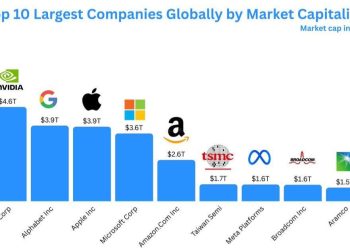
The so-called Magnificent Seven—Alphabet, Amazon, Apple, Meta Platforms, Microsoft, Nvidia and Tesla—have become extraordinarily important to global investment portfolios.
Their combined influence extends well beyond the United States.
European households alone have roughly €440 billion invested in US technology equities, according to the ECB analysis. European pension funds and insurance companies have a similarly significant exposure.
That means a major correction in US technology stocks would not necessarily remain an American market event.
It could affect European household wealth, institutional portfolios and financial conditions.
Europe Could Be Hit Even Without an AI Bubble of Its Own
European equity markets are less exposed directly to the AI boom.
The continent’s stock indexes contain more traditional industries, including banks, industrial companies and other so-called old-economy businesses.
European valuations are also considerably lower than those in the US.
But that does not provide complete protection.
US and European equity markets have historically been highly correlated.
When Wall Street falls sharply, European markets often fall as well.
A US technology correction could therefore damage European investor confidence even if European technology valuations never reach the same extremes.
Financial Stability Is the Bigger Concern
The ECB’s concern goes beyond whether investors lose money.
A normal stock-market correction can be absorbed by financial markets.
A more dangerous scenario would occur if falling AI stocks triggered broader financial instability.
That could happen if losses damaged investor confidence, tightened financing conditions or caused businesses to postpone investment and hiring.
The ECB researchers describe a particularly serious scenario in which an equity correction coincides with broader market instability at a time when policymakers have less room to respond than they did during previous crises.
Policymakers Have Less Room Than During the Dot-Com Era
The comparison with the dot-com bubble is therefore particularly important.
When technology stocks collapsed in the early 2000s, central banks had considerable scope to cut interest rates.
Governments also had more fiscal room to support economic activity.
Today’s policy environment is different.
Higher public debt and other constraints could limit governments’ ability to cushion a major economic downturn.
That makes a large market correction potentially more difficult to manage.
AI Investment Is Still Growing
The warning comes at a time when investors continue to pour capital into AI infrastructure.
Technology companies are spending enormous amounts on data centers, chips and computing capacity.
Recent earnings have reinforced expectations that demand for AI infrastructure remains strong, helping fuel another leg higher in AI-linked equities.
That creates a difficult question for investors.
Are companies spending enough to support a genuinely transformative technology—or are they collectively investing ahead of demand?
If AI revenues ultimately justify the enormous capital expenditure, today’s valuations could prove less excessive.
If returns disappoint, the market could face a sharp repricing.
A Correction Does Not Mean the AI Revolution Is Over
The ECB researchers are careful not to argue that AI itself is doomed.
In fact, they acknowledge that if AI proves sufficiently transformative, valuations could rise further even after a correction.
That distinction is important.
A market correction would represent a change in the price investors are willing to pay for AI-related earnings.
It would not necessarily represent a failure of artificial intelligence.
The technology could continue improving while stocks undergo a substantial adjustment.
The Timing Cannot Be Predicted
Investors should also avoid interpreting the ECB warning as a precise market-timing call.
The researchers explicitly state that the timing of a correction is unknowable in advance.
Booms often look obvious only after they have ended.
That means markets could continue rising for considerably longer before valuations eventually adjust.
The warning is therefore about risk, not a prediction that an immediate crash is imminent.
The Real Question Is Earnings
Ultimately, the sustainability of the AI rally will depend on whether earnings can catch up with expectations.
Investors have already assigned enormous valuations to companies expected to benefit from AI.
For those valuations to remain sustainable, companies must deliver exceptional revenue and profit growth.
If AI produces productivity gains faster than expected, investors may ultimately be justified.
If adoption is slower, costs remain high or competition reduces profit margins, current valuations could become difficult to defend.
Looking Ahead
The ECB’s warning adds an important dimension to the debate over whether the AI boom represents a technological revolution or a financial bubble.
The central bank’s researchers do not argue that AI is fake or that today’s technology companies are destined to collapse.
Instead, they point to a recurring pattern in financial history: revolutionary technologies can create genuine economic value while simultaneously producing excessive stock-market valuations.
That distinction matters.
Investors may be right that artificial intelligence will fundamentally change productivity, business models and the global economy.
But they can still be wrong about how much those future profits are worth today.
The greatest vulnerability is the concentration of AI optimism in a relatively small number of giant US technology companies.
European households, pension funds and insurers have substantial exposure to those companies, meaning a sharp correction could spread across borders.
The ECB estimates that euro-area households alone have around €440 billion invested in the Magnificent Seven, while financial institutions carry similarly significant exposure.
That transforms an American technology-stock correction into a potential European financial-stability issue.
The warning is therefore not simply about Nvidia, Microsoft, Alphabet or other individual companies. It is about concentration, valuation and the growing importance of AI to global financial markets.
If AI delivers extraordinary productivity improvements and corporate profits grow fast enough, today’s valuations may eventually be justified.
But if expectations become impossible to satisfy, investors could demand higher risk premiums and rapidly reduce the prices they are willing to pay.
And because today’s markets are deeply interconnected, the consequences would not stop at Silicon Valley or Wall Street.
The ECB’s message is ultimately one of caution rather than certainty: the AI revolution may be real, but that does not make every price attached to it rational.
History suggests that major technological breakthroughs often generate periods of excessive optimism.
When that optimism eventually changes, corrections can be painful.
The timing remains unknowable, but the potential vulnerability is becoming increasingly difficult for investors and policymakers to ignore.