Autonomous Delivery Company Broadens Its Platform Reach as Competition for Robot-Powered Food Delivery Intensifies
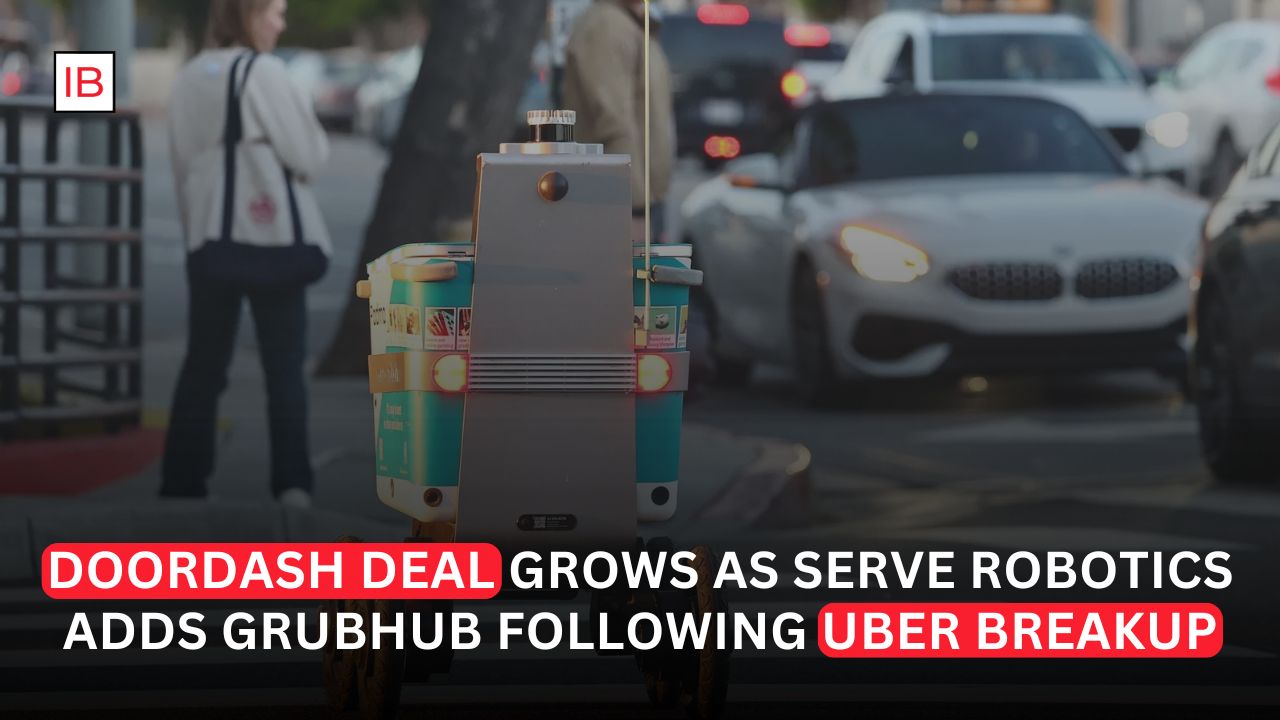
Serve Robotics is expanding its partnership with DoorDash into additional US markets while adding Grubhub to its growing list of food-delivery platforms, strengthening the company’s position in autonomous sidewalk delivery just days after Uber exited its investment and partnership with the robotics company.
The moves represent an important strategic shift for Serve. Rather than relying heavily on a single delivery platform, the company is building a multi-platform model that allows its autonomous robots to serve customers through several major food-delivery applications.
Serve had already added DoorDash alongside Uber Eats, giving it access to a large share of the US food-delivery market. The company said earlier this year that its platform partnerships covered more than 80% of the US food-delivery market.
Now, with Grubhub being added and Uber’s relationship deteriorating, Serve is moving further toward platform diversification.
DoorDash Deal Expands
DoorDash has become increasingly important to Serve’s growth strategy.
The companies initially announced their partnership in 2025, with Serve robots beginning to deliver DoorDash orders in Los Angeles.
The latest expansion takes the relationship into additional cities, allowing more DoorDash customers to receive food through Serve’s autonomous robots.
That expansion is significant because robot utilization is one of the biggest challenges facing autonomous delivery companies.
A robot sitting idle generates little revenue.
A robot continuously moving between restaurants and customers can generate significantly more economic value.
By expanding DoorDash demand into more cities, Serve can potentially increase utilization without having to build an entirely new customer-acquisition system of its own.
Grubhub Adds Another Source of Demand
The addition of Grubhub gives Serve another channel for generating delivery orders.
That diversification becomes particularly important after Uber’s recent decision to sell its entire stake in Serve.
Uber had been one of Serve’s earliest and most important strategic partners. Serve originated as a robotics initiative associated with Postmates before becoming an independent company following Uber’s acquisition of Postmates.
Serve later became publicly traded while maintaining a relationship with Uber Eats.
The company had therefore spent years building its business around Uber’s ecosystem.
The addition of DoorDash and now Grubhub gives Serve an opportunity to reduce that dependence.
Uber’s Exit Changes the Relationship
Uber’s withdrawal has been one of the most important recent developments for Serve.
Uber sold its entire stake in Serve earlier this month, surprising the robotics company and raising questions about the future of their commercial relationship.
The two companies had previously been closely linked.
Serve’s robots were already operating through Uber Eats across several US markets, including Los Angeles, Miami, Dallas-Fort Worth, Atlanta, Chicago, Fort Lauderdale and Alexandria, Virginia.
The end of the investment relationship does not necessarily mean Serve’s robots will immediately disappear from Uber Eats.
But it does remove one of Serve’s most important strategic connections.
That makes the DoorDash and Grubhub expansions much more significant.
Serve Is Becoming Platform-Agnostic
The company’s strategy appears increasingly focused on controlling the robotic delivery infrastructure rather than depending on one particular consumer-facing application.
This distinction is important.
DoorDash owns the customer relationship.
Grubhub owns its own customer relationship.
Uber Eats does the same.
Serve provides the physical delivery layer.
Its robots pick up food from participating restaurants, navigate sidewalks and deliver orders to customers.
That means Serve can potentially become the autonomous equivalent of a logistics provider serving multiple competing platforms.
The Robot Is the Product
Serve’s long-term opportunity rests on the economics of autonomous delivery.
Human couriers represent a major cost in food delivery.
Every order requires someone to travel from the restaurant to the customer.
Autonomous robots can potentially perform some of those short-distance deliveries at a lower marginal cost.
Serve’s robots are designed for sidewalk delivery and operate autonomously in urban environments.
The company reported a 99.8% delivery completion rate across its fleet as it expanded its operations.
That reliability is crucial.
Customers may accept autonomous delivery only if robots can consistently complete deliveries safely and efficiently.
Scale Has Become a Major Priority
Serve has been rapidly increasing the size of its fleet.
The company reached 2,000 deployed robots by the end of 2025 and was operating across 20 cities and six major metropolitan areas.
Its merchant network had also expanded to more than 4,500 restaurant and retail partners.
That represents a dramatic increase from the roughly 400 merchants Serve had a year earlier.
The company is therefore attempting to solve two problems simultaneously:
More robots need more orders, while more orders require sufficient robot capacity.
Adding multiple delivery platforms helps address both sides of that equation.
The Business Is Moving Beyond Food Delivery
Serve is also trying to build a broader robotics business.
In 2025, the company completed acquisitions involving Vayu Robotics, Phantom Auto, Diligent Robotics and Vebu.
Those acquisitions expanded Serve’s technology into areas including physical AI, remote connectivity, healthcare robotics and kitchen automation.
That suggests management does not want Serve to remain solely a food-delivery robot company.
The company is instead trying to build a broader physical-AI platform.
Financial Pressure Remains
Despite the rapid expansion, Serve remains an early-stage company financially.
Its full-year 2025 revenue was only about $2.7 million, although revenue increased sharply from the previous year.
The company raised its 2026 revenue outlook to approximately $26 million and expected about $25 million in capital expenditures for the year.
That gap between current revenue and future expectations illustrates both the opportunity and the risk.
Serve needs to dramatically increase the number of profitable deliveries generated by each robot.
Simply deploying more machines is not enough.
The economics must eventually work at scale.
DoorDash Could Become Especially Important
DoorDash is arguably one of the most valuable partners Serve could have for that scaling strategy.
The company has a massive US customer base and restaurant network.
Serve does not need to convince every customer to download a separate robotics application.
Instead, customers can place an ordinary DoorDash order and potentially have a robot perform the delivery.
That reduces friction.
It also gives Serve access to existing delivery demand.
The same logic applies to Grubhub.
The Competitive Landscape Is Changing
The autonomous-delivery market is becoming increasingly competitive.
Companies are experimenting with sidewalk robots, autonomous vehicles and other forms of automated last-mile logistics.
Food-delivery companies themselves are also exploring automation.
The strategic question is therefore becoming increasingly important:
Will delivery platforms build their own autonomous fleets, or will they rely on specialized robotics companies such as Serve?
Serve’s multi-platform approach suggests the company believes specialization will win.
Rather than competing directly with DoorDash, Grubhub or Uber for consumers, Serve can provide the underlying delivery technology.
Uber’s Departure Creates Both Risk and Opportunity
Uber’s exit is clearly a setback.
Losing a major investor and long-standing commercial partner can reduce demand and create uncertainty around future growth.
But it could also force Serve to become more independent.
The company now has stronger incentives to establish direct relationships with restaurants and other delivery platforms.
Recent investor discussions have focused on Serve’s effort to make it easier for restaurants to use its robots directly, potentially allowing the company to build a more diversified business model.
That could ultimately give Serve greater control over its customer relationships.
Investors Face a High-Risk Growth Story
Serve’s stock remains highly speculative.
Investors are effectively betting that autonomous delivery will become a meaningful part of the global logistics industry.
If robot deployment scales successfully and delivery costs fall, the opportunity could be enormous.
But the company still faces major challenges.
Robots must navigate complicated urban environments.
Cities need to approve and regulate their use.
Customers must accept autonomous deliveries.
Restaurants need to integrate with the technology.
And most importantly, Serve must demonstrate sustainable unit economics.
Physical AI Is the Bigger Opportunity
Serve’s strategy increasingly reflects the broader rise of physical AI.
Large technology companies have spent years developing AI systems that operate in digital environments.
The next frontier is applying AI to the physical world.
Robots that can understand their surroundings, navigate independently and perform useful tasks could become a major technology market.
Food delivery is one of the easiest commercial applications because the task is relatively well-defined.
A robot needs to travel a relatively short distance, carry a limited amount of cargo and reach a specific destination.
If Serve can solve that problem at scale, the same technology could potentially be adapted to other logistics and service applications.
Looking Ahead
Serve Robotics’ expansion with DoorDash and Grubhub represents an important strategic moment for the autonomous-delivery company.
The company is attempting to transform itself from a business closely associated with Uber into a multi-platform robotics provider.
That transition is happening at exactly the moment when Uber has withdrawn its investment and its long-standing relationship with Serve has become increasingly complicated.
The timing is therefore significant.
DoorDash provides Serve with additional demand, while Grubhub gives it another distribution channel. Together, the partnerships could help compensate for some of the uncertainty created by Uber’s departure.
Serve has already demonstrated that it can deploy robots at significant scale.
Its fleet reached 2,000 machines at the end of 2025, while the company expanded to 20 cities and more than 4,500 merchant partners.
But scale alone will not determine whether the strategy succeeds.
The company’s financial performance will ultimately depend on utilization and unit economics.
Its 2026 revenue target of approximately $26 million represents a huge increase from the $2.7 million generated in 2025.
That means Serve needs to turn its rapidly expanding fleet and platform partnerships into substantially higher delivery volumes.
DoorDash and Grubhub could help.
So could Serve’s growing restaurant network and its efforts to diversify beyond food delivery into healthcare and other robotics applications.
The broader opportunity is even larger.
If autonomous robots become a standard part of last-mile logistics, companies controlling the physical infrastructure could become extremely valuable.
Serve is betting that it can occupy that position.
But the company’s path remains risky.
It must compete against other robotics companies, satisfy regulators, maintain reliable operations and secure enough capital to finance continued expansion.
The loss of Uber is a reminder that strategic partnerships can change quickly.
The expansion of DoorDash and the addition of Grubhub show that Serve is trying to make sure it is no longer dependent on any single platform.
That may ultimately prove to be the most important development of all.
Serve’s future may not depend on choosing between Uber, DoorDash or Grubhub.
Instead, its ambition is to become the robotic delivery layer that can work with all of them.
If it succeeds, Serve could move from being a niche autonomous-delivery company to a critical piece of the physical-AI and last-mile logistics ecosystem.
If it fails to achieve sufficient utilization or profitability, however, the enormous cost of building and maintaining a robotic fleet could become a major burden.
For now, the expansion into DoorDash and Grubhub gives Serve another opportunity to prove that autonomous delivery can move from technological demonstration to a scalable commercial business.