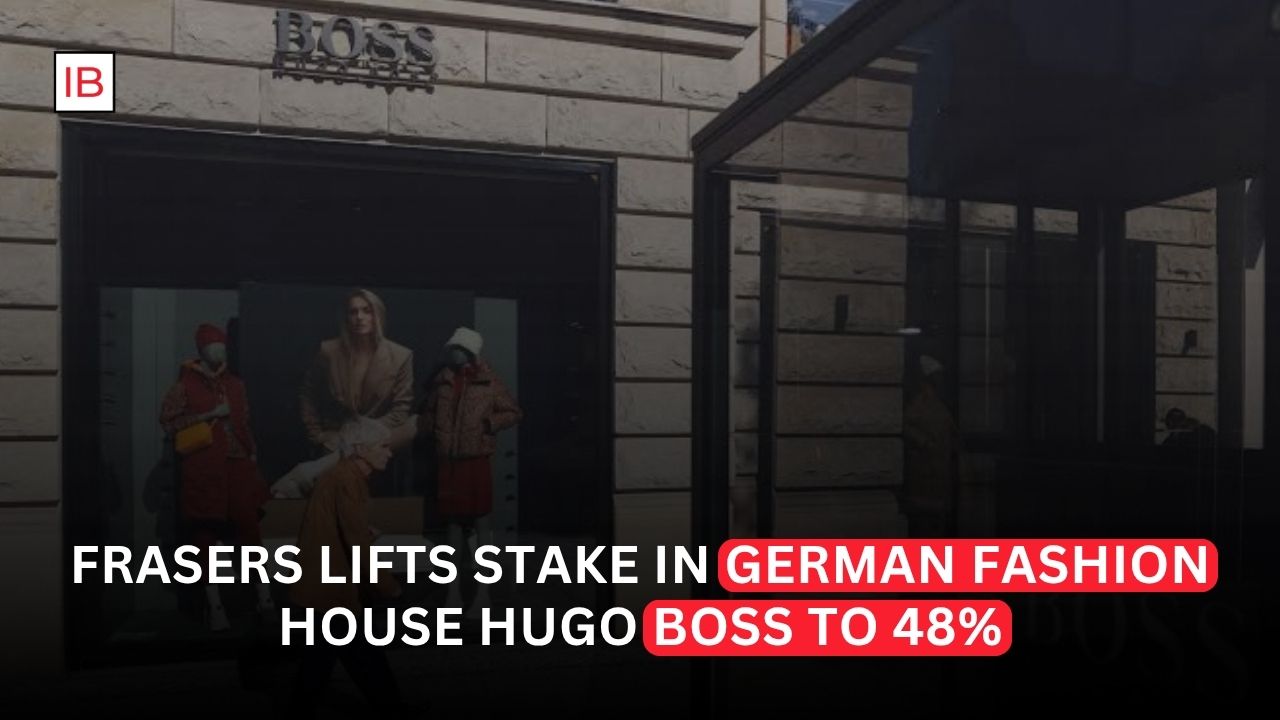
Frasers Group is strengthening its position in Hugo Boss, taking its stake in the German fashion company to about 48% and moving closer to becoming the dominant shareholder in a business it has spent years targeting.
The latest increase is another step in Mike Ashley’s strategy of transforming Frasers from a sports-focused retailer into a broader luxury and premium-fashion group.
But the bigger question is whether accumulating more Hugo Boss shares will create lasting value—or simply increase Frasers’ exposure to a struggling luxury market.
Frasers Is Becoming a Major Force at Hugo Boss
Frasers has steadily built its position in Hugo Boss over several years.
The British retailer had already crossed the 30% threshold in July, reaching about 30.28% after acquiring additional shares following the exercise of put options.
That threshold was important because German takeover rules can trigger an offer requirement once an investor reaches 30%.
Frasers subsequently launched a voluntary cash offer for the rest of Hugo Boss at €38 per share, valuing the shares it did not already own at roughly €2 billion.
The latest move takes its direct and economic interest much further.
Frasers’ growing stake gives it significantly more influence over Hugo Boss’s strategic direction, even though it does not necessarily mean full ownership is imminent.
Why Mike Ashley Wants Hugo Boss
The investment is not simply a financial bet.
Hugo Boss is already an important brand within Frasers’ retail network.
Frasers sells Hugo Boss products through its premium and luxury channels, meaning the company can potentially benefit in two ways from a successful Hugo Boss turnaround.
First, its investment in the fashion company could appreciate.
Second, stronger Hugo Boss products and sales could benefit Frasers’ own retail operations.
That creates a strategic relationship that goes beyond a traditional shareholder position.
Frasers itself has described Hugo Boss as a key brand partner and one of the group’s top five brands.
The Hugo Boss Investment Is a Long-Term Bet
Frasers has repeatedly argued that Hugo Boss is undervalued and has long-term potential.
The company’s formal takeover documents said Frasers believes increasing its investment in Hugo Boss can create value for its shareholders.
That thesis depends heavily on a successful turnaround.
Hugo Boss has already undergone a major repositioning under CEO Daniel Grieder, including efforts to strengthen the brand, improve its product offering and expand its premium positioning.
But the luxury and premium-fashion environment has become more difficult.
Consumer spending has weakened in several major markets, while competition for affluent shoppers has intensified.
That makes the timing of Frasers’ investment important.
Frasers Is Buying Into Luxury During a Downturn
The biggest risk is that Frasers is expanding aggressively into luxury just as the sector is experiencing a prolonged slowdown.
Frasers has recently acquired Harvey Nichols, another major luxury retail name, after the department-store chain entered administration. The deal gives Frasers control of its UK stores, online operations and inventory, while the company has warned that significant restructuring will be necessary.
The company also owns stakes in other premium brands, including Burberry and Mulberry, and has invested in US luxury retailer The Webster.
That means Hugo Boss is not an isolated investment.
It is part of a much larger strategy.
Frasers is effectively attempting to build a luxury ecosystem spanning brands, stores, distribution and customer relationships.
The Strategy Has a Clear Logic
There is an obvious strategic advantage to owning pieces of the brands that you sell.
Frasers can potentially gain:
- Greater access to products
- Stronger relationships with brand owners
- More influence over distribution
- Exposure to brand-level profits
- Better control of retail inventory
- Potential investment gains
This model could become particularly valuable if Frasers succeeds in expanding its luxury retail network.
But there is a catch.
Owning stakes in brands does not automatically make those brands more desirable.
Luxury depends heavily on brand perception, scarcity, pricing power and consumer aspiration.
Those are difficult things for a retailer to manufacture.
Hugo Boss Has Its Own Challenges
Hugo Boss is not a traditional ultra-luxury company.
It operates in the premium fashion segment, competing with a broad range of international brands.
That creates both an opportunity and a problem.
The opportunity is that Hugo Boss has a much larger potential customer base than many ultra-luxury labels.
The problem is that the brand has to remain sufficiently aspirational while also maintaining volume.
Discounting can increase sales in the short term but risks weakening brand positioning.
Frasers understands this tension because its traditional business was built on aggressive retail pricing.
That history has led to questions about whether the company’s approach can translate effectively into luxury.
Frasers Says Luxury Requires a Different Model
Mike Ashley has acknowledged that luxury is fundamentally different from the discount retail model that made him wealthy.
He has argued that luxury brands depend on scarcity and higher pricing rather than simply selling more products at lower prices.
That distinction will be critical for Hugo Boss.
Frasers cannot simply apply the Sports Direct playbook to a premium fashion house.
The value of the brand depends partly on what customers believe the products are worth.
If distribution becomes too broad or promotions become too aggressive, that perception can deteriorate.
Harvey Nichols Adds Another Test
The acquisition of Harvey Nichols makes the Hugo Boss strategy more consequential.
Frasers is now taking responsibility for another luxury business that has struggled financially.
The retailer has warned that it may need to reduce its store portfolio and restructure its operations to return the business to sustainable profitability.
That means Frasers is attempting multiple turnarounds simultaneously.
Hugo Boss requires brand and consumer momentum.
Harvey Nichols requires operational restructuring.
Burberry requires its own turnaround.
The combined strategy could generate significant value if management executes successfully.
But it also increases the consequences of failure.
The Balance Sheet Matters
Frasers has generated substantial operating cash flow and has a relatively strong asset base, but its expansion strategy is not cost-free.
Its FY26 results showed net debt excluding securitisation of about £1.17 billion, up from roughly £848 million a year earlier.
The company also has substantial financing facilities supporting its operations.
That doesn’t mean Frasers is financially distressed.
It does mean investors need to consider whether the company’s acquisition strategy is generating returns fast enough to justify the capital being deployed.
Buying more brands can increase the size of the business without necessarily increasing shareholder value.
Why 48% Is Important
A stake approaching half of Hugo Boss gives Frasers considerable strategic influence.
It also changes the risk-reward profile.
At 20% or 25%, Frasers could be viewed primarily as a strategic investor.
At nearly 50%, its fortunes become much more closely linked to Hugo Boss.
If the brand’s turnaround succeeds, Frasers has enormous exposure to the upside.
If sales remain weak and the fashion market stays difficult, the investment becomes a significant drag.
The company is therefore making a much larger commitment to its luxury thesis.
The Bigger Picture
The Hugo Boss stake is part of Mike Ashley’s attempt to transform Frasers into something much larger than Sports Direct.
The group wants to control more of the premium-fashion value chain rather than simply operate stores.
That means owning or influencing brands, controlling retail space, building international distribution and collecting customer data through its own loyalty and credit platforms.
The strategy could eventually create a powerful vertically integrated luxury retailer.
But there is a fundamental risk:
Retail scale does not guarantee luxury-brand strength.
Frasers can control distribution, but it cannot force consumers to want a brand.
That is why Hugo Boss’s underlying performance will matter far more than the size of Frasers’ stake.
The Bottom Line
Frasers’ move to about 48% of Hugo Boss shows that Mike Ashley is willing to commit significant capital to his luxury strategy even as the sector remains difficult.
The investment makes strategic sense because Hugo Boss is already a major brand partner for Frasers, while greater ownership could give the British retailer more influence and greater exposure to a potential turnaround.
But the strategy carries real execution risk.
Frasers is simultaneously expanding into luxury retail, acquiring distressed businesses and building stakes in major fashion brands.
If Hugo Boss recovers, the rewards could extend across both the investment and retail sides of Frasers.
If the luxury slowdown persists, however, Frasers may discover that owning more of a fashion brand doesn’t solve the harder problem of making consumers buy more of it.