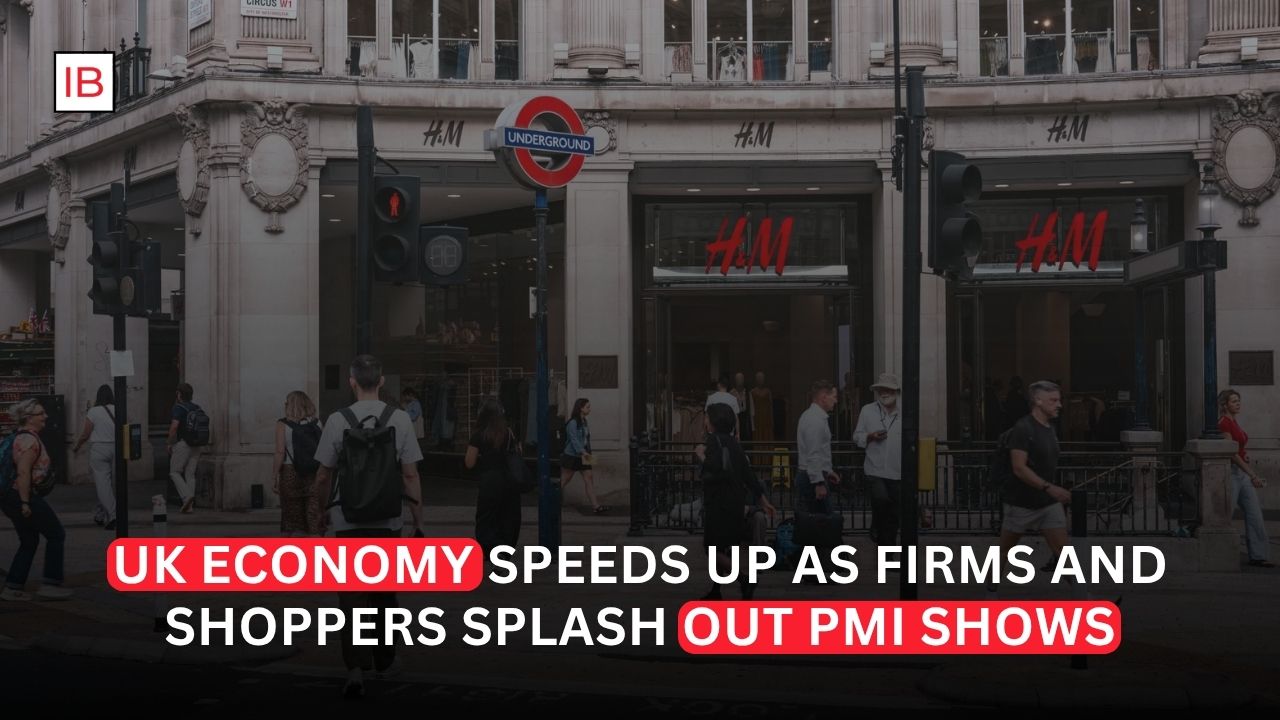
Britain’s economy is showing fresh signs of resilience as businesses and consumers increase spending, helping private-sector activity accelerate in August despite continuing inflation and geopolitical uncertainty.
The latest S&P Global Flash UK PMI showed the services sector expanding at its fastest pace in six months, with the services PMI rising to 52.8 from 52.1 in July. The composite PMI, which combines services and manufacturing, climbed to 52.5, a four-month high. Readings above 50 indicate that economic activity is expanding.
The figures provide a welcome signal for policymakers after concerns that higher energy prices, weak employment and elevated borrowing costs could push the UK economy toward another slowdown.
But the data are not entirely positive.
Businesses are still reducing employment, while inflationary pressures are beginning to build again. That leaves the Bank of England facing the difficult task of supporting growth without allowing renewed price pressures to become entrenched.
Services Sector Leads the Recovery
The strongest part of the August survey was the services economy.
Services account for the largest share of British economic output, meaning their performance has an outsized influence on overall growth.
The services PMI reached 52.8, its highest level since February and comfortably above economists’ expectations for a decline to 51.8.
The improvement suggests that domestic demand is proving stronger than many businesses had feared.
Companies reported better trading conditions, while consumer confidence also improved.
This matters because Britain’s economy is heavily dependent on household spending.
When consumers become more confident about their finances, they are more willing to spend on restaurants, travel, entertainment, retail and other services.
Consumers Are Showing Greater Confidence
Consumer confidence has also strengthened.
The improvement suggests households may be becoming less pessimistic about the economic outlook after a prolonged period of high inflation and weak purchasing power.
However, the recovery in consumer spending should not be exaggerated.
Official retail-sales data showed that UK retail sales fell 0.5% in July after rising 1% in June.
That means the PMI’s stronger picture of consumer demand has not yet translated into consistently strong retail activity.
The difference is important.
Consumers may be spending more on services while remaining cautious about goods.
They may also be benefiting temporarily from better weather, travel activity and other seasonal factors.
Businesses Are Increasing Their Spending
Companies are also contributing to the improvement.
The UK economy has benefited from stronger investment in technology, with the artificial-intelligence boom encouraging businesses to spend on computing equipment, software and other infrastructure.
That investment can improve productivity over time.
It can also create demand for suppliers, professional services and technology companies.
The Bank of England has previously noted that AI-related investment is already influencing business activity, although it expects broader business investment to soften as higher borrowing costs and uncertainty weigh on spending decisions.
This creates an interesting contrast.
Some companies are investing aggressively in technology while remaining cautious about hiring workers.
AI Investment Could Be Supporting Growth
Artificial intelligence is becoming an increasingly important part of Britain’s investment story.
Companies are spending on:
- Software
- Computing equipment
- Data infrastructure
- Automation
- Digital services
- AI-related research
These investments can raise productivity if businesses successfully use the technology to produce more output with fewer resources.
However, there is also a downside.
The Bank of England has reported that AI adoption is gradually reducing demand for some highly automatable jobs, with companies sometimes choosing not to refill vacancies rather than increasing headcount.
That could explain why stronger economic activity has not yet translated into a strong recovery in employment.
The Jobs Market Remains a Weak Spot
Despite the stronger PMI, Britain’s labor market remains under pressure.
Employment across the private sector has been declining for an extended period.
Earlier PMI data showed companies cutting headcount for a 22nd consecutive month, with the services-sector employment downturn reaching a length comparable to the period around the global financial crisis.
That creates an unusual economic situation.
Businesses can be growing while simultaneously reducing their workforce.
The explanation is partly productivity.
Companies may be trying to produce more with fewer employees by investing in technology, restructuring operations and controlling costs.
For workers, however, this means that stronger GDP growth does not necessarily translate into better job prospects.
Manufacturing Is Losing Some Momentum
The services sector provided most of the positive news, while manufacturing was less impressive.
The UK manufacturing PMI fell to 51.5 in August from 52.1 in July.
Although the reading remains above 50 and therefore indicates expansion, the slowdown suggests manufacturers are facing greater challenges.
Higher energy prices are particularly important.
Manufacturing businesses tend to be more exposed to energy costs than many service companies.
The geopolitical situation in the Middle East has pushed energy prices higher, creating additional pressure on companies already dealing with uncertain demand.
Inflation Is Still the Major Problem
The stronger economic data come at an awkward time for the Bank of England.
UK inflation accelerated to 2.9% in July from 2.6% in June, reaching its highest level in four months.
That means policymakers cannot simply celebrate stronger economic activity.
If demand accelerates while inflation is already above the Bank’s 2% target, interest-rate policy becomes more complicated.
The central bank has to determine whether the stronger activity is sustainable or merely temporary.
Energy Prices Could Complicate the Recovery
The biggest threat to the improving outlook may be another energy shock.
Higher oil and gas prices can affect Britain through several channels.
First, households pay more.
Higher energy bills reduce disposable income.
Second, businesses face higher costs.
Companies may respond by raising prices or reducing margins.
Third, inflation rises.
Energy costs feed into transportation, manufacturing and other parts of the economy.
Fourth, demand can weaken.
Consumers may spend less elsewhere because more of their income is going toward essential costs.
This creates the possibility of a damaging combination: higher inflation alongside slower growth.
The Bank of England Has Limited Room to Maneuver
The latest PMI data may make the Bank of England more cautious about cutting interest rates aggressively.
The central bank’s July assessment projected underlying GDP growth of only around 0% in the third quarter, reflecting continued weakness and the effects of the Middle East conflict.
The stronger August PMI therefore represents a meaningful upside surprise.
If the economy continues expanding faster than expected, policymakers may have less reason to reduce rates quickly.
But the opposite argument remains valid.
If inflationary pressure is primarily caused by energy costs rather than excessive domestic demand, raising rates would not solve the underlying problem.
The Bank therefore has to distinguish between demand-driven inflation and supply-driven inflation.
Business Optimism Is Improving
One encouraging aspect of the August survey is that business optimism improved.
Companies appear more confident about future activity than they were earlier in the summer.
That can become self-reinforcing.
Higher confidence can encourage businesses to invest.
More investment can increase productivity and demand.
Stronger demand can encourage additional investment.
The problem is that confidence can also disappear quickly if geopolitical tensions intensify or energy prices continue rising.
Britain May Avoid a Sharp Slowdown
The latest data suggest that fears of an immediate economic contraction may have been overstated.
The services sector is expanding.
Consumers are showing greater confidence.
Businesses are investing in technology.
Overall private-sector activity is growing.
That makes a severe short-term downturn less likely.
However, it would be premature to describe Britain as entering a powerful economic boom.
Growth remains modest.
Employment is weak.
Inflation is still elevated.
And the external environment remains highly uncertain.
The better description is resilience rather than acceleration into a major expansion.
Why the PMI Matters
PMI surveys are closely watched because they provide an early indication of economic conditions before official GDP data become available.
A reading above 50 indicates expansion, while a reading below 50 indicates contraction.
The August composite reading of 52.5 therefore provides evidence that private-sector activity is continuing to grow.
Investors will now look to upcoming official data to determine whether the improvement is reflected in actual economic output.
If it is, markets may begin revising upward their expectations for UK growth.
What Investors Should Watch Next
Several indicators will determine whether the August improvement lasts.
Consumer spending
Continued household spending would support services and retail businesses.
Employment
A sustained recovery in hiring would make the expansion more convincing.
Inflation
If inflation continues rising, the Bank of England may remain cautious.
Energy prices
Higher oil and gas prices could undermine household purchasing power.
Business investment
Continued technology investment would strengthen productivity prospects.
Interest rates
Monetary policy will influence both consumers and companies.
The Bigger Economic Picture
Britain is entering a period in which growth, inflation and productivity are moving in conflicting directions.
On one side, businesses are investing in technology and consumers appear more confident.
On the other, companies remain cautious about hiring and inflation has begun accelerating again.
That creates an unusual economic environment.
The UK may be able to grow without generating a corresponding boom in employment if businesses increasingly rely on technology and productivity improvements.
That could be positive for corporate profits but less beneficial for workers.
Conclusion
The latest PMI data provide a stronger picture of the UK economy than many expected.
Services activity accelerated in August, reaching a six-month high of 52.8, while the composite PMI climbed to 52.5.
Businesses are reporting better domestic conditions, consumer confidence has improved and technology investment is helping support economic activity.
But the recovery remains fragile.
Manufacturing growth has slowed, employment continues to weaken and inflation has risen again.
Energy prices present another significant risk, particularly if geopolitical tensions keep them elevated.
For the Bank of England, the data make the policy outlook more complicated.
A stronger economy reduces the urgency for aggressive rate cuts, but supply-driven inflation makes higher borrowing costs an imperfect solution.
The key question is whether Britain’s improving activity can continue without generating another wave of inflation.
If consumers keep spending, businesses maintain investment and energy prices stabilize, the UK could enter the second half of 2026 with considerably more momentum than expected.
If inflation continues rising and companies respond by cutting jobs and investment, the current improvement could prove temporary.
For now, the PMI delivers a clear message: Britain’s economy is showing resilience, with businesses and consumers spending more, but the recovery still faces significant inflation and employment risks.