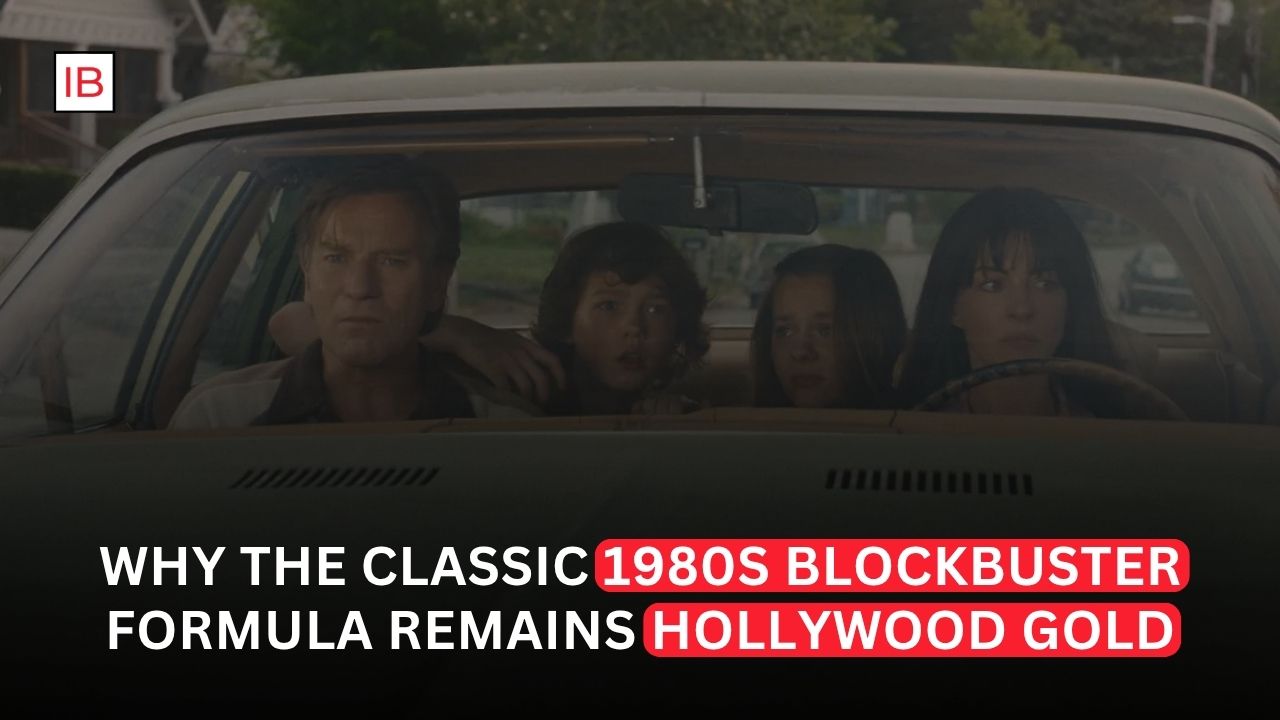
The End of Oak Street is built around a premise that sounds deliberately pulled from another era of Hollywood: an ordinary suburban family, an apparently perfect American neighborhood, strange supernatural forces and a sudden encounter with something far bigger and more terrifying than everyday domestic problems.
Directed by David Robert Mitchell and starring Anne Hathaway and Ewan McGregor, the 2026 film places a 1982 suburban neighborhood in extraordinary circumstances when a mysterious event transports it into a prehistoric world filled with dinosaurs. The movie combines family drama with science-fiction survival and clearly draws on the filmmaking language associated with Steven Spielberg’s 1980s work.
But the interesting question is not simply whether Mitchell has copied Spielberg.
The more important question is why Hollywood keeps returning to this formula — and whether audiences still want it.
The Spielberg Formula Still Has Power
Steven Spielberg’s most influential films were rarely just about their spectacular premises.
The aliens in E.T., the dinosaurs in Jurassic Park and the supernatural elements of Poltergeist worked because they were placed inside recognizable environments.
The extraordinary entered the ordinary.
That contrast was essential.
A suburban house was familiar. A family argument was familiar. Children worrying about their parents was familiar.
Then something impossible happened.
The End of Oak Street follows essentially the same structural idea.
The Platt family begins with ordinary domestic problems before the neighborhood itself becomes the center of an extraordinary survival story. The film therefore uses the family as an emotional anchor while dinosaurs provide the spectacle.
That combination is one of Spielberg’s most enduring contributions to blockbuster filmmaking.
Why the 1980s Setting Matters
The decision to set the story in 1982 is not accidental.
The early 1980s represent a particular version of American suburbia that Hollywood has repeatedly transformed into a nostalgic fantasy.
The houses are familiar.
The neighborhoods appear safe.
Children ride bicycles.
Families gather around dinner tables.
The outside world seems distant.
That image provides a perfect foundation for a horror or adventure story.
The safer the environment looks, the more dramatic its destruction becomes.
The film’s setting also deliberately connects it with Spielberg’s E.T. and Poltergeist, both of which emerged during the same cultural period.
A Family Crisis Before the Dinosaurs Arrive
The movie does not begin with dinosaurs simply appearing for spectacle.
The Platt family is already experiencing emotional problems.
Denise, played by Anne Hathaway, is dealing with a strained marriage, while the family’s children are caught between their parents’ problems and their own fears.
That is classic Spielberg territory.
The external threat becomes a physical representation of an internal family crisis.
The family cannot simply survive individually.
They have to cooperate.
That gives the spectacle an emotional purpose.
Without that family structure, the dinosaur sequences could become little more than expensive visual effects.
The Movie Flips the Jurassic Park Concept
One of the more interesting aspects of the premise is that humans are not deliberately traveling into a dinosaur environment.
The environment comes to them.
The entire suburban neighborhood is displaced into the prehistoric past.
That reverses the basic structure of Jurassic Park.
In Spielberg’s film, humans enter an artificial dinosaur environment.
Here, an artificial-looking suburban environment is suddenly placed inside the dinosaur world.
That creates visual comedy as well as danger.
A quiet residential street becomes a prehistoric hunting ground.
A family home becomes a potential shelter.
Cars and suburban objects become survival tools.
The familiar becomes strange.
The Dinosaurs Are More Than Monsters
The dinosaurs are obviously there to provide action.
But they also destroy the illusion of suburban safety.
The neighborhood represents order.
The prehistoric world represents chaos.
Once the two collide, the characters discover how fragile their comfortable existence actually was.
This is one reason the film can be read as more than a straightforward creature feature.
The prehistoric environment strips away the conveniences that define modern suburban life.
Food becomes scarce.
Technology becomes less useful.
Physical strength becomes important.
Family cooperation becomes essential.
The characters are forced to confront a world where their social status and possessions mean almost nothing.
Anne Hathaway Carries the Emotional Center
Anne Hathaway’s Denise is positioned at the center of the story.
That matters because the movie could easily have become dominated by its dinosaurs.
Instead, Denise gives the audience someone to follow emotionally.
Reviews have particularly highlighted Hathaway’s performance and the way the character combines vulnerability with determination.
Her character is not simply trying to escape monsters.
She is trying to protect her children while dealing with a collapsing relationship.
The external survival story therefore becomes connected to a personal struggle.
Ewan McGregor’s Character Represents the Family’s Emotional Conflict
Ewan McGregor plays Greg, Denise’s husband.
Their relationship is already under strain when the extraordinary events begin.
That gives the film another familiar Spielberg-style device: a family that is emotionally divided must physically come together.
The survival situation forces the characters to reconsider what actually matters.
It is a simple structure.
It is also one that Hollywood has used repeatedly because it works.
The danger outside becomes a reason to resolve the conflict inside.
J.J. Abrams’ Involvement Makes the Formula Even More Obvious
The movie is produced by J.J. Abrams, a filmmaker whose own career has frequently interacted with the Spielberg tradition.
Abrams has long been associated with projects that combine mystery, nostalgia, youthful adventure and large-scale genre entertainment.
His involvement makes the film’s throwback quality less surprising.
The result is a movie consciously positioned between modern blockbuster filmmaking and the emotional grammar of 1980s Amblin cinema.
That is not necessarily a criticism.
It is the film’s basic identity.
The Real Problem: Nostalgia Can Become Formula
Here is where the movie’s biggest weakness appears.
Nostalgia is useful when it adds meaning.
It becomes less effective when it simply reproduces familiar imagery.
There is a legitimate criticism that The End of Oak Street relies too heavily on a formula audiences have already seen many times.
Critics have described it as a Spielberg homage, while some have gone further and argued that its nostalgia feels recycled.
That criticism should not be dismissed.
The film has:
- A suburban family
- Troubled parents
- Children caught in the middle
- An extraordinary event
- Dinosaurs
- 1980s Americana
- Spielberg-style adventure
- Emotional reconciliation
Almost every ingredient is recognizable.
The question is whether Mitchell adds enough of his own voice.
David Robert Mitchell Brings Something Darker
This is where the film becomes more interesting.
Mitchell is not Spielberg.
His earlier work, particularly It Follows and Under the Silver Lake, has been associated with alienation, uncertainty and psychological unease.
That sensibility appears to remain present here.
The film may look like a conventional family adventure on the surface, but there is something stranger underneath it.
Reviews have noted the tension between Spielberg’s warmth and Mitchell’s more detached, unsettling style.
That creates an unusual combination.
The movie wants to be comforting and frightening at the same time.
The Film Is Nostalgic but Not Entirely Comfortable
The nostalgic surface is important because it makes the destruction of the neighborhood more disturbing.
The audience recognizes the setting.
But Mitchell repeatedly reminds viewers that nostalgia is constructed.
The supposedly perfect suburban world is already full of marital problems, anxiety and dissatisfaction before the dinosaurs arrive.
That undermines the idea that the past was actually simpler.
The movie therefore has a tension at its center.
It celebrates the Spielberg era while also questioning the fantasy that era represented.
Why Spielberg’s Formula Still Works
Despite the criticism, there is a reason filmmakers keep returning to this structure.
The formula connects spectacle to emotion.
A giant monster alone is not enough.
A family alone is not enough.
But combine them and the stakes become immediately understandable.
The audience does not need a complicated explanation for why survival matters.
Protecting your family is enough.
That emotional simplicity is one reason Spielberg’s films remain influential decades later.
The Difference Between Homage and Imitation
This is the central artistic question surrounding The End of Oak Street.
An homage takes an old formula and uses it to say something new.
An imitation simply recreates the formula.
The film appears to sit somewhere between the two.
Some critics see enough of Mitchell’s own style to make the movie distinctive.
Others see a nostalgic exercise that depends too heavily on Spielberg’s visual and emotional vocabulary.
That disagreement is important.
If audiences walk away remembering only Spielberg and Jurassic Park, Mitchell’s movie has a problem.
If they remember the unusual combination of suburban anxiety, dinosaurs and time displacement, then the experiment has worked.
The Film Also Reflects Hollywood’s Nostalgia Problem
The broader significance of The End of Oak Street extends beyond one movie.
Hollywood has increasingly turned to recognizable intellectual property and nostalgic formulas.
Studios know audiences understand familiar concepts.
A 1980s suburban setting requires less explanation.
A Spielberg-style family adventure immediately communicates its tone.
Dinosaurs communicate spectacle.
Anne Hathaway and Ewan McGregor communicate star power.
This makes the film commercially understandable.
But it can also make modern Hollywood feel trapped in its own past.
Why Originality Is Becoming More Difficult
There is an irony here.
The End of Oak Street is technically an original story.
It is not another sequel to Jurassic Park.
It is not a remake of E.T.
It has its own characters and premise.
Yet its cultural references are so recognizable that it can still feel familiar.
That illustrates how difficult originality has become.
A movie does not need to copy a specific story to feel derivative.
It can reproduce an entire filmmaking language.
The Emotional Ending Matters
The film’s ending also demonstrates Hollywood’s preference for emotional closure.
The story reportedly went through changes during production, including a different approach to Greg’s fate. The final version moves toward family reunion and emotional resolution rather than leaving the characters in complete despair.
That choice fits the Spielberg tradition.
The extraordinary event ultimately leads back to the family.
The adventure changes them.
But it does not necessarily destroy the emotional world they came from.
That is part of what makes the formula accessible to broad audiences.
Why the Formula May Still Work in 2026
There is another reason the movie’s nostalgic approach may resonate now.
The modern world is increasingly defined by uncertainty.
Technology changes rapidly.
Political divisions remain intense.
Economic pressures affect families.
Artificial intelligence is reshaping expectations about work and society.
Against that background, an imagined 1982 suburban America can look comforting.
The movie offers a fantasy of a world that seems easier to understand.
Then it destroys that fantasy with dinosaurs.
That contradiction may be exactly why the film feels relevant despite its backward-looking style.
The Biggest Risk Is Over-Nostalgia
The strongest criticism remains the simplest one.
Hollywood cannot endlessly recycle the emotional language of the 1980s without eventually exhausting it.
The same suburban houses.
The same family conflicts.
The same bicycles.
The same mysterious events.
The same sentimental resolutions.
At some point, nostalgia stops being a creative tool and becomes a substitute for creativity.
Some critics have explicitly argued that The End of Oak Street represents this exhaustion of Spielberg-inspired nostalgia.
That argument deserves serious consideration.
But the Movie Understands Why the Formula Works
At the same time, dismissing the movie as simple nostalgia would miss something.
The Spielberg formula survived because it solves a difficult storytelling problem.
It combines enormous spectacle with ordinary human emotion.
The audience can watch dinosaurs destroy a suburban neighborhood while still caring about whether a family can stay together.
That combination is difficult to achieve.
Mitchell clearly understands that.
His challenge is making the formula feel like a living storytelling structure rather than a museum exhibit.
Conclusion
The End of Oak Street is clearly indebted to the Hollywood tradition Steven Spielberg helped define.
Its 1982 setting, suburban family, extraordinary disruption and dinosaur spectacle deliberately recall the emotional architecture of films such as E.T., Poltergeist and Jurassic Park.
But the movie is more interesting than a simple Spielberg imitation.
David Robert Mitchell brings a darker and more alienated sensibility to the formula, creating tension between warm family adventure and unsettling science-fiction survival.
That tension is both the film’s greatest strength and its greatest weakness.
When the Spielberg formula works, it makes spectacular events emotionally meaningful.
When it fails, it becomes nostalgia without substance.
The End of Oak Street walks directly along that line.
Its dinosaurs provide the spectacle, but the family provides the reason to care.
Its 1980s setting provides nostalgia, but the family’s problems remind viewers that the past was never as perfect as nostalgia suggests.
And its Spielberg-inspired structure provides familiarity, while Mitchell’s darker perspective attempts to give that familiar structure a new identity.
Whether audiences see the film as a refreshing return to old-fashioned blockbuster filmmaking or another example of Hollywood struggling to move beyond the 1980s will depend largely on how much they value nostalgia.
The more important question, however, is whether the movie can make audiences care about its characters after the dinosaurs disappear.
That is the real test of the Spielberg formula.