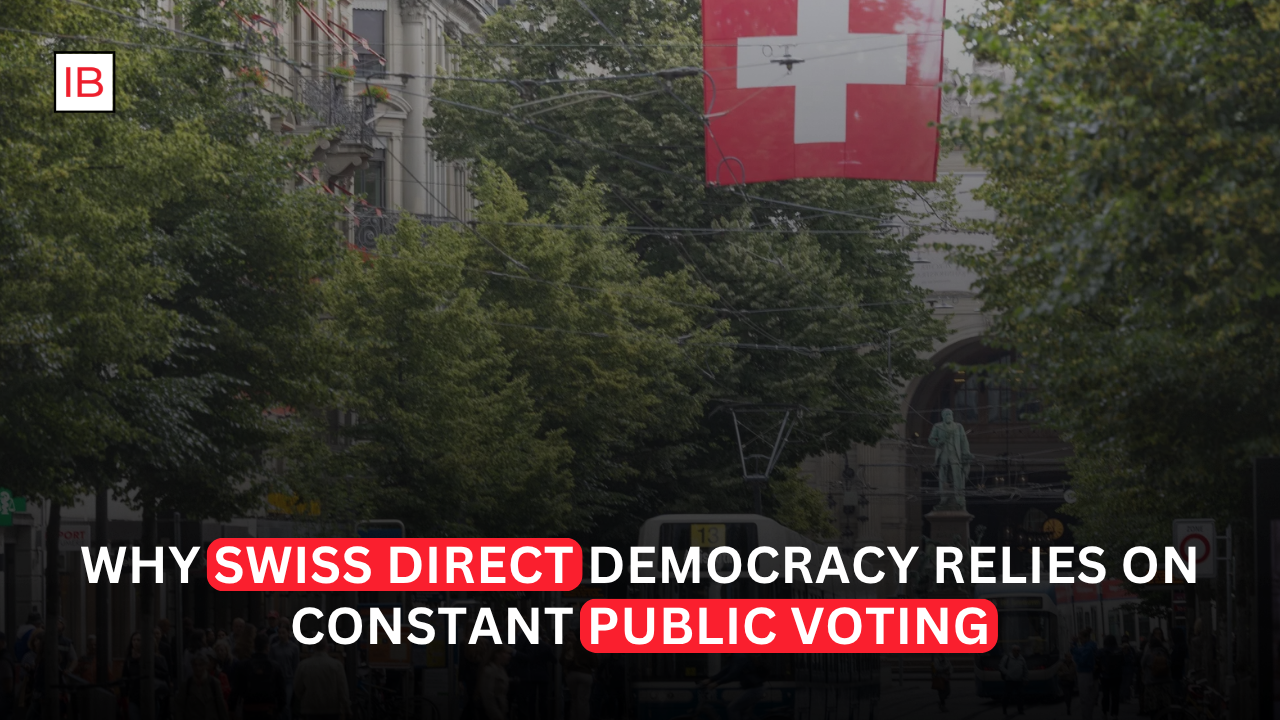
Switzerland is unusual among wealthy democracies because voters are not asked to choose their political representatives and then simply wait for the next election. Citizens can intervene directly in policymaking through popular initiatives and referendums, giving them a regular opportunity to challenge laws, propose constitutional changes and influence national policy. The system is one of the defining features of Swiss political life.
That helps explain why Swiss voters repeatedly find themselves deciding questions that, in many other countries, would be left almost entirely to parliament or the government.
Food policy, immigration, taxes, pensions, environmental rules, healthcare and even questions about neutrality can all reach the ballot box.
The result is a political system in which voting is not an occasional event. It is a recurring part of governing.
Switzerland’s Direct-Democracy Machine
Switzerland combines representative government with unusually strong direct-democracy mechanisms.
Citizens elect parliament, but they also retain tools that allow them to challenge political decisions or propose constitutional changes.
The two most important instruments are referendums and popular initiatives.
A referendum can allow voters to approve or reject certain decisions made by parliament. A popular initiative works differently: citizens can propose an amendment to the federal constitution themselves.
That distinction is important.
Swiss voters are not simply being asked whether they like the government.
They can intervene on individual policy questions.
How a Popular Initiative Works
The popular initiative is one of the most powerful tools available to Swiss citizens.
To bring a federal popular initiative to a vote, campaigners generally need to collect 100,000 valid signatures within 18 months. If the initiative reaches the required threshold, it proceeds through the political process and can eventually be put before voters.
This creates a political incentive that does not exist in most countries.
If a group believes parliament is ignoring an issue, it does not necessarily have to wait for the next election.
It can try to build public support and force the issue onto the national agenda.
That gives political movements, campaign organizations and ordinary citizens an unusually direct route into policymaking.
Why Switzerland Votes So Often
Federal popular votes are held several times a year.
Switzerland’s system has historically produced an average of roughly four federal voting dates annually, although the number of individual questions placed before voters varies.
In 2026 alone, federal voting dates have been scheduled across multiple months, with another national vote scheduled for September 27. The Swiss government’s official voting calendar lists the September ballot as containing two proposals.
This is why describing Switzerland as a country that is “always voting” is not entirely exaggerated.
There is almost always another issue moving through the political pipeline.
Politics Does Not Disappear Between Elections
In many democracies, political participation peaks around elections.
Citizens vote for representatives and then political activity largely shifts toward parliament, government agencies and political parties.
Switzerland works differently.
Political campaigns can continue between elections because groups know that a specific issue may eventually reach a public vote.
That keeps citizens engaged.
But it also means political debates can become permanent.
A tax proposal may be followed by an environmental initiative, which may be followed by a healthcare referendum, which may then be followed by an immigration proposal.
The political calendar rarely becomes completely quiet.
The System Gives Citizens Real Power
The strongest argument for Swiss direct democracy is straightforward.
Citizens have meaningful ways to influence policy between elections.
If parliament passes a controversial law, voters may have a mechanism to challenge it.
If politicians refuse to act on an issue, campaigners can potentially launch an initiative.
That creates pressure on elected officials.
They know that unpopular decisions may not simply disappear after a parliamentary vote.
Voters can potentially come back and challenge them.
This can make politicians more responsive.
But Direct Democracy Also Changes How Politicians Govern
The system creates a second effect that is less obvious.
Politicians often have to anticipate what voters will accept before legislation is finalized.
That can encourage compromise.
If a government knows a controversial measure could face a referendum, it has an incentive to negotiate with opponents and modify the proposal.
In that sense, direct democracy does not necessarily mean constant conflict.
It can actually encourage politicians to compromise before conflict reaches the ballot box.
The Referendum Can Act as a Political Brake
There is, however, a major downside.
Direct democracy can make significant reforms slower.
A government may spend years designing legislation only to face a referendum campaign that threatens to overturn it.
That uncertainty can make policymaking more complicated.
Businesses may have to consider the possibility that rules could change.
Government departments may have to prepare for multiple outcomes.
Political parties may campaign against their own government’s policies.
The system therefore sacrifices some speed for greater public involvement.
Switzerland’s Constitutional System Makes Initiatives Especially Powerful
The most important initiatives can change the constitution.
That is unusually significant.
A constitutional amendment normally sits at a higher level than ordinary legislation.
In Switzerland, however, citizens can propose constitutional changes through the popular-initiative system.
This means campaigns can seek to turn political demands into constitutional principles.
The consequences can be long-lasting.
Once voters approve a constitutional amendment, future governments have to operate within the new framework.
The Double-Majority Requirement
There is also an important safeguard.
For constitutional changes, Switzerland generally requires both a majority of voters nationwide and a majority of the cantons — the country’s states.
This is known as the double majority.
The system prevents a proposal from succeeding solely because it has strong support in Switzerland’s largest population centers.
Rural and smaller cantons retain significant influence.
That is an important feature of Swiss federalism.
Small Cantons Matter
A proposal might win a majority of individual voters but still fail if it does not secure the required cantonal support.
This means political campaigns cannot focus only on Zurich, Geneva, Basel or other major population centers.
They have to build broader geographic coalitions.
That can encourage moderation.
A proposal that appeals strongly to urban voters but is unpopular in rural areas may struggle to pass.
The political system therefore creates another incentive for compromise.
The Food Debate Is a Perfect Example
The current debate over Switzerland’s food system demonstrates how far the direct-democracy model can reach.
The upcoming September 27 vote includes a proposal aimed at increasing food security, encouraging more plant-based production and consumption and strengthening protections for drinking water, soil and biodiversity. Recent polling suggests the initiative currently faces substantial opposition.
In many countries, such a policy would probably be debated inside parliament and government ministries.
In Switzerland, voters can ultimately have the final say.
That is the system working exactly as designed.
Neutrality Can Also Reach the Ballot Box
The same September vote illustrates how broad Swiss direct democracy can become.
Voters are also being asked to consider an initiative that would impose a stricter constitutional definition of Swiss neutrality.
The proposal would define neutrality as “perpetual and armed” and impose restrictions on military cooperation and sanctions, with limited exceptions. Recent polling indicates that the measure currently faces strong opposition.
This is not a minor administrative question.
It concerns Switzerland’s position in the international security system.
Yet it can still become a question for voters.
The System Creates Permanent Campaigning
The downside is obvious.
Political groups have a reason to keep campaigning even after elections.
Every initiative needs signatures.
Every referendum needs supporters.
Every ballot requires public persuasion.
That creates a political culture where campaigns can become continuous.
Politicians have to think not only about winning elections but also about winning individual policy battles.
For voters, this creates more opportunities for participation.
For governments, it creates another layer of uncertainty.
It Can Make Voters More Informed — But Not Automatically
Frequent voting can encourage citizens to learn about specific policy questions.
People are regularly presented with arguments from campaign groups, government officials, business organizations and civil-society groups.
But more voting does not automatically mean better-informed voters.
Complex policy questions can be reduced to simple slogans.
Campaigns can emphasize emotional issues.
Political organizations can spend heavily to influence public opinion.
The same direct-democracy mechanism that gives voters more power can therefore also create opportunities for misinformation or oversimplification.
The System Encourages Political Compromise
One of the strongest arguments in favor of Swiss direct democracy is that politicians know they cannot ignore public opinion indefinitely.
A government may technically have enough parliamentary votes to pass legislation.
But if the legislation is deeply unpopular, opponents can potentially challenge it.
That creates an incentive to negotiate.
Political parties may seek compromise before legislation reaches the referendum stage.
This can produce a slower but more consensual style of politics.
But Compromise Can Also Dilute Reform
The same mechanism has another side.
A proposal may begin as a major reform but emerge from political negotiations as something much weaker.
Politicians may remove controversial elements to make it more acceptable to voters.
That can prevent radical changes.
But it can also make genuine structural reforms harder to implement.
In other words, direct democracy can protect stability while making transformation more difficult.
Switzerland Has Built a Political Pressure Valve
There is a deeper reason the system has remained important.
Switzerland is a country with multiple languages, regions, religious traditions and political identities.
Direct democracy provides groups with a way to express disagreements without necessarily leaving the political system.
If a minority strongly opposes a policy, it has institutional mechanisms for fighting it.
That can make political conflict more manageable.
Instead of taking place entirely through street protests or party warfare, disputes can be transferred into formal campaigns and votes.
Why Politicians Cannot Simply Ignore Defeats
Another feature of the system is that political parties can lose individual votes without necessarily losing government.
A party may oppose a proposal and lose.
The government can continue functioning.
That separates policy battles from the question of who controls the entire state.
In countries where every political disagreement becomes an election-level confrontation, this can be valuable.
Swiss voters can reject a policy without having to replace the entire government.
It Also Makes Politics More Personal
The opposite risk is voter fatigue.
If citizens are asked to decide on numerous proposals every year, not everyone will have the time or interest to study every issue.
That can increase the importance of political parties, campaign organizations and trusted institutions that explain the choices.
The system therefore creates a paradox.
It gives individual citizens more direct power.
But citizens may rely more heavily on organized groups to understand what they are voting on.
Turnout Is Not Always Extremely High
Frequent voting also means citizens do not necessarily participate in every ballot.
If voting happened only once every four or five years, citizens might treat the election as a major political event.
When votes happen regularly, individual ballots can feel less significant.
That can produce varying turnout depending on the importance of the issue.
High-profile questions can attract considerable attention.
Technical or less controversial issues may receive less engagement.
The Swiss Model Is Difficult to Copy
Other democracies sometimes look at Switzerland and wonder whether they should adopt more referendums.
But the Swiss model is not simply a voting mechanism.
It is an entire political culture.
It depends on:
- Federalism
- Strong institutions
- Political parties
- Organized civil society
- Long-established voting traditions
- Regular public consultation
- Constitutional rules
- A culture of compromise
Simply adding more referendums to another country’s political system would not automatically reproduce the Swiss outcome.
Direct Democracy Versus Representative Democracy
The debate ultimately comes down to a basic question.
Who should make political decisions?
In a representative system, citizens primarily choose politicians and allow those politicians to govern.
In Switzerland, citizens retain additional opportunities to intervene directly.
Neither system is perfect.
Representative democracy allows governments to make complicated decisions efficiently.
Direct democracy gives citizens greater control over individual policies.
Switzerland has chosen to combine both.
The Real Swiss Trade-Off
The country’s system offers a clear exchange.
More voter power comes with less political speed.
Citizens gain more opportunities to challenge decisions.
Governments lose some freedom to act quickly.
Politicians become more accountable.
But major reforms can take longer.
Public participation increases.
Political campaigning becomes more constant.
That trade-off is not an accident.
It is the basic design of the Swiss model.
Why Switzerland Keeps Voting
The answer, therefore, is not simply that Swiss politicians like referendums.
The system was deliberately built to give citizens recurring influence over political decisions.
Popular initiatives allow citizens to propose constitutional changes, while referendums give them mechanisms to approve or reject certain parliamentary decisions.
That creates a political system where elections are only one part of democracy.
The ballot box remains active between elections.
Conclusion
Switzerland keeps voting because its political system treats citizens not only as voters who choose representatives but also as participants who can directly intervene in policymaking.
That gives Swiss citizens unusual power.
They can challenge laws, propose constitutional changes and vote on major national questions.
The advantage is accountability.
Politicians know that controversial decisions can be challenged.
The system can encourage compromise and prevent governments from moving too far ahead of public opinion.
But the cost is complexity.
Reforms can take longer.
Campaigns can become permanent.
Voters can experience fatigue.
And complicated questions can be reduced to simple yes-or-no choices.
Switzerland has effectively accepted that trade-off.
Its political model prioritizes participation and consent over speed.
That is why questions about food, immigration, taxes, environmental rules and national security can repeatedly end up on the same ballot.
The deeper lesson is that Swiss direct democracy is not really about voting “on everything.”
It is about ensuring that politicians never have complete control over the political agenda.
Swiss voters may not run the government themselves, but they have unusually powerful tools for telling the government where the limits are.