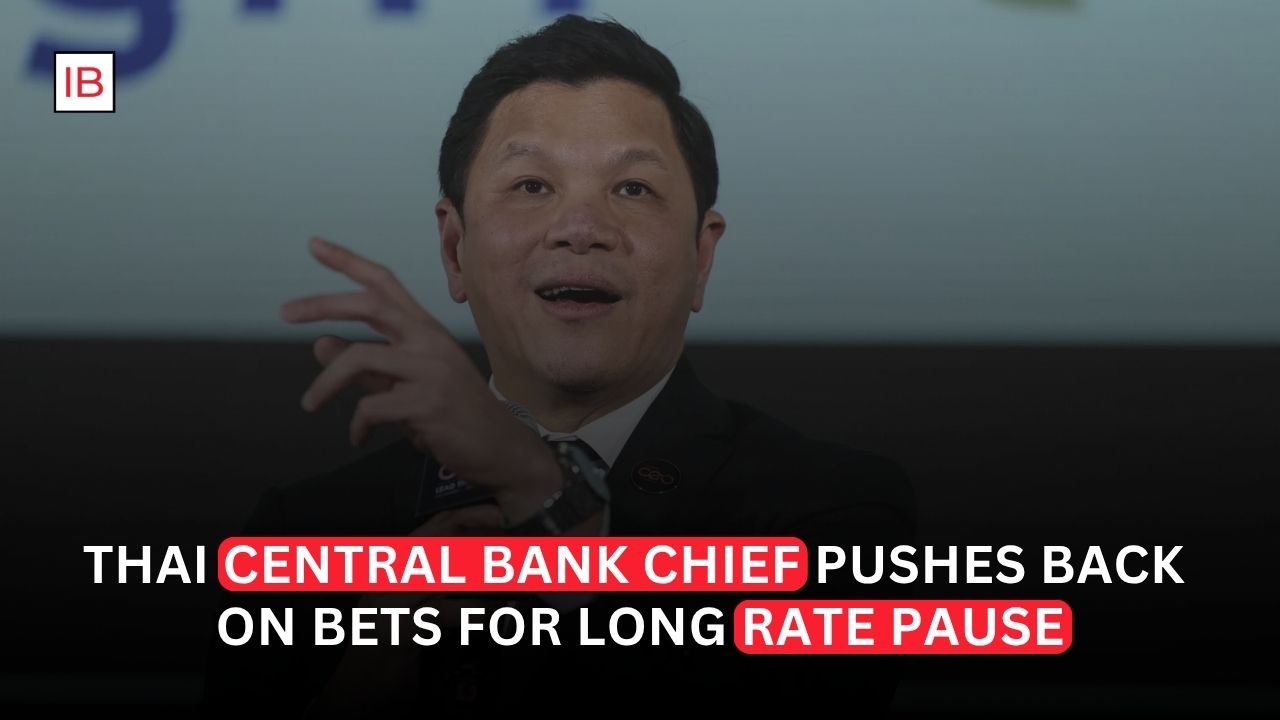
The Bank of Thailand is pushing back against expectations that its benchmark interest rate will remain unchanged for an extended period, warning that economic and inflation risks could force policymakers to reconsider their stance.
The central bank left its policy rate unchanged at 1% on Aug. 26, marking the third consecutive meeting at that level. The decision was unanimous and broadly expected by economists. But the message from policymakers was more complicated than a simple commitment to keep rates unchanged.
Thailand’s central bank is trying to balance weak domestic demand and sluggish growth against renewed inflation risks, volatile energy prices and geopolitical uncertainty. That makes it difficult for policymakers to provide the kind of forward guidance investors increasingly want.
Rate Held at 1%
The Bank of Thailand has kept its benchmark rate at 1% since February.
At its latest meeting, the Monetary Policy Committee said the current level remained appropriate for supporting economic recovery. It also emphasized that growth remained low and uneven, even though technology and artificial-intelligence investment has provided some momentum to exports and private investment.
The decision itself was not surprising.
Economists had widely expected the central bank to leave borrowing costs unchanged.
What matters more for financial markets is what happens next.
Investors have increasingly been betting that Thailand could enter a prolonged period of unchanged rates because the economy remains weak and inflation is relatively contained.
Officials, however, are warning against treating the current rate as a permanent destination.
Why Policymakers Are Cautious
Thailand faces an unusual combination of economic problems.
Growth is weak enough to justify keeping monetary policy accommodative, but inflation is expected to rise during the remainder of 2026 and into early 2027.
The Bank of Thailand said headline inflation is expected to increase through the first quarter of next year because of factors including El Niño and gradual pass-through of higher costs. After that, inflation is expected to fall again as weak domestic demand weighs on prices.
That creates a difficult policy environment.
If the central bank cuts rates too aggressively, it could encourage financial instability or put additional pressure on the currency.
If it keeps rates too high for too long, it could further weaken households and businesses already struggling with soft demand.
Inflation Is Not Completely Defeated
Thailand’s inflation situation looks relatively manageable compared with many other economies.
But the central bank is not treating low inflation as a guarantee that rates can remain unchanged indefinitely.
Energy prices remain volatile.
Geopolitical tensions can quickly affect fuel and transportation costs.
Companies may also gradually pass higher input costs on to consumers.
The Bank of Thailand specifically said it would monitor cost pass-through and medium-term inflation expectations.
That is important because policymakers are less concerned about a temporary increase in prices than about inflation becoming embedded in expectations.
The Middle East Adds Uncertainty
The conflict in the Middle East has complicated Thailand’s monetary-policy outlook.
Higher energy prices can raise inflation while simultaneously reducing household purchasing power.
That creates a difficult trade-off.
Consumers spend more on fuel and other necessities, leaving less money available for discretionary purchases.
At the same time, businesses face higher operating costs.
Thailand’s central bank therefore has to consider both sides of the shock.
Growth Remains the Bigger Problem
Despite the inflation risks, Thailand’s underlying economic problem is weak growth.
The Bank of Thailand describes expansion as low and uneven.
Technology and AI-related exports and investment have provided support, but the benefits have not spread broadly throughout the economy. Much of the investment depends on imported inputs, limiting the domestic economic spillover.
Private consumption is also weaker than previously expected.
Households remain cautious because living costs are high and debt burdens remain significant.
That limits the effectiveness of monetary easing.
Thailand’s Household Debt Problem
Thailand has one of the highest household-debt burdens among emerging economies.
Household debt has been estimated at around 86% of GDP, creating a major obstacle for consumer spending.
When households already have substantial loans, lower interest rates do not necessarily encourage them to borrow more.
Instead, many consumers may use any additional income to repay existing debt.
This is one reason why Thailand’s central bank cannot rely on interest-rate cuts alone to generate stronger economic growth.
Monetary Policy Has Limits
Thailand’s policymakers are increasingly acknowledging that interest rates cannot solve all of the country’s structural problems.
The central bank has already maintained a highly accommodative stance.
Yet economic growth remains relatively weak.
That suggests the problem is deeper than the cost of borrowing.
Thailand is dealing with demographic changes, high household debt, weaker domestic demand and stronger competition from neighboring economies.
Monetary policy can provide support, but it cannot reverse those structural trends by itself.
The Risk of a Long Pause
This is why the central bank is reluctant to commit to a lengthy rate pause.
Markets tend to interpret repeated unchanged decisions as a signal that policymakers have reached their preferred level.
But economic conditions can change quickly.
A major increase in energy prices could push inflation higher.
A sharp slowdown could justify another rate cut.
Financial instability could require a different response.
The Bank of Thailand therefore wants to preserve flexibility.
Thailand’s Currency Is Another Consideration
The Thai baht has been volatile against the US dollar.
The central bank said movements have been influenced by developments in the Middle East and changing expectations for US Federal Reserve policy.
This matters because interest-rate differentials influence capital flows.
If Thailand cuts rates while US rates remain relatively attractive, pressure could build on the baht.
A weaker currency could then raise the local cost of imported energy and other goods.
That could create additional inflationary pressure.
The Fed Still Matters
Thailand cannot set monetary policy in isolation.
The Federal Reserve remains one of the most important influences on global capital markets.
Changes in expectations for US interest rates can affect the dollar, emerging-market currencies and bond yields.
Thai policymakers therefore need to monitor US monetary policy even when domestic economic conditions point in a different direction.
That is another reason why officials may resist giving investors an overly precise rate outlook.
Credit Growth Is Uneven
Thailand’s credit market is also sending mixed signals.
Overall credit growth has picked up, but the improvement is concentrated among large corporate borrowers.
Small and medium-sized businesses continue to face difficulties accessing credit.
The central bank said SME loans remain in contraction and that loan quality among SMEs and vulnerable households requires close monitoring.
That suggests the problem is not simply that borrowing costs are too high.
Banks are also concerned about credit risk.
SMEs Need More Than Lower Rates
Small businesses are particularly important for employment and domestic activity.
But if banks believe borrowers are financially vulnerable, cutting the policy rate may not automatically lead to more lending.
Financial institutions may still restrict credit to companies considered risky.
The Bank of Thailand has therefore encouraged banks to use targeted financial measures to support vulnerable households and SMEs.
This approach could prove more effective than relying exclusively on broad interest-rate cuts.
Thailand’s AI Boom Has Limits
The central bank has highlighted technology and AI as positive forces supporting exports and investment.
Thailand is benefiting from increased regional demand for technology-related goods and manufacturing investment.
But policymakers caution that these gains have limited spillovers.
Many of the components used in technology production are imported.
That means an increase in exports does not necessarily translate into a proportionate increase in domestic income.
The result is a two-speed economy.
Some sectors are expanding rapidly while large parts of the domestic economy remain weak.
The Tourism Problem
Thailand’s economy also remains heavily dependent on tourism.
Tourism generates employment, foreign exchange and demand for services.
But the sector remains vulnerable to geopolitical events, global economic conditions and changes in consumer behavior.
A weak tourism recovery would make it harder for domestic demand to accelerate.
That increases pressure on other sectors to drive growth.
Demographics Are Becoming a Major Constraint
Thailand is also aging rapidly.
The country’s working-age population is shrinking while the number of older people is increasing.
That creates pressure on economic growth because fewer workers must support a larger retired population.
It also affects consumption patterns and government spending.
An aging population tends to reduce potential growth and can contribute to a prolonged environment of low inflation and low interest rates.
Thailand Faces a Japanification Risk
Some economists have warned that Thailand risks following a path similar to Japan’s long period of weak growth and low inflation.
The comparison is not exact, but there are similarities.
Both economies face aging populations and weak domestic demand.
Thailand also has a heavy household-debt burden.
The difference is that Thailand has not yet reached Japan’s income level, making the prospect of prolonged stagnation particularly concerning.
Fiscal Policy Matters More
The limitations of monetary policy mean Thailand increasingly needs help from fiscal policy.
Government spending can support demand directly through infrastructure investment, targeted assistance and other measures.
But Thailand’s fiscal space is not unlimited.
Public debt is approaching the government’s self-imposed ceiling, limiting how aggressively officials can use spending to stimulate the economy.
That leaves the central bank in an uncomfortable position.
A Rate Cut Is Still Possible
The current message does not mean another rate cut is impossible.
The Bank of Thailand has left the door open to further action if economic conditions deteriorate.
But officials appear reluctant to promise a specific direction.
That is particularly important because inflation is expected to rise temporarily before falling again.
Policymakers may prefer to wait for clearer evidence rather than move preemptively.
Why Markets Misread Central Banks
Investors often try to turn central-bank decisions into simple forecasts.
A rate hold becomes a “long pause.”
A cut becomes the beginning of an easing cycle.
A hike becomes the start of tightening.
Central banks rarely operate that mechanically.
Their decisions depend on changing inflation, growth, financial stability and currency conditions.
Thailand’s latest policy message demonstrates why investors should be cautious about assuming that a 1% rate automatically means rates will remain there for a long period.
What Could Change the Outlook?
Several developments could force the Bank of Thailand to reconsider.
A sharp rise in global energy prices could increase inflation.
A significant deterioration in exports could weaken growth.
A stronger or weaker baht could alter imported inflation.
A worsening credit problem could require targeted financial intervention.
And a major shift in Federal Reserve policy could change capital flows.
Each of these factors could influence the timing of Thailand’s next move.
Investors Are Watching the Baht
The currency may become an increasingly important indicator.
If the baht remains relatively stable, policymakers have greater freedom to focus on domestic growth.
If the currency comes under sustained pressure, the central bank may become more cautious about easing.
That is particularly true if imported energy prices are also rising.
Bond Markets Are Also Important
Thai government bond yields have remained relatively stable despite higher yields in major global markets.
That suggests investors broadly accept the idea that the Bank of Thailand will maintain an accommodative stance.
But a sudden change in inflation expectations could quickly alter that view.
The central bank therefore has an incentive to keep communicating that its options remain open.
What Businesses Need
For businesses, the immediate issue is not simply whether the policy rate moves by another 25 basis points.
Companies need stable access to credit and predictable demand.
Large corporations are already benefiting from investment related to technology and AI.
SMEs need more direct assistance because many remain constrained by credit conditions.
That is why targeted financial measures may be more important for the broader economy than another broad rate reduction.
The Broader Asian Context
Thailand’s monetary-policy dilemma reflects a wider challenge across Asia.
Some Asian economies are dealing with strong inflation and financial instability.
Others are struggling with weak domestic demand and aging populations.
Central banks therefore face increasingly different policy conditions.
Thailand’s 1% rate stands out as particularly low, especially at a time when other central banks are considering tighter policy.
A Prolonged Low-Rate Environment Is Not Necessarily Good
Investors sometimes treat low rates as automatically positive.
That is too simplistic.
Low rates can support borrowers and asset prices.
But if rates remain low because economic growth is weak, they can also signal deeper structural problems.
Thailand’s challenge is not merely to keep borrowing costs low.
It needs to generate stronger productivity, investment and household income.
Structural Reform Is the Bigger Issue
The central bank can influence financial conditions, but it cannot solve Thailand’s demographic and productivity problems.
The country needs reforms that improve competitiveness, encourage investment and raise productivity.
It also needs to address household debt and help SMEs regain access to credit.
Without those changes, even very low interest rates may have limited effects.
What Investors Should Watch
Markets should focus on several indicators over the coming months:
- Headline and core inflation
- Energy prices
- Baht movements
- Household consumption
- SME credit growth
- Export performance
- Tourism arrivals
- AI-related investment
- US Federal Reserve policy
- Thailand’s fiscal position
Together, these indicators will determine whether the Bank of Thailand can maintain its current stance.
Conclusion
The Bank of Thailand’s decision to keep its benchmark interest rate at 1% was widely expected, but investors should not interpret it as a guarantee of an extended rate freeze.
The central bank itself says the current rate is appropriate, while emphasizing that economic growth remains low and uneven and that inflation risks remain.
Thailand’s policymakers are dealing with an unusually complicated environment.
The economy needs support because domestic demand is weak, household debt is high and growth remains below its potential.
At the same time, inflation is expected to rise temporarily, energy markets remain volatile and the baht is exposed to shifts in global monetary policy.
That makes a rigid commitment to keeping rates unchanged risky.
The bigger issue is that Thailand’s economic weakness cannot be solved through monetary policy alone.
The country faces structural challenges involving demographics, household debt, productivity, exports and tourism.
AI and technology investment are providing some support, but the central bank says those gains have limited spillovers into the wider economy.
For investors, the key takeaway is that the 1% policy rate should not be viewed as a permanent floor or ceiling.
The Bank of Thailand wants flexibility.
If growth deteriorates sharply, further easing could return to the discussion.
If inflation or financial-stability risks intensify, policymakers may need to hold rates for longer—or reconsider their stance altogether.
That uncertainty is precisely why the central bank is pushing back against simplistic bets on a prolonged pause.
Thailand’s next monetary-policy move will ultimately depend less on today’s rate and more on whether the economy can generate stronger, broader-based growth without creating renewed inflation or financial instability.