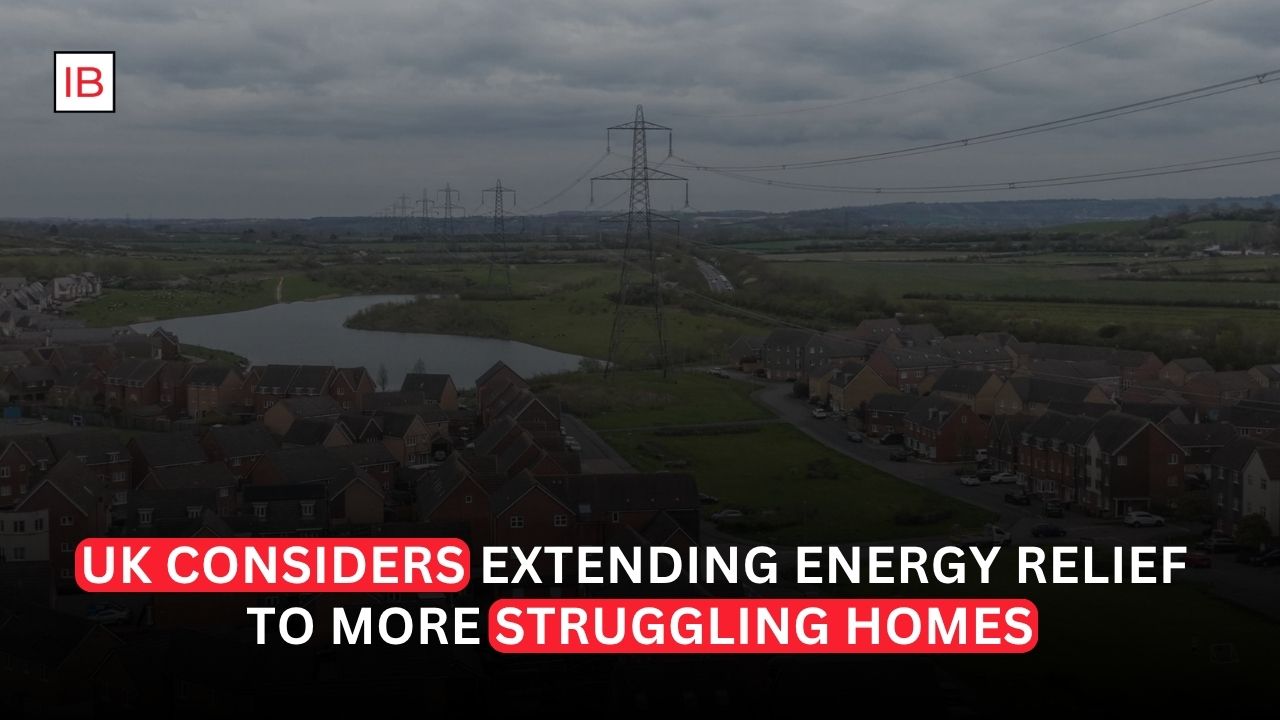
The UK government is considering expanding energy-bill support to more households as rising wholesale energy prices threaten to increase pressure on families this winter. The discussion comes at a difficult moment for British consumers, with the energy price cap scheduled to rise by 4% in October to an average annual level of about £1,723 for a typical household.
Ministers are reportedly examining ways to provide more targeted assistance rather than returning to the extremely expensive universal support schemes used during the previous energy crisis. The debate highlights a difficult choice for the government: provide immediate relief to households struggling with bills while avoiding a policy that simply shifts the cost onto taxpayers or other energy customers.
Energy Bills Are Rising Again
British households are heading into another period of higher energy costs.
Ofgem’s latest price-cap decision means the typical annual bill will increase by around £60 from October, reaching £1,723. The increase is being driven largely by higher wholesale gas prices, which have been affected by geopolitical tensions and disruption in international energy markets.
The October increase follows another substantial rise earlier in the year.
That means many households have had little opportunity to recover from previous increases before facing another jump.
For families already struggling with rent, mortgages, food and transportation costs, even an additional £5 a month can matter.
Government Considers Targeted Support
Rather than introducing another universal subsidy, ministers are considering ways to identify households that need help most.
This approach would be significantly different from the broad emergency measures introduced during the energy crisis.
The government wants support to reach lower-income households and people who are particularly vulnerable to rising energy costs.
Possible options include expanding existing discounts, introducing income-based tariffs or creating a more permanent social discount.
The challenge is determining who qualifies.
The Warm Home Discount
One of the most obvious mechanisms is the Warm Home Discount, which already provides eligible households with help toward their winter electricity bills.
Expanding the programme would allow the government to use an existing framework rather than creating an entirely new system.
The advantage is administrative simplicity.
The disadvantage is that many households facing financial pressure may not qualify under existing rules.
That raises the question of whether eligibility should be broadened.
Why Ministers Prefer Targeted Help
Universal energy subsidies are expensive.
During the earlier energy crisis, the government spent tens of billions of pounds protecting households from extreme increases.
That approach helped prevent an immediate cost-of-living disaster, but it also placed a major burden on public finances.
With government budgets under pressure, repeating such a scheme would be difficult.
Targeted assistance would allow ministers to spend less while concentrating support on households most likely to struggle.
The Problem of Households Outside the Benefits System
One of the biggest weaknesses in targeted support is identifying eligible households.
Not everyone experiencing financial hardship receives benefits.
Some low-income workers may earn too much to qualify for certain welfare programmes while still struggling to pay their energy bills.
That creates a gap between official eligibility and real financial need.
The government is therefore considering whether information held by tax authorities and other departments could be used to identify households more accurately.
Rising Energy Debt Adds Pressure
The issue is becoming more urgent because household energy debt is already extremely high.
Energy UK has warned that unpaid household energy debt and arrears could rise to around £7 billion by the end of 2026. It said energy debt had already reached a record level of roughly £6 billion by June.
That figure matters because households unable to pay their bills do not simply disappear from the energy system.
The debt eventually affects suppliers, which can then pass some costs through to other customers.
Energy Debt Can Become a Long-Term Problem
A household struggling with one winter bill may still be dealing with that debt months later.
If prices rise again, the problem compounds.
Families may borrow money, reduce spending on food and other necessities or fall behind on multiple household bills.
This creates a cycle that is much harder to solve than a temporary price increase.
Targeted energy support could therefore prevent a relatively small short-term problem from becoming a larger financial crisis.
October’s Price Cap Is Not the Only Concern
Another problem is what happens after October.
Analysts have warned that energy prices could rise further in January if wholesale gas prices remain elevated.
Some forecasts suggest the typical annualized bill could rise toward £1,872 in January, although future price-cap levels remain uncertain.
That means the government could face pressure to provide additional support just a few months after introducing any new programme.
Geopolitics Is Driving the Problem
The latest energy-price pressure is closely connected to international events.
Wholesale gas prices have risen sharply amid conflict involving Iran and disruptions affecting important energy routes.
The UK remains exposed because natural gas plays a significant role in its energy system.
Even when Britain produces renewable electricity domestically, international gas prices can still influence the cost of energy.
The UK’s Energy Market Creates Another Challenge
The British electricity market has a structural feature that complicates the situation.
Gas-fired power stations often influence the wholesale electricity price even when cheaper renewable electricity is available.
That means consumers do not necessarily receive the full benefit of low-cost wind and solar generation.
Longer-term reform of electricity pricing could therefore be more important than temporary discounts.
Short-Term Relief vs. Long-Term Reform
This is the central policy dilemma.
A discount can reduce bills immediately.
But it does not necessarily make energy cheaper.
If the underlying wholesale price remains high, the government must continue finding money to subsidize consumers.
That is difficult to sustain.
Long-term reforms involving electricity-market design, energy infrastructure and domestic generation could potentially reduce structural costs.
But those reforms take years.
Households facing higher bills this winter cannot wait that long.
Government Has Already Cut Electricity VAT
Prime Minister Andy Burnham’s government has already introduced a measure to reduce household electricity costs by removing VAT from domestic electricity bills.
The policy is expected to save the typical household roughly £45 a year.
However, the saving is being partly offset by the October price-cap increase.
That illustrates the limits of broad tax reductions when wholesale energy costs are rising rapidly.
Why a Social Tariff Is Being Discussed
A social tariff would provide cheaper energy to households based on income or financial circumstances.
Energy UK has argued that a more permanent social discount could provide more effective assistance than temporary emergency programmes.
Such a system could be designed to automatically reduce bills for eligible households.
The main advantage would be predictability.
Families would know that support exists without having to wait for a new emergency package each time prices rise.
The Risk of Making Energy More Expensive for Everyone Else
There is a major problem with social tariffs.
If suppliers are required to provide discounted electricity to some customers without receiving sufficient government funding, they may recover the cost through higher bills for other customers.
That could create a redistribution mechanism that helps poorer households but increases costs for everyone else.
The government therefore has to decide who ultimately pays.
Taxpayers Could Carry the Cost
If the government funds the discount directly, the burden falls on taxpayers.
That may be more transparent but increases pressure on public finances.
At a time when governments are already facing demands for greater spending on healthcare, defense and infrastructure, finding billions for energy subsidies may prove difficult.
Energy Companies Could Be Asked to Contribute
Another possibility is to impose additional taxes or levies on energy companies.
Supporters argue that companies benefiting from high energy prices should contribute toward helping households.
Critics warn that excessive taxation could discourage investment in domestic energy production.
The balance is politically sensitive.
The Politics of Rising Bills
Energy prices are particularly important politically because households notice them immediately.
A higher energy bill arrives every month.
That makes energy costs a highly visible measure of the government’s economic performance.
Promises to reduce household bills therefore carry significant political weight.
If prices continue rising, ministers could face growing criticism even if the underlying cause is largely international.
Low-Income Households Face the Greatest Pressure
Energy costs do not affect every household equally.
A wealthy family may be able to absorb an additional £60 or £100 in annual costs.
For a household with very little disposable income, the same increase can force difficult decisions.
People may reduce heating, delay payments or cut spending elsewhere.
This is why targeted support is likely to focus on lower-income households.
Pensioners and Vulnerable Consumers
Older people and households with medical or mobility needs can also face greater energy costs.
Some vulnerable consumers need to heat their homes for longer periods.
Others may rely on electrical medical equipment.
For these groups, reducing energy consumption is not always a realistic option.
A support programme based only on income may therefore need additional protections.
Energy Efficiency Could Reduce the Need for Subsidies
One way to address the problem is to reduce how much energy homes need.
Better insulation, efficient heating systems and improved building standards can lower bills permanently.
That is more expensive initially than a discount but can provide savings over many years.
The government therefore faces a choice between paying repeatedly for expensive energy and investing in measures that reduce consumption.
Heat Pumps and Electrification
The UK is also trying to encourage households to move toward electric heating.
Heat pumps can be highly efficient, but their economic appeal depends heavily on electricity prices.
If electricity remains significantly more expensive than gas, households may be reluctant to switch.
That creates another reason for policymakers to examine the structure of electricity prices.
Renewable Energy Offers a Long-Term Opportunity
Britain has expanded its renewable-energy capacity significantly.
Wind power in particular has become an important part of the electricity system.
The long-term objective is to use more domestic renewable electricity while reducing dependence on imported fossil fuels.
If successful, that could make the energy system less vulnerable to international gas-price shocks.
But Renewables Require Infrastructure
Adding renewable generation is not enough.
The UK also needs transmission lines, storage, grid connections and flexible generation.
Those investments cost money.
Some of those costs eventually appear in consumer bills.
That creates a difficult short-term trade-off between paying for infrastructure now and achieving lower energy costs in the future.
The Government’s Bigger Challenge
The energy-support debate exposes a broader economic problem.
Britain wants households to consume cleaner electricity, businesses to electrify and investors to build renewable infrastructure.
But high electricity prices make those objectives more difficult.
The government therefore needs to address both affordability and the structure of the energy market.
Temporary discounts can solve only the first problem.
What Investors Are Watching
Markets will be watching how the government finances any expanded support programme.
Investors will also monitor whether higher energy costs increase inflation.
If energy prices remain elevated, they could affect household spending and make it harder for the Bank of England to ease monetary policy.
Energy therefore has consequences beyond individual household budgets.
Inflation Could Be Affected
Higher utility bills directly increase household expenses.
They can also influence the cost of goods and services because businesses face higher operating costs.
If energy prices remain high, inflation could prove more persistent.
That would complicate the central bank’s policy decisions.
Businesses Face Similar Pressure
Household support is only one side of the problem.
British businesses also face high energy costs.
Manufacturers, retailers and hospitality companies can all be affected by rising electricity and gas prices.
If households receive discounts while businesses continue facing high costs, the policy may reduce consumer pressure without addressing wider economic competitiveness.
The Importance of Energy Security
The latest price shock also demonstrates the importance of energy security.
A country can have substantial renewable resources and still be vulnerable to global fossil-fuel prices if its energy system depends on gas.
Greater domestic generation, storage and grid capacity could reduce that exposure.
Energy policy is therefore increasingly connected to national security.
What Could Happen Next?
The government is likely to consider several options before making a final decision.
These could include:
- Expanding the Warm Home Discount
- Introducing an income-based energy tariff
- Creating a social discount
- Increasing support for vulnerable households
- Using tax-funded subsidies
- Increasing energy-company contributions
- Improving automatic enrolment
- Investing in energy efficiency
Each option has different financial and political consequences.
The Hardest Part Is Targeting Support Correctly
The government needs to avoid two opposite mistakes.
If eligibility is too narrow, many households in genuine need will receive nothing.
If eligibility is too broad, the programme becomes expensive and begins resembling a universal subsidy.
The effectiveness of the policy will therefore depend heavily on how accurately the government can identify households under financial pressure.
A Permanent Solution May Be Better
Repeated emergency interventions create uncertainty.
Households do not know whether support will continue.
Energy companies do not know how costs will be distributed.
Investors cannot easily predict the government’s long-term energy strategy.
A permanent, transparent support mechanism could therefore be more efficient than repeated temporary packages.
Conclusion
The UK government’s consideration of expanding energy-bill discounts reflects a growing problem: households are facing another increase in energy costs just as many families are still struggling with previous price shocks.
The October price cap will raise the typical annual bill to around £1,723, while household energy debt has already climbed to record levels and could approach £7 billion by the end of the year.
That makes additional assistance politically attractive.
But the government faces a difficult choice.
A universal subsidy would be expensive and could repeat the weaknesses of earlier emergency programmes. A narrowly targeted scheme would cost less but risks leaving out households that are struggling but do not qualify under traditional benefits criteria.
The more sustainable answer may be a combination of targeted financial support, energy-efficiency investment and structural reform of the electricity market.
Short-term discounts can protect vulnerable households from the next bill increase.
They cannot, however, solve Britain’s underlying energy-cost problem.
The bigger challenge is creating an energy system that is reliable, affordable and less exposed to international gas-price shocks.
Until that happens, governments may continue finding themselves in the same position: responding to rising bills with temporary assistance while the structural causes remain unresolved.