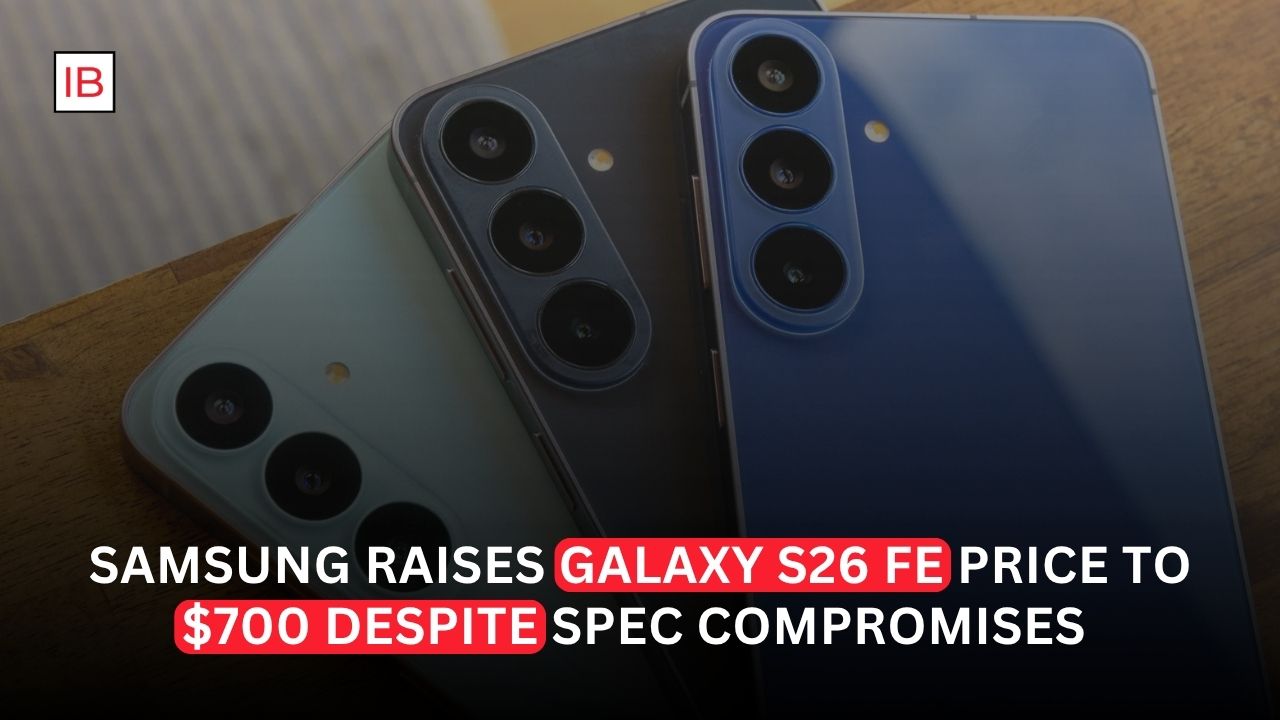
Samsung’s Galaxy S26 FE is entering a difficult part of the smartphone market: the company appears to be asking buyers to pay more while making only modest improvements over the previous generation.
The Galaxy S26 FE is expected to start around $700 in the US, while European pricing has been reported at about €799. That would represent a meaningful increase over the Galaxy S25 FE. At the same time, several key specifications appear largely unchanged, including the camera system, display resolution and charging speed.
Samsung has scheduled its Galaxy Event for August 27, where the company is expected to officially reveal the device and settle the remaining questions about price, specifications and availability.
A More Expensive Fan Edition
The Fan Edition line was created to give consumers many of Samsung’s flagship features without requiring them to pay full flagship prices.
That value proposition becomes harder to defend when the price moves closer to premium Galaxy models.
Reports suggest the Galaxy S26 FE could start at roughly $699 or potentially approach $799 depending on the market and final configuration. European reports point toward a €799 starting price for the 128GB model.
The increase matters because Samsung’s own Galaxy S26 sits above the FE in the company’s lineup, while discounts on the flagship can narrow the effective price difference.
That creates an awkward situation.
Consumers may ask why they should buy the cheaper model if a discounted flagship costs only slightly more.
The Hardware Improvements Are Limited
The biggest criticism of the S26 FE is not that it is a bad phone.
It is that the improvements do not appear proportional to the higher price.
Reports indicate that Samsung is retaining a 6.7-inch AMOLED display with a 120Hz refresh rate and a broadly familiar triple-camera arrangement.
The main camera is expected to remain a 50-megapixel sensor, accompanied by a 12-megapixel ultrawide and an 8-megapixel telephoto camera.
That means buyers are not getting a dramatic camera upgrade despite paying more.
The Exynos 2500 Is the Main Chip Change
The most significant hardware change is expected to be Samsung’s Exynos 2500 processor.
The chip is manufactured using Samsung’s 3-nanometer technology and represents an improvement over the Exynos 2400 used in the previous FE generation.
It should provide enough processing and neural-engine performance to support Samsung’s latest Galaxy AI features.
But there is an important catch.
The Exynos 2500 is not Samsung’s newest smartphone processor.
The international Galaxy S26 uses the newer Exynos 2600, while US Galaxy S26 models use Qualcomm’s Snapdragon 8 Elite Gen 5.
So the FE is positioned below the flagship in processor technology even though its price may be moving closer to flagship territory.
AI Features Are Doing More of the Selling
Samsung increasingly uses artificial intelligence as a major reason for upgrading its phones.
The S26 FE is expected to bring several Galaxy AI features to a cheaper device, including tools related to video tracking, audio cleanup and personalized assistance.
That may be the strongest argument for the FE.
For consumers who specifically want Samsung’s AI ecosystem, the phone could provide most of the software experience of a more expensive Galaxy S model.
The problem is that AI features are becoming increasingly common across Android phones.
Google’s Pixel range already places considerable emphasis on Gemini-powered features, while other manufacturers are building their own AI systems.
AI therefore cannot automatically justify a higher price.
The Battery Trade-Off Is Complicated
The Galaxy S26 FE is expected to use a battery around 4,900mAh, which is larger than the battery in the standard Galaxy S26.
On paper, that sounds like an advantage.
But battery capacity alone does not determine endurance.
The processor, display, software optimization and thermal management all influence how long a phone lasts.
The Exynos 2500 therefore needs to demonstrate strong efficiency in real-world testing before buyers can assume that the larger battery will translate into substantially longer battery life.
Battery Longevity Raises Another Question
Some reports based on European energy-label information indicate that the S26 FE could have a lower rated number of charging cycles than its predecessor.
One reported figure puts the S26 FE at around 1,200 full charge cycles, compared with roughly 2,000 for the S25 FE.
That does not necessarily mean the phone will have poor battery life.
It is a different measurement.
But it does create an uncomfortable trade-off for a device becoming more expensive.
Buyers increasingly expect premium smartphones to remain useful for many years, and battery longevity is an important part of that equation.
Charging Speed Is Not Moving Forward
Another area where Samsung appears conservative is charging.
The S26 FE is expected to retain 45W wired charging, essentially keeping the same charging ceiling as the previous model.
That is not necessarily slow.
But Samsung’s competitors have pushed charging technology much further in several markets.
For a phone that may cost around $700, buyers could reasonably expect a more substantial charging upgrade.
The Camera System Is Another Weak Spot
The camera hardware is another reason the price increase may be difficult to defend.
The expected setup remains a 50MP main camera, 12MP ultrawide and 8MP telephoto.
That is perfectly respectable on paper.
But the FE line is supposed to offer flagship experiences at a lower price.
If Samsung leaves the camera hardware largely unchanged while increasing the price, it becomes harder to distinguish the S26 FE from cheaper competitors based on photography alone.
Samsung will likely rely on image processing and AI features to compensate.
Whether that works will depend on real-world camera testing.
The Display Remains a Strength
The display is one area where the S26 FE should remain competitive.
The phone is expected to feature a large 6.7-inch AMOLED panel with a 120Hz refresh rate.
That makes it considerably larger than the standard Galaxy S26.
For people who watch videos, play games or multitask on their phones, the larger screen could be a meaningful advantage.
The trade-off is that the resolution is expected to remain at Full HD+, rather than moving to a higher-resolution panel.
The FE’s Size Could Be Its Selling Point
The S26 FE could therefore appeal to a specific customer.
Someone who wants a large Samsung screen but does not want to pay for a Galaxy S Ultra could find the FE attractive.
The problem is that Samsung has to price that advantage correctly.
A large display is useful, but it is not enough by itself to justify a price that approaches flagship territory.
Storage Could Become a Problem
The reported base configuration is expected to retain 128GB of storage.
That is increasingly difficult to justify at a phone price approaching $700.
Modern smartphone cameras generate large files, games can occupy tens of gigabytes and AI applications may require additional storage.
Consumers buying a premium midrange phone often expect 256GB to be the practical starting point.
If Samsung keeps 128GB at the base price, the value proposition becomes weaker.
Memory Costs May Be Part of the Story
The price increase is arriving during a difficult period for smartphone component costs.
Memory supply constraints have contributed to higher component prices across the industry.
Some reports have linked the S26 FE’s higher price to those broader cost pressures. However, Samsung has not publicly confirmed that component inflation is the specific reason for the phone’s pricing.
That distinction matters.
It is reasonable to see memory costs as a potential factor.
It is not reasonable to state that they definitively caused Samsung’s price increase without confirmation from the company.
Samsung Has a Discount Problem
The biggest competitor to the S26 FE may not be another manufacturer.
It may be Samsung’s own flagship.
The Galaxy S26 launched at around $899 in the US, but flagship Samsung phones frequently receive discounts after launch.
If consumers can find the Galaxy S26 for close to the S26 FE’s price, the FE’s value proposition becomes much harder to defend.
The flagship offers newer premium hardware and, in the US, the Snapdragon 8 Elite Gen 5.
That is a significant problem for Samsung’s cheaper model.
Google Is Another Major Threat
Google’s Pixel lineup creates another challenge.
The Pixel 10a has been reported at around $499, significantly below the expected S26 FE price, while offering Google’s AI ecosystem and long software-support commitment.
The Pixel does not match Samsung in every category.
But consumers who do not care about the Samsung ecosystem may see little reason to spend an additional $200 or more.
That puts pressure on Samsung to explain exactly what the extra money buys.
The FE Brand Is Losing Some of Its Original Meaning
When the first Fan Edition phones appeared, the basic idea was simple.
Take a flagship phone.
Keep the important features.
Remove expensive extras.
Sell it for substantially less.
That formula becomes less effective when the price gap narrows.
If the S26 FE costs only modestly less than the flagship, consumers may simply choose the flagship.
Samsung Still Has an Ecosystem Advantage
There is one area where Samsung remains difficult to replace.
Its ecosystem.
Galaxy phones integrate closely with Galaxy Watches, Buds, tablets, PCs and other Samsung products.
Features such as Samsung DeX and cross-device functionality can make the Galaxy platform more attractive to existing Samsung users.
For those customers, switching to Pixel or another Android manufacturer may involve giving up familiar features.
That ecosystem lock-in can help Samsung sell an FE model even when the hardware-to-price ratio is not exceptional.
Software Support Matters
Samsung’s long-term software support is also increasingly important.
Consumers are keeping smartphones for longer.
A phone that receives operating-system and security updates for many years can offer more value than a device with slightly better hardware but shorter support.
The S26 FE is expected to benefit from Samsung’s long software-support strategy.
That could make the higher upfront price easier to justify for buyers planning to keep the device for several years.
Samsung Is Targeting the Premium Midrange
The S26 FE is effectively competing in a crowded space between traditional midrange phones and premium flagships.
This category is becoming increasingly competitive.
Consumers can now buy phones with high-refresh-rate OLED displays, large batteries, powerful processors and strong cameras for substantially less than $700.
Samsung therefore needs to differentiate the FE through software, ecosystem integration and brand reputation.
The Price Will Determine Everything
At around $699, the S26 FE could still make sense.
At that price, the large display, Samsung software, Galaxy AI and long-term support could create a reasonable package.
At $799, the situation becomes more difficult.
The phone would be entering territory where discounted flagship models become direct competitors.
That is why the final US price is arguably more important than any individual specification.
The August 27 Launch Is Crucial
Samsung’s August 27 Galaxy Event should remove much of the uncertainty.
The company is expected to reveal the final specifications, pricing and availability.
Until then, many of the details circulating about the S26 FE remain based on leaks and regulatory information rather than Samsung’s final announcement.
That means consumers should avoid treating every leaked specification as confirmed.
Should Buyers Upgrade?
For someone using a Galaxy S22, S23 or older FE model, the S26 FE could still represent a meaningful upgrade.
The newer processor, larger screen, modern software and AI capabilities could make a noticeable difference.
But someone using a recent Galaxy S25 FE has a much weaker reason to upgrade.
The hardware changes appear too limited to justify paying substantially more.
Who Should Consider the S26 FE?
The phone makes the most sense for buyers who want:
- A large Samsung AMOLED display
- Galaxy AI features
- Long software support
- Samsung ecosystem integration
- A flagship-style design at a lower price
- A newer processor than the S25 FE
For those buyers, the FE could remain attractive.
Who Should Skip It?
Buyers should be more cautious if they prioritize:
- Maximum performance
- Best camera hardware
- Fastest charging
- Maximum storage
- Best price-to-performance ratio
- Long-term battery durability
Those consumers may find better options elsewhere.
The Bigger Smartphone Trend
The S26 FE illustrates a broader change in the smartphone market.
Manufacturers are finding it increasingly difficult to offer major hardware improvements every year.
Instead, they are relying more heavily on software, AI and incremental design changes.
At the same time, component costs are rising in some areas.
That combination creates a difficult situation.
Phones can become more expensive without necessarily becoming dramatically better.
Consumers Are Becoming More Price Sensitive
The smartphone market is mature.
Most consumers already own devices capable of handling messaging, social media, photography, video and gaming.
That makes convincing them to upgrade harder.
A $700 phone therefore needs to offer a clear advantage over a two- or three-year-old device.
Minor improvements may not be enough.
Samsung’s Biggest Risk
The biggest risk is not that the S26 FE will be a bad phone.
It is that it will be too close to the Galaxy S26 in price and too close to the S25 FE in hardware.
That is the worst possible middle ground.
If the price is low enough, consumers accept compromises.
If the hardware is good enough, consumers accept a higher price.
But combining a higher price with relatively modest hardware improvements weakens both arguments.
The Final Verdict Depends on the Price
The S26 FE could still be a sensible purchase.
But the economics need to work.
At around $699, Samsung has a reasonable case.
At $799, buyers should compare it aggressively with discounted Galaxy S26 models, Pixel devices and competing Android flagships.
The FE name alone is no longer enough to guarantee value.
Conclusion
Samsung’s Galaxy S26 FE is entering the market with a problem that has become increasingly common in smartphones: the price is moving upward faster than the hardware is improving.
The expected $700-or-higher price puts the device in a difficult position. Reports suggest Samsung is retaining much of the previous generation’s camera hardware and 45W charging while introducing the Exynos 2500, updated software and Galaxy AI features.
The larger 6.7-inch display and 4,900mAh battery could make the phone attractive, particularly for Samsung ecosystem users who want a large-screen device without paying Ultra-level prices.
But the competition is getting tougher.
A discounted Galaxy S26 could offer more powerful flagship hardware for a relatively small premium. Google’s Pixel range offers strong AI capabilities at lower prices. And other Android manufacturers continue to compete aggressively on charging, cameras, battery capacity and specifications.
That leaves Samsung with a narrow window.
If the Galaxy S26 FE launches around $699, it can still be positioned as a sensible premium-midrange alternative.
If it reaches $799, Samsung risks undermining the entire purpose of the Fan Edition line.
The key question is therefore not whether the Galaxy S26 FE is a capable smartphone.
It almost certainly will be.
The question is whether Samsung has priced it low enough to make its compromises acceptable.
For consumers, the safest approach is to wait for the official August 27 announcement and then compare the final price against the discounted Galaxy S26 and competing devices.
The FE concept only works when the discount is large enough to make the compromises feel worthwhile.