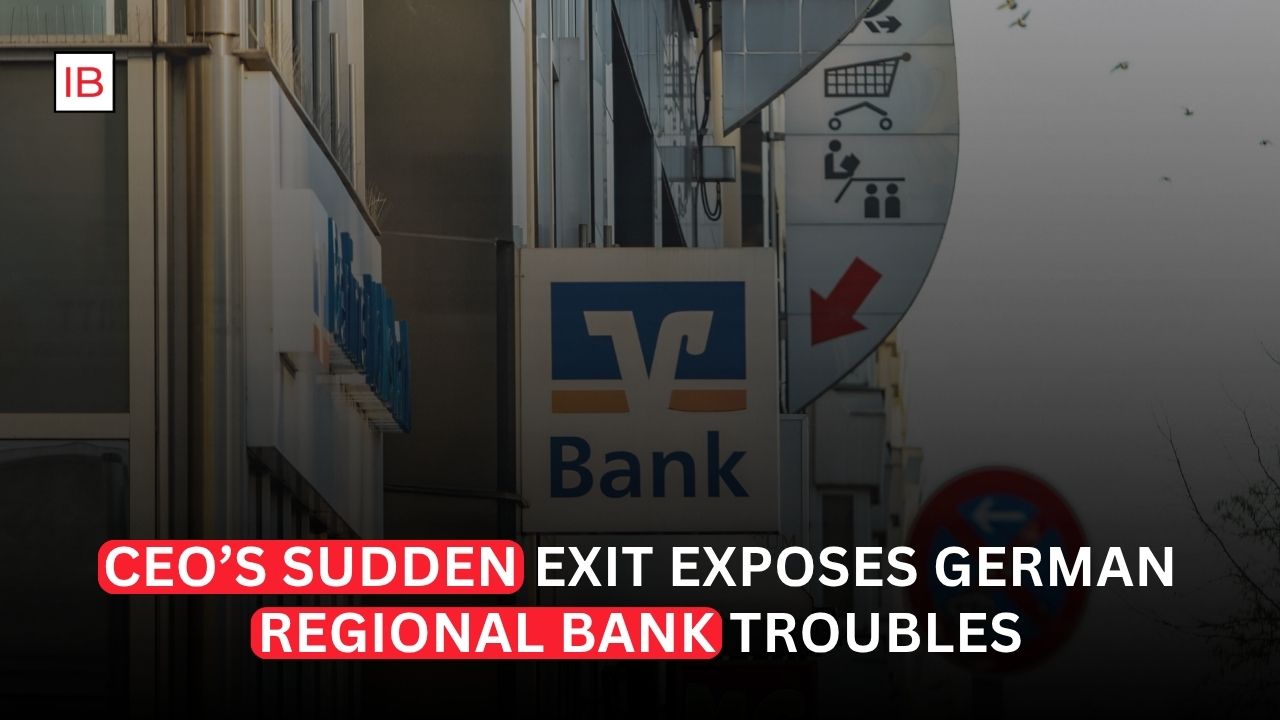
A sudden leadership change at a German regional bank is drawing attention to deeper problems facing the country’s Landesbanken and other smaller lenders, where weak profitability, economic uncertainty and pressure to modernize are creating a difficult environment for executives.
The departure is significant because regional banks occupy an important position in Germany’s financial system. They finance small and medium-sized companies, support local economies and maintain close relationships with businesses that depend heavily on bank lending. But their traditional model is facing increasing pressure as competition intensifies and borrowing conditions change.
A Sudden Leadership Change
The abrupt exit of a chief executive naturally raises questions about what is happening behind the scenes.
In banking, leadership stability matters because management decisions can affect lending standards, risk controls, restructuring programs and relationships with institutional stakeholders. A sudden departure does not automatically mean a bank is in financial trouble, but it can become a warning signal when it occurs against a difficult operating backdrop.
Investors and customers therefore tend to look beyond the official explanation and examine the institution’s broader financial and strategic position.
Regional Banks Under Pressure
Germany’s regional banking sector has been dealing with structural problems for years.
Many lenders remain heavily dependent on traditional interest income, while competition from larger commercial banks and digital financial companies has increased.
At the same time, German businesses have faced weak economic growth, high energy costs and uncertainty surrounding industrial investment.
That creates a difficult combination for regional lenders: their customers need financing, but many borrowers are operating in sectors where profitability and investment remain under pressure.
The German Economy Matters
Germany’s banks are closely tied to the health of the domestic economy.
The country’s industrial base has struggled with weak demand, high production costs and increased competition from China. Automobile manufacturers, machinery companies and other exporters have been forced to rethink their business models.
Regional banks are particularly exposed because they frequently have long-standing relationships with Mittelstand companies.
If those businesses experience prolonged weakness, banks can face rising credit risks even before problems become visible in headline non-performing-loan figures.
The Profitability Problem
Another challenge is profitability.
Large banks can spread technology, compliance and regulatory costs across enormous balance sheets. Smaller regional institutions have less room to do so.
Digital banking also requires substantial investment in technology and cybersecurity.
That creates an uncomfortable equation for regional lenders: they need to spend more to remain competitive while their traditional sources of revenue are under pressure.
The result is a sector where consolidation and restructuring are increasingly difficult to avoid.
Landesbanken Face a Unique Challenge
Germany’s Landesbanken have historically had strong links to regional governments and savings banks.
Their role is broader than simply maximizing shareholder returns. They provide financing to businesses and support regional economic development.
That public-service function can be valuable, but it can also complicate strategic decisions.
Management may face pressure to maintain lending to important local companies even when purely commercial considerations would suggest greater caution.
This makes governance particularly important.
Credit Risks Are Rising
The biggest concern is not necessarily an immediate banking crisis.
It is the possibility that prolonged weakness in the German economy gradually increases loan losses.
Commercial real estate, manufacturing and other economically sensitive sectors deserve particular attention.
A bank can appear healthy while credit quality is deteriorating slowly underneath the surface.
That is why sudden changes in senior management can attract disproportionate attention from investors. They may wonder whether the departure reflects disagreements over strategy, risk appetite or the pace of restructuring.
Technology Is Changing Banking
Regional banks are also being squeezed by technological change.
Customers increasingly expect instant payments, sophisticated mobile applications and fully digital account management.
Building those capabilities internally can be expensive.
Large banks and fintech companies can invest heavily in technology, while smaller institutions may struggle to match that spending.
The solution could be greater cooperation, outsourcing or consolidation.
But each option creates its own governance and operational risks.
Consolidation Is Becoming Harder to Avoid
Germany has thousands of banks and financial institutions compared with many other developed economies.
That fragmented structure has long been criticized for creating excess capacity and weak profitability.
Mergers could reduce costs and create stronger institutions, but combining banks with different regional interests and governance structures is complicated.
Political considerations can make consolidation even more difficult.
Regional authorities may resist changes that reduce local influence or employment.
The CEO Exit Is a Symptom
The most important lesson from a sudden CEO departure is therefore not necessarily the identity of the next executive.
It is whether the bank has a convincing strategy for dealing with the pressures facing the sector.
A new chief executive cannot solve weak economic growth, excessive competition and rising technology costs overnight.
The board must decide whether the institution needs cost reductions, a different lending strategy, greater digital investment or deeper cooperation with other banks.
Germany’s Mittelstand Is Crucial
The health of Germany’s small and medium-sized companies will remain one of the most important indicators for regional banks.
The Mittelstand has traditionally been a strength of the German economy, providing employment and supporting exports.
But these companies are facing major changes.
Energy prices, labor shortages, decarbonization costs and competition from Asia are forcing many firms to invest heavily just to remain competitive.
That creates both opportunities and risks for lenders.
Banks can finance modernization, but they also assume greater credit exposure when companies are already operating under pressure.
Regulation Adds Another Burden
Banks must also comply with increasingly complex European financial regulations.
Large institutions can often absorb compliance costs more efficiently than smaller lenders.
For regional banks, regulatory investment can consume resources that could otherwise be used for lending or technology.
This is another reason consolidation has become part of the debate about Germany’s banking system.
The question is whether smaller institutions can remain economically viable while meeting the same regulatory and technological expectations as much larger competitors.
What Investors Should Watch
The CEO departure should prompt attention to several indicators.
The most important are loan-loss provisions, non-performing loans, capital ratios, net interest margins and operating costs.
Investors should also examine whether management is accelerating restructuring or simply replacing one executive with another.
A genuine turnaround requires measurable improvements in efficiency and risk management.
Leadership changes alone do not fix structural problems.
Conclusion
The sudden departure of a CEO at a German regional bank is attracting attention because it comes at a difficult time for the country’s smaller financial institutions.
Germany’s regional lenders face a combination of weak economic growth, pressure on corporate borrowers, rising technology costs, regulatory demands and intense competition.
Those challenges are particularly important because regional banks are deeply connected to the Mittelstand, the network of small and medium-sized companies that forms a central part of Germany’s economic model.
The risk is not necessarily an immediate banking collapse. A more realistic concern is gradual deterioration: weaker profitability, rising operating costs and increasing credit problems that force banks to rethink their traditional business models.
That makes leadership especially important.
A new CEO will need to balance the bank’s regional responsibilities with the need for stronger commercial discipline. Cutting costs too aggressively could damage customer relationships, while failing to restructure could leave the institution permanently uncompetitive.
Germany’s fragmented banking system makes that dilemma even more difficult.
The sector may ultimately need more consolidation, greater technological cooperation and sharper specialization. But political and regional interests can make such changes slow and complicated.
The CEO’s sudden exit is therefore best understood as a symptom rather than a complete explanation of the sector’s problems.
The bigger question is whether Germany’s regional banks can adapt quickly enough to an economy and financial system that are changing faster than their traditional business models.
For customers, companies and investors, the answer will matter far beyond one executive’s departure.