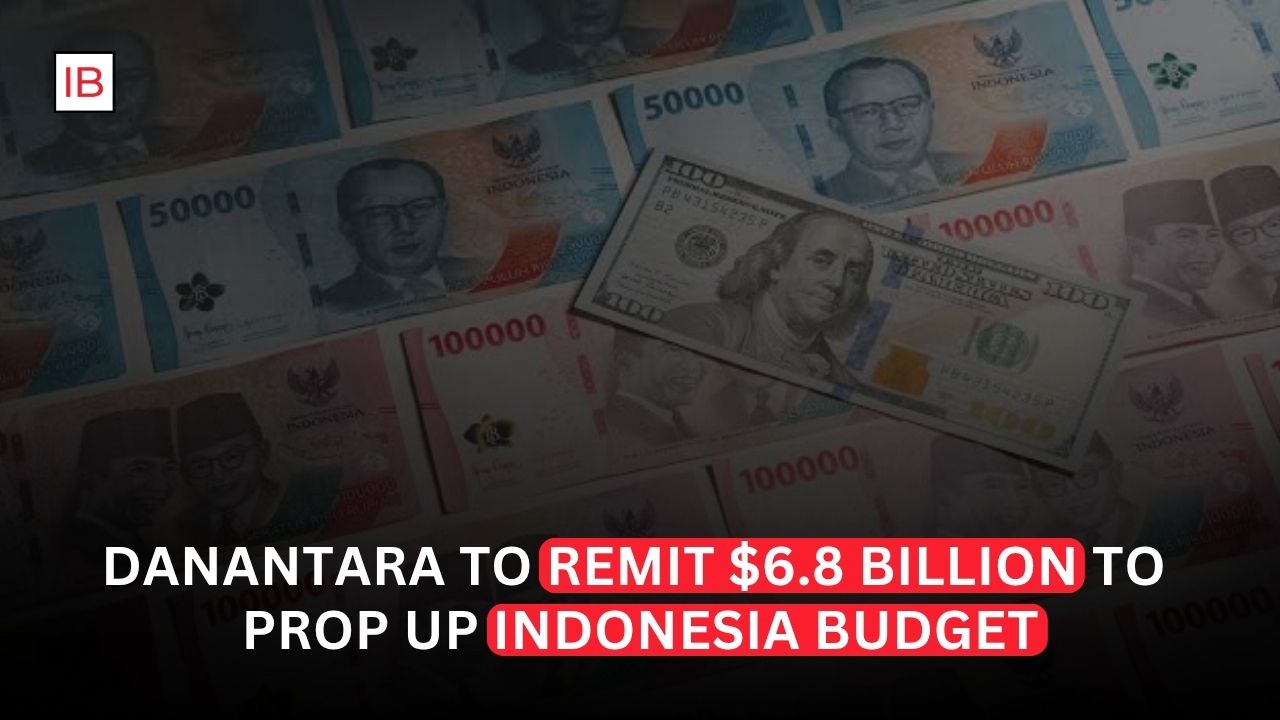
Indonesia’s sovereign wealth fund Danantara is preparing to transfer about $6.8 billion to the government, providing additional support for President Prabowo Subianto’s budget plans as Jakarta looks for ways to finance its ambitious economic agenda.
The transfer highlights the growing role of Danantara in Indonesia’s fiscal strategy. Created to manage and coordinate some of the country’s largest state assets, the fund has increasingly been positioned as a vehicle for mobilizing capital for national development while helping the government manage pressure on public finances.
Danantara’s Growing Fiscal Role
Danantara was established as Indonesia’s new state asset-management institution with the objective of improving the performance of government-linked companies and directing capital toward strategic investments.
The fund oversees stakes in major state-owned enterprises and has access to substantial pools of capital.
Its planned remittance of $6.8 billion represents a significant contribution to the government’s budget and shows how Jakarta is seeking to make greater use of state assets to support fiscal priorities.
The transfer could also reduce the government’s immediate need to rely entirely on taxation or additional borrowing.
Support for Prabowo’s Budget
President Prabowo has outlined an expansive economic program focused on strengthening purchasing power, developing infrastructure, improving food and energy security and expanding social programs.
Those priorities require substantial government spending.
At the same time, Indonesia has traditionally maintained relatively strict fiscal discipline, limiting the budget deficit to a ceiling of 3% of gross domestic product under its fiscal framework.
Finding additional funding without breaching those limits is therefore an important challenge.
Danantara’s planned contribution could provide Jakarta with greater room to pursue its priorities.
State Assets Become More Important
Indonesia owns large stakes in banks, energy companies, telecommunications firms and other major businesses.
For years, the government has relied on dividends from state-owned companies as one source of budget revenue.
Danantara’s creation changes the way those assets can potentially be managed.
Instead of treating state companies primarily as dividend-generating entities, the government can use the sovereign wealth fund to coordinate investments, restructure businesses and direct capital toward national priorities.
That creates opportunities but also raises questions about how financial returns will be balanced against political objectives.
Indonesia Wants Higher Returns
One of Danantara’s central goals is improving the efficiency and profitability of state-owned enterprises.
Indonesia has some of the largest state-controlled companies in Southeast Asia, but their performance varies widely.
The fund has been tasked with improving governance and capital allocation while seeking higher returns from the assets under its control.
If successful, Danantara could generate more value for the government over the long term.
The immediate $6.8 billion transfer, however, means some of that value is being directed toward current fiscal needs.
Fiscal Pressure Is Rising
Indonesia’s budget faces several competing demands.
The government wants to increase spending on social assistance, infrastructure, education, health and economic development while maintaining investor confidence.
At the same time, tax revenues can be difficult to expand rapidly.
A large contribution from Danantara therefore provides an attractive source of funding because it comes from existing state assets rather than requiring an immediate increase in taxes.
However, the approach cannot be repeated indefinitely without affecting the fund’s ability to invest.
The Opportunity Cost
Using sovereign wealth assets to support the annual budget carries an opportunity cost.
Money transferred to the government cannot simultaneously be invested in companies, infrastructure or other projects that could generate future returns.
That creates an important question for Danantara: should it prioritize immediate fiscal support or long-term wealth creation?
If the fund consistently sends large amounts to the budget, investors may question whether it is functioning primarily as a sovereign investment institution or as another arm of government finance.
Investors Will Watch Governance
The success of Danantara will depend heavily on its governance structure.
Sovereign wealth funds generally work best when they operate with clear investment mandates, professional management and transparency.
Indonesia’s new fund therefore faces pressure to demonstrate that decisions are based on economic returns rather than political priorities.
The larger its role becomes, the more closely international investors are likely to monitor its activities.
State-Owned Banks Are Central
Indonesia’s state-owned banks are among the country’s most valuable assets.
Institutions such as Bank Mandiri, Bank Rakyat Indonesia and Bank Negara Indonesia generate substantial profits and dividends.
Their balance sheets also give the government access to significant financial resources.
Danantara’s control of major state companies means its decisions can influence the broader Indonesian financial system.
That makes its governance especially important.
Prabowo’s Economic Ambitions
The transfer comes as Prabowo seeks to accelerate Indonesia’s economic growth.
His administration has emphasized industrial development, downstream processing of natural resources and investment in strategic sectors.
The government also wants to improve infrastructure and expand programs designed to support lower-income households.
All of those initiatives require funding.
Danantara could therefore become an important financing mechanism for Prabowo’s economic strategy.
Indonesia Wants Faster Growth
Indonesia has generally recorded steady economic growth, but the government wants to raise the pace.
Prabowo has repeatedly emphasized the need for stronger growth to create jobs and raise incomes.
Higher investment in infrastructure and industry is central to that objective.
Danantara could potentially channel capital toward projects that private investors might consider too risky or too long-term.
But if the fund is required to prioritize budget transfers, its ability to pursue those investments may be reduced.
A New Model for State Capital
Danantara represents an attempt to create a more centralized system for managing government-owned assets.
Rather than allowing individual ministries and state companies to make disconnected decisions, the fund is intended to coordinate capital allocation across the state-owned sector.
That could improve efficiency.
It could also make Indonesia’s sovereign assets easier to manage as a unified portfolio.
The challenge will be ensuring that centralization does not reduce accountability.
International Comparison
Indonesia’s strategy has similarities with sovereign wealth funds in countries such as Singapore, Norway and the United Arab Emirates.
Those funds manage national wealth and invest internationally and domestically.
However, Danantara’s mandate is more closely connected to managing state-owned companies and supporting national development.
That gives it a distinctive role.
Its eventual success will depend on whether it can combine commercial discipline with government development goals.
Debt Versus State Assets
The planned transfer also reflects a broader choice facing Indonesia.
The government can finance spending through borrowing, taxation or the monetization of state assets.
Borrowing increases public debt and interest costs.
Tax increases can be politically difficult.
Using state assets avoids some of those immediate problems but can reduce the pool of capital available for future investment.
Danantara therefore provides flexibility, but it is not free money.
Risks for the Fund
There is a danger that Danantara becomes too closely tied to short-term fiscal policy.
If the government repeatedly draws on the fund to cover budget pressures, the institution could lose its investment focus.
That could weaken long-term returns and reduce confidence among international investors.
The fund will need to demonstrate that each transfer is compatible with its broader mandate.
Conclusion
Danantara’s planned $6.8 billion remittance to the Indonesian government represents a major step in the fund’s emergence as an important part of the country’s fiscal and economic strategy.
For President Prabowo Subianto, the transfer provides additional resources at a time when the government is pursuing ambitious spending and investment plans while trying to maintain fiscal discipline.
The contribution could help finance infrastructure, social programs and economic-development initiatives without requiring Jakarta to rely entirely on higher taxes or additional borrowing.
But the arrangement also creates a difficult trade-off.
Every dollar transferred to the budget is a dollar that Danantara cannot invest in state-owned companies, infrastructure or other assets that might generate higher returns in the future.
That makes governance and transparency crucial.
If Danantara can improve the performance of Indonesia’s state-owned enterprises while carefully balancing investment with fiscal support, it could become one of the country’s most powerful economic institutions.
If political demands dominate investment decisions, however, the fund risks becoming little more than a financing tool for government spending.
The $6.8 billion transfer therefore represents more than a budget contribution. It is an early test of how Indonesia intends to use its enormous pool of state-owned assets under the Danantara model.
The outcome will matter not only for Prabowo’s fiscal plans but also for investors watching Indonesia’s long-term approach to sovereign wealth, state-owned companies and economic growth.