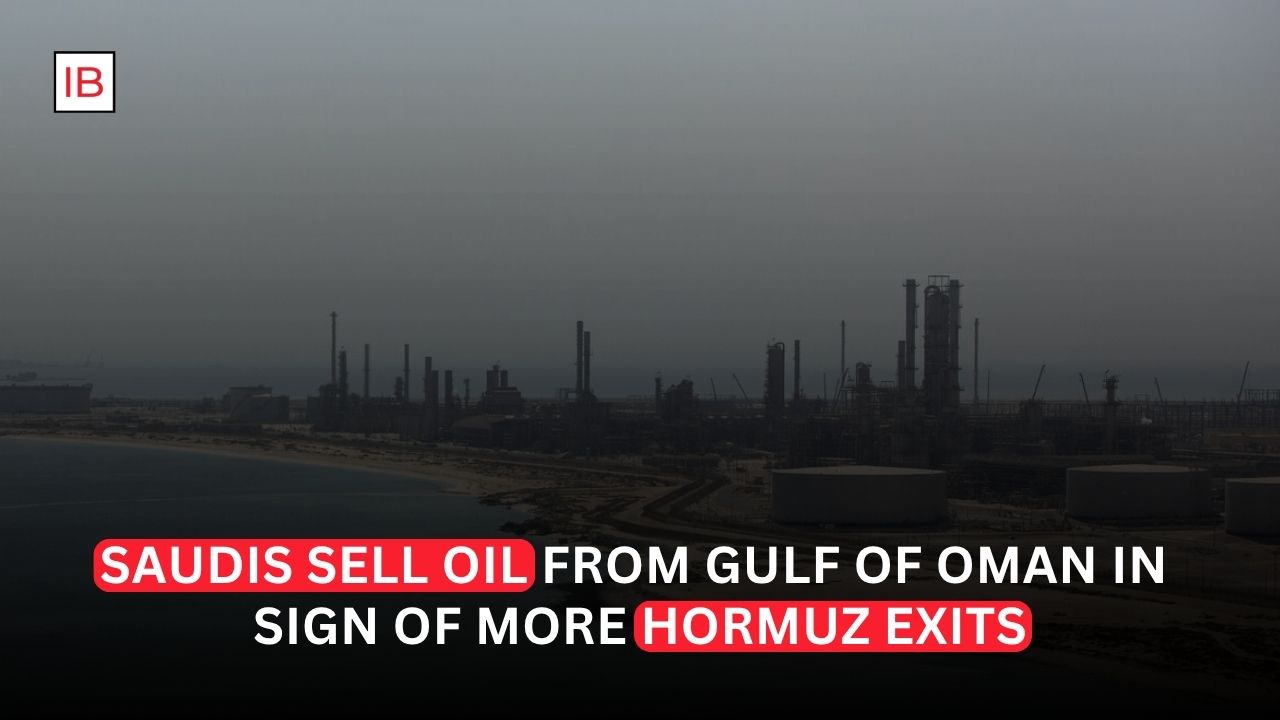
Saudi Arabia is increasingly moving crude oil outside the Strait of Hormuz, with shipments being offered for sale from the Gulf of Oman in a sign that Gulf producers are adapting to prolonged disruption around one of the world’s most important oil chokepoints.
The move gives Saudi Arabia another way to keep crude flowing to international buyers while reducing its dependence on the Strait of Hormuz. It also highlights how the region’s oil industry is gradually developing alternative logistics as security concerns continue to disrupt shipping.
Saudi Oil Moves Beyond Hormuz
Saudi Arabia has traditionally relied heavily on Hormuz to transport crude from its eastern oil fields to global customers.
The Strait remains the primary export route for much of the Gulf’s oil. In 2025, nearly 15 million barrels a day of crude, representing about 34% of global crude oil trade, passed through the waterway, according to the International Energy Agency.
The latest Saudi shipments indicate that producers are increasingly willing to use ship-to-ship transfers outside the chokepoint.
Ship-to-Ship Transfers Offer an Alternative
The strategy involves moving crude through the Strait and then transferring cargoes to larger vessels in waters outside the immediate chokepoint.
Saudi Aramco has offered crude for loading through ship-to-ship transfers near Sohar in Oman, according to industry reporting.
This approach does not eliminate Hormuz exposure entirely, but it can reduce the amount of time large export tankers spend navigating the most vulnerable section of the route.
It also allows smaller vessels to shuttle crude through the Strait before transferring it to larger tankers.
Gulf Producers Are Adapting
Saudi Arabia is not alone.
The United Arab Emirates has also been using alternative routes and logistics to maintain exports, while Kuwait and Qatar have increased efforts to move crude beyond Hormuz through shuttle services and ship-to-ship transfers.
Recent reports indicate that Qatar and Kuwait have restored crude exports to roughly 70% of pre-war levels, partly through these methods.
The combined response suggests Gulf producers are developing a new operating model for an environment in which Hormuz can no longer be treated as a completely reliable export route.
Oman Becomes More Important
The Gulf of Oman is gaining strategic importance because it lies outside the narrow Strait of Hormuz and provides access to the Arabian Sea.
Ports such as Sohar offer locations where cargoes can be transferred before continuing toward Asian markets.
That makes Oman increasingly important to the region’s energy logistics.
For Saudi Arabia, using offshore transfers near Oman can provide another layer of flexibility without requiring the country to completely rebuild its export infrastructure.
Saudi Arabia Has Another Route
Saudi Arabia has a major advantage compared with some of its Gulf neighbors: it already possesses infrastructure that can bypass Hormuz.
The country’s East-West pipeline connects oil-producing areas in the east with Yanbu on the Red Sea.
That allows some crude to reach export terminals without crossing the Strait.
The pipeline was originally developed partly because of earlier regional security concerns, demonstrating that Saudi Arabia has long recognized the strategic vulnerability of relying on a single maritime route.
Hormuz Still Matters
Despite these alternatives, Saudi Arabia cannot completely avoid the Strait.
The scale of its oil industry is simply too large.
The same is true for other Gulf producers.
The IEA describes Hormuz as the primary export route for oil from Saudi Arabia, the UAE, Kuwait, Qatar, Iraq, Bahrain and Iran.
Alternative pipelines and offshore transfers can reduce exposure, but they cannot instantly replace the full capacity of the waterway.
A Sign of Lasting Change
The increased use of Gulf of Oman transfers could nevertheless represent a structural change in how Gulf oil is traded.
For decades, Hormuz was treated as an unavoidable part of the global energy system.
The current crisis is encouraging producers to invest in alternatives and develop more flexible shipping arrangements.
If those alternatives become permanent, the strategic importance of Hormuz could gradually decline.
That would have major geopolitical consequences for Iran and the Gulf states.
Iran’s Leverage Could Weaken
The Strait has historically given Iran significant strategic leverage because of its location.
Any disruption can affect a large share of global oil and LNG flows.
But every additional alternative route reduces that leverage.
Recent analysis has highlighted the paradox facing Iran: attempts to restrict the Strait are encouraging Gulf producers to build infrastructure and logistics that make them less dependent on it.
Over time, that could weaken one of Tehran’s most important economic and geopolitical tools.
Oil Markets Are Watching
For global oil markets, the Saudi shipments are important because they show that physical barrels are still reaching buyers despite the disruption.
That can limit the upward pressure on crude prices.
Market participants are closely watching tanker movements, export volumes and the availability of alternative routes to determine how much Gulf production is actually reaching international customers.
The situation is complicated because official claims about flows can differ from vessel-tracking data. Reuters has noted significant uncertainty over the actual volume of oil moving through Hormuz during the crisis.
Asian Buyers Remain Critical
Most oil leaving Hormuz traditionally heads toward Asia.
China, India and Japan are among the largest destinations for Gulf crude.
That means Saudi Arabia has a strong incentive to maintain export connections with Asian refiners even during periods of maritime disruption.
Ship-to-ship transfers and alternative routes can help preserve those relationships.
For Asian buyers, maintaining access to Saudi crude is equally important because replacing large volumes of Middle Eastern oil quickly would be difficult.
Shipping Costs Are Higher
The alternative routes are not free.
Ship-to-ship transfers require additional vessels, coordination and time.
War-risk insurance has also become more expensive in parts of the region, increasing the cost of transporting oil.
Those expenses can ultimately influence the price paid by buyers.
The more complicated the logistics become, the greater the premium required to move crude safely.
Gulf States Want Greater Control
The crisis is also encouraging Gulf governments to think differently about energy security.
Rather than depending entirely on international shipping routes, producers are looking for greater control over pipelines, ports, storage and tanker logistics.
Saudi Arabia’s East-West pipeline, the UAE’s pipeline to Fujairah and growing use of Omani ports are all examples of this broader strategy.
The objective is not necessarily to eliminate Hormuz but to ensure that an interruption there does not completely shut down exports.
The UAE Has a Strong Position
The UAE is particularly well placed because its Abu Dhabi Crude Oil Pipeline can transport oil from the interior to Fujairah on the Gulf of Oman.
That gives the country direct access to an export terminal outside Hormuz.
Saudi Arabia’s larger pipeline network gives it similar flexibility, although the kingdom still needs maritime routes for a substantial share of its exports.
The result is likely to be greater competition among Gulf export hubs.
A New Energy Map
If the current disruption continues, the geography of Gulf oil exports could change permanently.
More crude could move through Yanbu, Fujairah and Omani waters, while Hormuz becomes one route among several rather than the dominant gateway.
Such a shift would require investment in storage, pipelines, ports and tanker capacity.
But the current crisis provides Gulf producers with a powerful incentive to make those investments.
Conclusion
Saudi Arabia’s decision to sell crude from the Gulf of Oman is an important sign that Gulf oil producers are adapting to a prolonged period of uncertainty around the Strait of Hormuz.
The strategy allows Saudi Aramco to use ship-to-ship transfers and alternative logistics to move crude toward international buyers while reducing exposure to the most vulnerable part of the maritime route. Industry reporting shows Saudi crude being offered for ship-to-ship loading near Sohar, Oman.
The development is part of a much larger regional adjustment.
The UAE, Kuwait and Qatar are also exploring ways to move more oil beyond the chokepoint, while Saudi Arabia can rely on its East-West pipeline to transport crude toward the Red Sea.
None of these alternatives can completely replace Hormuz in the short term.
But they can reduce the Strait’s importance.
That matters because Hormuz has historically given Iran enormous geopolitical leverage. If Gulf producers become increasingly capable of bypassing the waterway, Tehran’s ability to use disruption of the Strait as an economic weapon could gradually weaken.
For global oil markets, the immediate consequence is potentially positive: more barrels can continue reaching international buyers even when shipping through Hormuz remains difficult.
For Saudi Arabia, the lesson is even more direct. Energy security increasingly means having multiple ways to reach the market.
The Gulf of Oman shipments are therefore not simply another oil-trading arrangement. They are evidence that the region’s energy infrastructure and shipping patterns are being reshaped by the crisis—and that some of those changes may remain long after the immediate disruption ends.