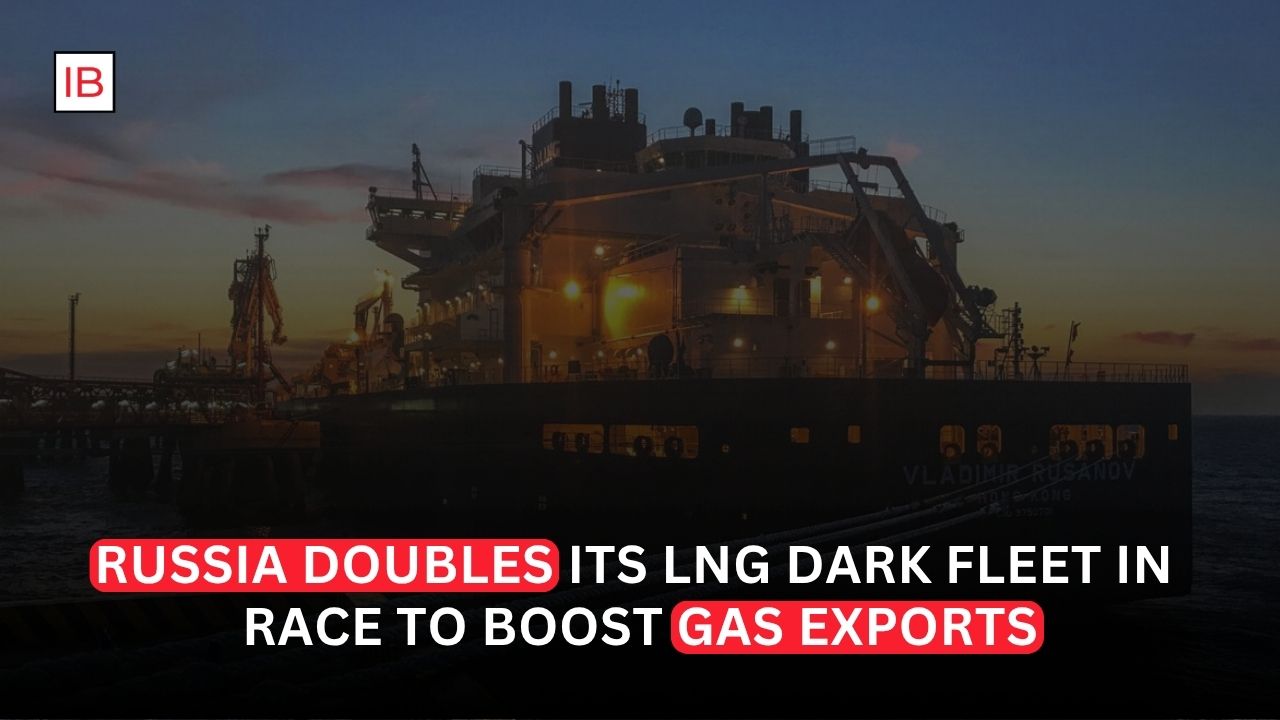
Russia is rapidly expanding a fleet of liquefied natural gas tankers used to move cargoes from sanctioned projects, highlighting Moscow’s efforts to keep its LNG exports growing despite Western restrictions. The fleet, increasingly described as a “dark fleet,” has roughly doubled in size this year as Russia searches for ways around sanctions that have made conventional shipping and financing more difficult.
The expansion is particularly important for Russia’s Arctic LNG projects. Moscow needs specialized vessels capable of operating in difficult northern waters, but many of the ships traditionally available for Arctic LNG transportation have links to Western owners, insurers or operators. Sanctions have therefore created a major logistical obstacle.
Russia’s response has been to acquire older vessels, change ownership structures and bring tankers into a shadow network that can transport sanctioned cargoes outside the traditional Western-controlled shipping system.
Russia Builds a Shadow LNG Fleet
At least 25 vessels are now believed to form part of Russia’s shadow LNG fleet, according to recent analysis of shipping activity. That represents a significant increase from earlier in the year. At least eight second-hand LNG carriers were brought into Russian service during the six months leading up to August.
The vessels are not necessarily owned directly by the Russian government.
Instead, ownership and management can involve companies with limited public information, making it more difficult for regulators and investigators to establish who ultimately controls the ships.
That structure is similar to the shadow fleet Russia has built for its oil exports.
Arctic LNG Is the Main Target
The fleet expansion is closely linked to Russia’s Arctic LNG operations.
Yamal LNG and Arctic LNG 2 are located in the country’s Arctic region, where shipping conditions are considerably more difficult than at conventional LNG terminals.
Specialized ice-class carriers are needed for parts of the year.
That makes the shipping fleet one of the most important bottlenecks for Russian LNG exports.
The problem became particularly severe after Western sanctions targeted Arctic LNG 2, limiting access to conventional shipping, financing and technology.
Russia’s growing fleet is intended to reduce that vulnerability.
Arctic LNG 2 Faces Heavy Sanctions
Arctic LNG 2 has been hit by extensive US sanctions.
The project was intended to become a major source of Russian LNG, but sanctions complicated its development and sharply restricted its ability to access conventional international markets.
Despite those restrictions, the project has continued producing and exporting some cargoes.
In May, Arctic LNG 2 exported more than 400,000 metric tons of LNG, its highest monthly volume since shipments began in 2024, according to ship-tracking data cited in earlier reporting.
That suggests Moscow is finding ways to keep the sanctioned project operating.
Old Tankers Are Being Recruited
Russia’s strategy involves buying or redirecting older LNG carriers.
Several vessels previously involved in Oman’s LNG trade have been moved into Russian service.
In May, four such tankers — Kosmos, Merkuriy, Orion and Luch — were reported to be loading or positioning to load LNG from the sanctioned Saam floating storage unit near Murmansk.
The vessels are considerably older than the newest generation of LNG carriers.
But their age matters less than their availability.
For Moscow, an aging tanker that can move sanctioned LNG may be more valuable than a modern vessel that cannot legally access the trade.
Saam Is a Key Link
The Saam floating storage unit near Murmansk plays an important role in the logistics of Arctic LNG 2.
It stores LNG produced by the sanctioned project before the cargo is transferred to ships capable of moving it toward international markets.
The location also allows Russia to manage cargoes separately from the main production site.
Because Arctic LNG 2 is difficult to access for much of the year, Saam effectively provides a logistical bridge between the Arctic production system and conventional LNG carriers.
That makes the floating storage facility a critical part of Moscow’s export strategy.
Russia Is Finding New Ways Around Sanctions
The growing dark fleet illustrates a broader problem facing Western sanctions.
Sanctions can make a trade more expensive and complicated without necessarily stopping it completely.
When conventional shipping companies withdraw, alternative operators can emerge.
When major banks refuse financing, less transparent financial structures can be used.
And when insurance becomes difficult to obtain, shipowners can seek alternative coverage arrangements.
The result is often a fragmented market rather than a complete shutdown.
Shipping Has Become a Strategic Weapon
For LNG, shipping capacity is especially important because the fuel cannot simply be sent through pipelines to distant markets.
Once natural gas is liquefied, it has to be transported in specialized refrigerated vessels.
That gives shipowners and shipping infrastructure enormous strategic importance.
Russia’s ability to acquire more LNG carriers therefore directly affects its ability to monetize gas reserves that might otherwise remain stranded.
The fleet expansion is consequently about much more than ships.
It is about preserving access to export revenue.
Russia Wants to Protect Gas Revenue
Energy exports remain a major source of income for Russia.
Western sanctions have targeted oil and gas in an effort to reduce Moscow’s ability to finance its war effort and constrain the country’s energy revenues.
LNG has become particularly important because Russia’s pipeline gas exports to Europe have been heavily disrupted compared with prewar levels.
Moscow therefore has an incentive to maintain and expand LNG exports wherever possible.
The development of alternative shipping capacity is one way to preserve that revenue stream.
LNG Exports Face a Changing Market
Russia is also operating in a global LNG market that has become more strategically important.
The war involving Iran and disruptions around the Strait of Hormuz have recently created major challenges for global gas supply.
Qatar, one of the world’s largest LNG exporters, has experienced a severe reduction in shipments because of difficulties moving cargoes through the strait.
Those disruptions have tightened the global market and pushed European LNG prices sharply higher.
That creates an unusual opportunity for Russia.
Even when sanctions restrict Russian LNG’s market access, elevated prices can increase the financial incentive to find alternative routes and buyers.
Europe Remains a Major Buyer
Despite sanctions, Europe remains an important destination for Russian LNG.
Data from the Centre for Research on Energy and Clean Air show that the European Union accounted for about 49% of Russia’s LNG exports in July 2026, ahead of China, Japan and South Korea.
That is a significant vulnerability for European energy policy.
The EU has been moving toward a full phaseout of Russian gas, but existing contracts and transitional arrangements mean Russian LNG has not disappeared immediately.
The remaining trade provides Moscow with an important source of revenue while Europe continues searching for alternative supplies.
The EU Is Tightening Restrictions
European restrictions on Russian LNG are becoming progressively tougher.
Short-term Russian LNG supply contracts were restricted earlier in 2026, while a broader EU import ban is scheduled to take effect in 2027 under the bloc’s REPowerEU framework.
That deadline increases the pressure on Russian producers.
If European demand disappears, Moscow will need alternative customers in Asia and elsewhere.
That makes the development of a shadow shipping fleet even more important.
Asia Could Become More Important
China, Japan and South Korea are already significant buyers of Russian LNG.
China accounted for about 23% of Russian LNG exports in July, while Japan accounted for approximately 18% and South Korea around 6%, according to CREA data.
Russia will likely look increasingly toward Asian markets as European restrictions tighten.
But transporting LNG from the Arctic to Asia is not straightforward.
Ice conditions, vessel availability and the distance involved all create logistical challenges.
Russia therefore needs more specialized shipping capacity to make that shift sustainable.
Western-Owned Ships Remain Important
The expansion of Russia’s dark fleet does not mean Moscow has solved its shipping problem.
Yamal LNG remains dependent on specialized Arc7 ice-class carriers.
Fourteen of the 15 vessels used for year-round exports from Yamal have Western ownership, according to CREA’s analysis.
That means Western-controlled shipping capacity remains a major source of leverage.
Russia is trying to reduce that leverage, but replacing a highly specialized fleet takes time.
Building New Ice-Class Ships Is Difficult
Russia has begun developing domestic LNG shipping capacity, including new vessels at the Zvezda shipyard.
The shipyard has delivered two carriers, while additional vessels are under construction.
However, several ice-class vessels ordered from South Korea remain blocked by sanctions.
This illustrates the technological challenge facing Moscow.
Building a conventional LNG carrier is already complicated.
Building one capable of operating safely through Arctic ice is significantly more demanding.
Ship-to-Ship Transfers Increase Flexibility
Russia has also increasingly relied on ship-to-ship transfers.
These operations can allow LNG cargoes to be moved between specialized Arctic carriers and conventional vessels.
Earlier this year, a rare double ship-to-ship operation near Murmansk demonstrated the growing sophistication of Russia’s Arctic LNG logistics network.
Such transfers can reduce the need for every vessel in the supply chain to have the same Arctic capabilities.
That gives Moscow greater flexibility.
But it also introduces additional safety, regulatory and logistical risks.
The Dark Fleet Is Not Risk-Free
Older vessels can present higher operational risks.
Many shadow-fleet ships have less transparent ownership structures and may operate outside the insurance and regulatory systems used by major Western shipping companies.
That can make accidents more difficult to manage.
For LNG, the risks are particularly serious because the cargo must be kept at extremely low temperatures.
A major incident could damage both the environment and Russia’s ability to continue using certain maritime routes.
Sanctions Could Become More Targeted
The growth of Russia’s LNG shadow fleet is likely to attract greater attention from Western governments.
Rather than trying to block every Russian LNG cargo, authorities could target individual vessels, owners, insurers and intermediaries involved in sanctioned trade.
That approach would increase the cost of operating the shadow fleet.
It could also make banks and ports more cautious about dealing with ships associated with Russian LNG.
Russia Is Playing a Long Game
Moscow’s strategy appears designed around persistence.
The goal is not necessarily to restore the LNG trade to its pre-sanctions structure.
Instead, Russia can create an alternative network that is more expensive, less transparent and more complicated, but still capable of generating exports.
The growing fleet is evidence of that strategy.
Each additional tanker reduces Russia’s dependence on the small number of specialized vessels still available through conventional markets.
The Economics Still Matter
The strategy only works if LNG exports remain economically worthwhile.
Shadow shipping is expensive.
Older vessels require more maintenance and can face higher insurance and financing costs.
Ship-to-ship transfers add logistical expenses.
Longer routes can also consume more fuel and increase transit times.
If global LNG prices fall sharply, some of those marginal shipments may no longer make economic sense.
Higher Prices Help Moscow
The current global environment is more favorable.
European LNG prices have risen to their highest levels since 2023 following disruptions to Middle Eastern gas supplies.
Higher prices can offset some of the additional costs associated with sanctioned trade.
That gives Russia a stronger incentive to continue expanding its alternative shipping network.
The longer prices remain elevated, the more attractive the economics of shadow shipping become.
Russia’s Oil Shadow Fleet Provides a Model
Russia already has extensive experience using shadow vessels to transport crude oil.
In July, more than half of Russian seaborne oil was transported by shadow tankers under sanctions, according to CREA.
The LNG fleet is much smaller because LNG carriers are more specialized.
But the basic strategy is similar.
Acquire vessels outside conventional Western ownership structures, obscure beneficial ownership where possible and create alternative logistics that can keep exports moving.
The LNG Fleet Could Continue Growing
Russia’s recent purchases suggest the fleet may expand further.
The country still faces a shortage of ice-class vessels, particularly for Arctic LNG 2.
If Moscow can acquire more suitable ships, it could increase the project’s export capacity.
That would make sanctions less effective unless Western governments also target the vessels and companies facilitating the trade.
The Bigger Battle Is Over Energy Influence
The dispute over Russian LNG is ultimately part of a broader contest over global energy markets.
Russia wants to remain one of the world’s leading gas exporters.
Western governments want to reduce Moscow’s energy revenues and diversify away from Russian supplies.
Asian buyers, meanwhile, are primarily interested in securing reliable gas at competitive prices.
Those competing objectives will continue to shape the LNG market.
Conclusion
Russia’s decision to roughly double its LNG dark fleet shows how aggressively Moscow is adapting to Western sanctions.
At least 25 vessels are now associated with the country’s shadow LNG shipping network, with at least eight second-hand carriers entering Russian service during the six months before August.
The objective is clear: keep Russian LNG moving even when conventional shipping, financing and insurance channels become unavailable.
The strategy is especially important for Arctic LNG 2, a project heavily targeted by US sanctions.
Russia has already demonstrated that it can move significant volumes from the project.
Arctic LNG 2 exported more than 400,000 tons in May, the highest monthly volume since the facility began shipping in 2024.
The expansion of the shadow fleet gives Moscow another tool for increasing those exports.
Older LNG carriers, alternative ownership structures and ship-to-ship transfers can help overcome some of the logistical restrictions imposed by sanctions.
But Russia has not eliminated its vulnerabilities.
The country still lacks enough specialized ice-class vessels, while many of the carriers serving Yamal LNG remain connected to Western owners.
New domestic vessels are being built, but production is slow and sanctions have disrupted some foreign orders.
Europe’s planned phaseout of Russian LNG will make the shipping challenge more important.
The EU remains Russia’s largest LNG market, accounting for nearly half of its exports in July.
If that market disappears, Russia will have to redirect more cargoes toward Asia.
That will increase the importance of shipping capacity and Arctic logistics.
At the same time, the current global LNG market gives Moscow an incentive to continue.
Middle Eastern supply disruptions have pushed LNG prices sharply higher, creating stronger economic returns for alternative shipments.
The key question is therefore whether Western sanctions can make Russia’s shadow LNG trade expensive enough to discourage additional exports.
So far, the evidence suggests that sanctions have raised the cost and complexity of Russian LNG exports rather than stopped them completely.
Russia’s expanding fleet demonstrates that Moscow is willing to spend money and accept greater logistical and operational risks to preserve its position in the global gas market.
For Europe, the development is another warning that reducing dependence on Russian energy will require more than formal import restrictions.
For Russia, the growing dark fleet is an attempt to ensure that even under increasingly restrictive sanctions, its Arctic gas reserves can still reach international buyers.