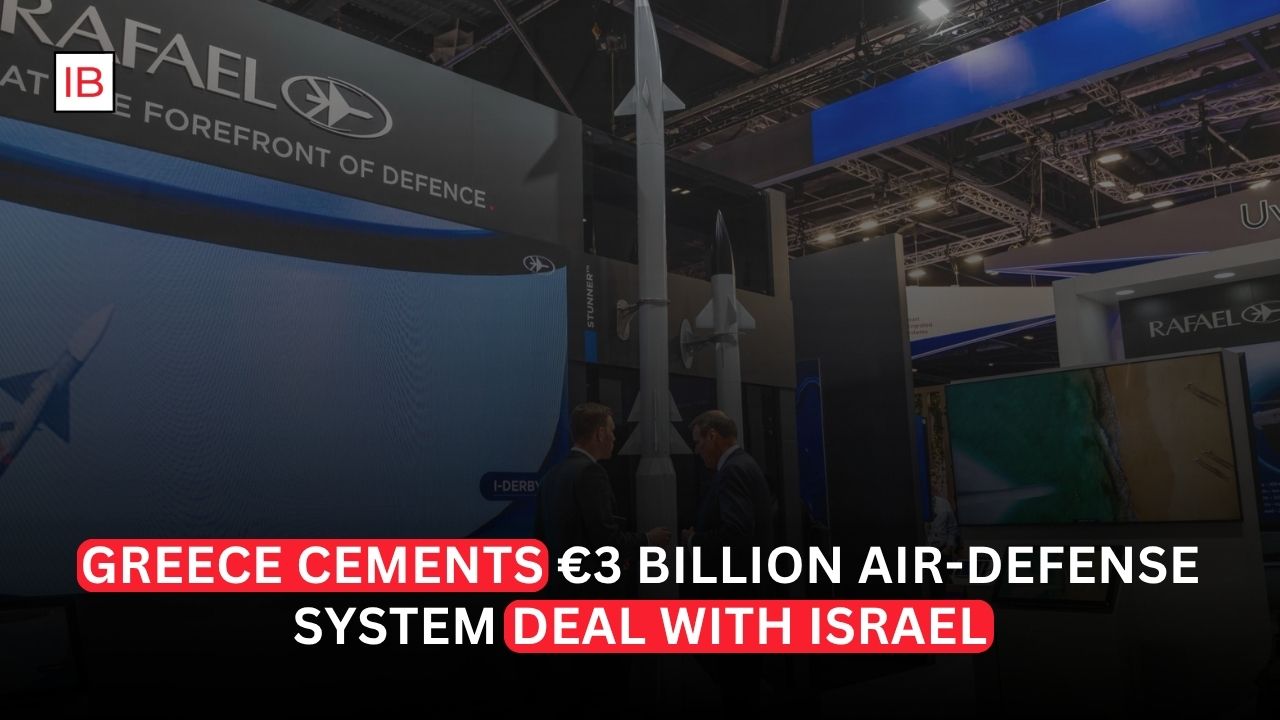
Greece and Israel have signed a roughly €3 billion ($3.5 billion) agreement that will give Athens a new multilayered air and missile defense network, marking the largest defense export deal between the two countries. The agreement, known as “Achilles Shield,” is a central part of Greece’s broader military modernization program as security concerns rise across the Eastern Mediterranean and beyond.
The deal brings together several Israeli-made systems designed to counter different types of threats, ranging from ballistic missiles and aircraft to drones. Rather than relying on a single interceptor or radar system, Greece is building an integrated network in which different layers are designed to work together.
A Multilayered Defense Network
The centerpiece of the agreement is the creation of a comprehensive air-defense architecture.
The system will include Rafael Advanced Defense Systems’ David’s Sling and SPYDER platforms, Israel Aerospace Industries’ BARAK MX system, and MMR multi-mission radars produced by IAI subsidiary ELTA. Greece will also receive a national command-and-control system designed by Rafael to coordinate the different components.
This structure is intended to give Greek forces multiple options for detecting and responding to incoming threats.
The concept reflects a major change in modern warfare, where missiles, drones, aircraft and other weapons can be used simultaneously.
David’s Sling Takes a Bigger Role
David’s Sling is one of the most prominent elements of the agreement.
The system is designed to intercept medium- and long-range rockets and ballistic missiles. It has been used by Israel during its recent conflict with Iran, giving Greece access to technology with recent operational experience.
Greece will become the second foreign customer for David’s Sling after Finland.
For Athens, that provides access to a system whose performance has been tested under actual combat conditions.
Drones Are Now a Major Threat
The agreement also reflects the growing importance of drones in modern warfare.
Greece will receive SPYDER systems and a separate €26 million deal for Rafael’s Drone Dome systems. The latter will be used to protect strategic sites against unmanned aerial vehicles and strengthen existing defenses.
Drones have become significantly cheaper and easier to deploy than traditional aircraft or missiles.
That has changed the economics of air defense.
A relatively inexpensive drone can force an opponent to spend considerably more on detection and interception.
For Greece, building dedicated counter-drone capabilities is therefore becoming increasingly important.
Greece Is Modernizing Its Military
The air-defense agreement forms part of a much larger Greek defense buildup.
Athens plans to spend around €28 billion through 2036 on strengthening its armed forces, including the purchase of up to 40 F-35 fighter jets from the United States and additional warships from European suppliers.
Greece already spends close to 3.5% of gross domestic product on defense, placing it among the higher-spending NATO members.
The government argues that the changing character of warfare requires a substantial upgrade of existing capabilities.
Turkey Remains a Major Factor
Greece’s defense planning cannot be separated from its long-running tensions with neighboring Turkey.
The two NATO members have repeatedly disagreed over territorial waters, airspace, energy resources and competing claims in the eastern Mediterranean.
Although both countries are members of the same military alliance, their rivalry has encouraged Athens to maintain substantial defense capabilities.
The new air-defense system is therefore not simply a response to the wider regional environment.
It also strengthens Greece’s deterrence against a sophisticated neighboring military.
Israel and Greece Deepen Their Strategic Relationship
The agreement represents another step in the expanding defense relationship between Israel and Greece.
The two countries have increased military cooperation over the past decade, including training, procurement and industrial partnerships.
Israel views Greece as an important strategic partner in the Eastern Mediterranean, while Greece sees Israeli defense technology as a way to rapidly strengthen its capabilities.
The scale of the latest agreement demonstrates how far that relationship has developed.
Israel’s Biggest Deal With Greece
The €3 billion contract is the largest defense export agreement in the history of Israel-Greece relations and one of the largest Israeli defense deals overall.
For Israel’s defense industry, the agreement is significant both financially and strategically.
Israeli defense companies have increasingly benefited from demand for missile defense, drones, radar and other systems.
The country’s recent wars have also given its manufacturers an unusual selling point: many of their systems have been used in active combat.
That does not eliminate questions about cost or performance, but it provides foreign buyers with operational evidence.
Technology Transfer to Greece
The agreement goes beyond simply delivering weapons.
Israel will expand defense-industrial cooperation with Greece, including the transfer of knowledge and technology to Greek industry.
That could provide longer-term benefits for Greece.
Local companies could participate in production, maintenance, integration and other parts of the program.
Earlier reports indicated that Greek industry could receive a meaningful share of the project’s work through subcontracting arrangements.
This could help Athens develop greater domestic expertise instead of relying entirely on foreign suppliers.
Command and Control Is Crucial
One of the less visible but important elements of the agreement is the national command-and-control system.
Modern air defense depends on more than interceptors.
Radar networks must identify threats, determine their trajectory and communicate that information quickly to the appropriate defense system.
A centralized command structure can coordinate multiple systems and reduce duplication.
The Greek network is expected to incorporate advanced software and artificial-intelligence capabilities to help manage the country’s air-defense architecture.
The System Will Cover Multiple Threats
The key advantage of a multilayered network is that different systems can address different threats.
Longer-range ballistic missiles require different interception capabilities from low-flying aircraft or small drones.
A single defense system cannot efficiently handle every type of attack.
By combining David’s Sling, BARAK MX, SPYDER, radars and command systems, Greece is attempting to create overlapping layers of protection.
The objective is not to make the country completely invulnerable.
No air-defense system can guarantee that.
Instead, the goal is to make attacks more difficult, expensive and uncertain for an adversary.
Greece Moves Toward Network-Centric Warfare
The program represents a broader shift in Greek military thinking.
Rather than purchasing isolated weapons systems, Athens is trying to create a connected defense architecture.
That approach is increasingly important as modern militaries use drones, satellites, electronic warfare, cyber capabilities and precision missiles together.
Greek Defense Minister Nikos Dendias has argued that traditional defense doctrines are no longer sufficient for the modern battlefield.
The Achilles Shield program is intended to reflect that reality.
Israel Gains a Major Export Customer
The agreement is also important for Israel.
Israeli defense exports exceeded $19 billion in 2025, according to official data cited by the Associated Press, and Israel has become one of the world’s leading suppliers of missile and air-defense technology.
The Greek contract strengthens the country’s position in the European defense market.
European governments have been increasing military spending because of the war in Ukraine, concerns about Russia and broader uncertainty over regional security.
Israel is therefore competing for a growing pool of European defense spending.
Europe Is Spending More on Defense
Greece’s decision is part of a wider European trend.
Governments across the continent are reassessing military capabilities after Russia’s invasion of Ukraine exposed weaknesses in ammunition stocks, air defense and other areas.
Missile defense has become particularly important because modern conflicts have demonstrated how vulnerable infrastructure and military bases can be to drones and missiles.
For European defense companies and foreign suppliers, this has created a substantial market opportunity.
The Cost Will Be Significant
A €3 billion defense system is a major financial commitment.
Greece has improved its fiscal position in recent years, but defense spending competes with other government priorities.
The country must also fund pensions, healthcare, infrastructure and economic development.
The larger €28 billion defense modernization program therefore represents a long-term fiscal commitment.
Athens will need to ensure that procurement costs, maintenance and future upgrades remain affordable.
More Than an Arms Purchase
The Achilles Shield agreement should therefore be viewed as more than a simple weapons transaction.
It represents a shift in Greece’s defense strategy, deeper cooperation with Israel and a significant expansion of Greek military capabilities.
It also reflects a broader transformation in warfare.
Drones, ballistic missiles, precision weapons and networked systems are increasingly shaping military planning.
Countries that previously focused heavily on fighter jets and traditional weapons are now investing more heavily in integrated air defense.
Conclusion
Greece’s €3 billion agreement with Israel marks a major step in the country’s military modernization and strengthens an increasingly important strategic relationship between Athens and Jerusalem.
The Achilles Shield program will combine David’s Sling, SPYDER, BARAK MX, MMR radar systems and a national command-and-control network into a multilayered defense architecture.
The system is designed to address a broad range of threats, including ballistic missiles, aircraft and drones.
That matters because modern conflicts are becoming increasingly complex.
The battlefield is no longer dominated by traditional aircraft and artillery alone. Cheap drones can threaten expensive infrastructure, while ballistic and precision missiles can travel long distances and arrive with little warning.
Greece’s strategy is therefore to build overlapping defenses rather than rely on a single weapons platform.
The purchase also has a strong geopolitical dimension.
Athens has long-standing tensions with Turkey, and the two NATO members continue to compete over territorial and strategic issues in the eastern Mediterranean.
At the same time, Greece is responding to a broader deterioration in Europe’s security environment.
The country plans to spend about €28 billion through 2036 on defense modernization, including fighter aircraft and naval capabilities.
For Israel, the agreement is an important commercial and strategic victory.
It is the largest defense export deal between Israel and Greece and one of Israel’s largest arms agreements overall.
The deal also expands industrial cooperation by bringing Greek companies into the program and allowing technology and expertise to flow into Greece.
The larger significance may ultimately be the move toward an integrated defense network.
Greece is not simply buying individual weapons.
It is attempting to create a system in which radars, interceptors, counter-drone equipment and command infrastructure work together.
That approach is becoming increasingly common as militaries adapt to a battlefield defined by drones, missiles, electronic warfare and rapid technological change.
The Achilles Shield program will not make Greece immune to attack.
No defense network can provide that guarantee.
But it can increase the cost and complexity of any potential attack while giving Greek forces more options for responding to different threats.
For Athens, that makes the agreement a major investment in deterrence.
For Israel, it provides a significant new European customer and strengthens the country’s position in one of the world’s fastest-growing defense markets.