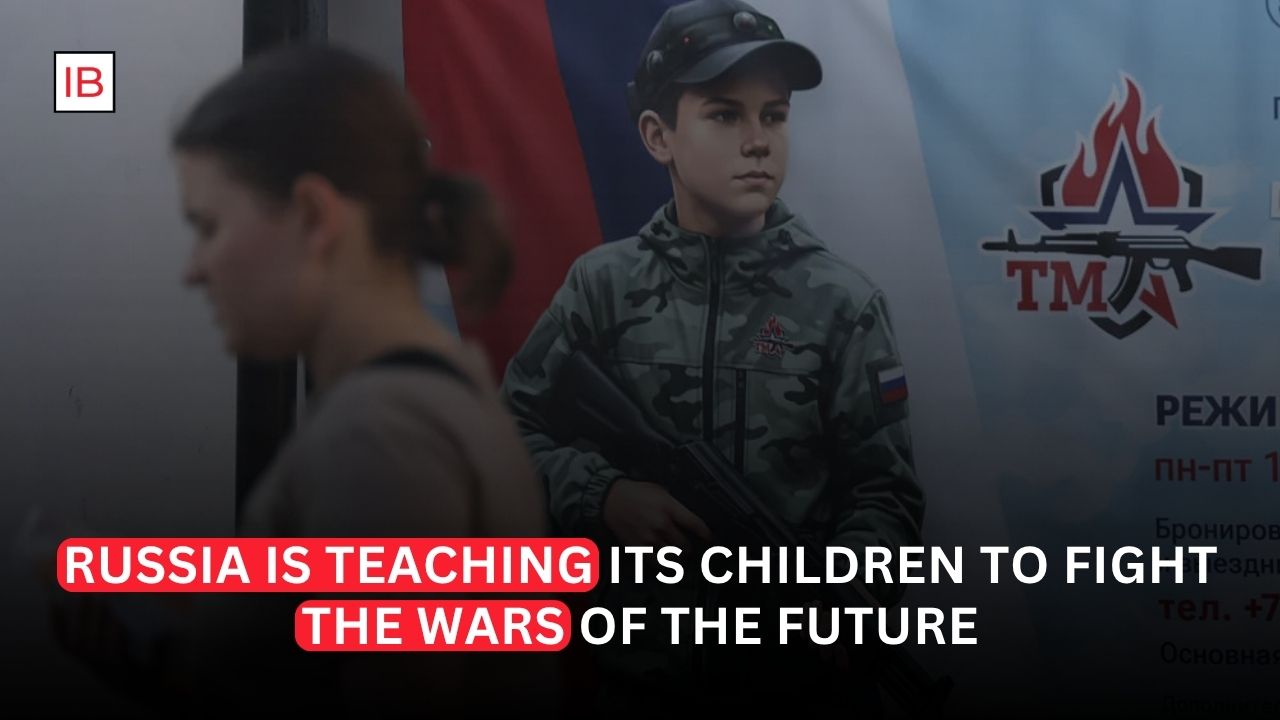
Russia is expanding military and patriotic education for children as the Kremlin prepares society for what it portrays as a prolonged confrontation with external threats. Schools, youth organizations and military-training centers are increasingly being used to familiarize young Russians with military values, national-security narratives and the practical skills associated with future service.
The development is part of a much broader transformation of Russian education since the invasion of Ukraine. What was once largely described as patriotic education is increasingly connected to military preparedness, with children exposed to the idea that defending the state is an important part of citizenship.
Military Training Moves Into Schools
From September 2026, Russia is expanding basic military training for students in Years 6 through 11. Reports indicate that military preparation within the school subject Fundamentals of Security and Defence of the Motherland will account for about half of teaching time, compared with roughly one-fifth previously. The expanded approach is also being extended to schools in Russian-occupied Ukrainian territories.
The change illustrates how military preparation is moving from voluntary youth activities toward the mainstream education system.
Students are being introduced to subjects connected with national security, emergency response and military service. The objective is not necessarily to turn every child into a soldier, but to make military concepts familiar long before young people reach conscription age.
A Culture of Permanent Readiness
The Kremlin’s approach goes beyond weapons or battlefield skills.
Russia is building a culture in which children are repeatedly exposed to ideas of national defense, sacrifice and loyalty. Recent nationwide exercises in schools and kindergartens included simulated responses to hostage situations, attacks involving flammable liquids and drone attacks. Russia’s Education Ministry said the exercises were designed to train staff and security personnel to respond to threats.
These exercises are presented as safety measures.
But when combined with military lessons, patriotic programs and youth organizations, they contribute to a wider environment in which children encounter security threats as a normal part of everyday life.
Youth Organizations Are Central
Russia has also built a large network of state-backed youth organizations.
Yunarmiya, or the Youth Army, combines physical training, military activities and patriotic education. The Movement of the First, established after the invasion of Ukraine, provides a broader youth platform built around state-approved ideas of citizenship and patriotism.
The Center for Military-Sports Training and Patriotic Education of Youth, known as VOIN, goes further by providing military-oriented training to teenagers and young adults.
According to research from the Center for Security Studies at ETH Zurich, more than 150,000 participants reportedly passed through VOIN programs between 2022 and 2026.
Preparing for Future Warfare
The training is also changing because warfare itself is changing.
Drones have become one of the defining technologies of the war in Ukraine. Surveillance, electronic warfare, battlefield medicine and rapid adaptation are increasingly important alongside traditional military skills.
Russian military-patriotic centers are consequently teaching young people skills that officials believe could be relevant to modern conflict.
The message is clear: future wars will not necessarily look like the wars of the 20th century.
That makes technological familiarity part of Russia’s broader effort to prepare its younger population.
Avangard Centers
Among the most important institutions are Avangard military-patriotic centers.
These programs provide teenagers with intensive military-oriented instruction, including weapons handling, tactical medicine, drills, drone operation and responses to chemical, biological, radiological and nuclear threats.
The centers are designed for teenagers approaching conscription age.
Their importance lies partly in the fact that participation can be integrated into school programs. That gives the state access to students who might never voluntarily join a military youth organization.
According to ETH Zurich researchers, Russia had established more than 100 Avangard centers across the country by 2025-26.
Veterans Become Teachers
Another important development is the increasing involvement of war veterans in education.
Russia’s Education Ministry has described veterans of the Ukraine war as having valuable potential for working with children.
That creates a direct connection between the battlefield and the classroom.
Veterans can present military service through personal experience, making the state’s message more emotionally powerful than a conventional textbook.
It also reinforces the idea that military service is not a separate profession but a respected path that young people should consider.
The Occupied Territories
The policy extends beyond Russia’s internationally recognized borders.
Schools in Russian-occupied parts of Ukraine are also being incorporated into Moscow’s military and patriotic education programs. Reports indicate that the military-training component for schoolchildren in those territories is being expanded significantly.
This has a political dimension as well as a military one.
Education is being used to reshape how children understand identity, history and their relationship with the Russian state.
International organizations have raised serious concerns about the militarization and indoctrination of Ukrainian children under Russian occupation.
Why Moscow Is Doing This
The immediate explanation is recruitment.
Russia has suffered enormous personnel losses during the war in Ukraine, while Western officials say the country is struggling to replace battlefield casualties with new recruits.
But recruitment alone does not explain the scale of the program.
The deeper objective is social preparation.
The Kremlin wants future generations to see military service, national security and confrontation with foreign powers as normal elements of Russian life.
That can make future mobilization politically easier.
It Is Also About Regime Stability
There is another dimension that receives less attention.
Militarized youth policy can strengthen political loyalty.
If schools teach a state-approved version of history while youth organizations promote loyalty and military service, young people are being socialized into a political system that places the state at the center of national identity.
ETH Zurich researchers argue that Russia’s youth militarization is aimed not only at military preparedness but also at regime stability and the creation of loyalty networks.
That distinction matters.
Russia does not necessarily need every young person to become an enthusiastic supporter of the war.
It may be enough to produce a smaller pool of highly committed recruits while making broader society less resistant to military policies.
Does the Strategy Work?
The answer is complicated.
Young Russians are not uniformly enthusiastic about the war, and age differences in political attitudes remain significant.
Some parents and teachers resist or minimize elements of patriotic education.
Others simply comply without internalizing the message.
That limits the effectiveness of any attempt to engineer political attitudes through education.
But the Kremlin does not necessarily need complete ideological success.
Repeated exposure can normalize military concepts even among people who remain politically indifferent.
That may be enough to reduce resistance to future recruitment or mobilization.
A Long-Term Strategy
The most important point is that Russia’s youth policy should be viewed as a long-term project.
The Kremlin is not simply responding to today’s battlefield.
It is preparing institutions, schools and young people for a future in which confrontation with the West may continue for years.
Military education therefore becomes part of national planning.
Children entering school today could reach adulthood in an environment where military service, technological warfare and geopolitical confrontation are considered ordinary.
The Drone Generation
Perhaps the clearest symbol of this transformation is the drone.
The Ukraine war has demonstrated how relatively inexpensive unmanned systems can transform battlefield tactics.
Teaching young people about drones therefore has both military and technological implications.
Russia wants future soldiers and engineers who understand the technologies that are reshaping warfare.
That could eventually influence the country’s defense industry as well as its armed forces.
A More Militarized Society
Russia’s approach ultimately raises a larger question: what happens when military thinking becomes embedded in civilian institutions?
Schools are supposed to prepare children for employment, citizenship and adult life.
When security and military preparation become increasingly prominent, the boundary between civilian education and national defense becomes less distinct.
That does not mean Russia is immediately converting all children into soldiers.
It does mean the state is making military readiness part of childhood socialization.
Conclusion
Russia’s expanding military education system represents a long-term effort to prepare its younger generation for a country that the Kremlin expects to remain under geopolitical pressure.
The changes go far beyond traditional patriotic lessons. Schools are incorporating more military preparation, youth organizations promote service and loyalty, veterans are being brought into educational settings, and specialized centers provide teenagers with practical military training.
The war in Ukraine has accelerated this transformation.
Drones, electronic warfare and other technologies are changing how Russia thinks about future conflict, while the country’s continuing manpower requirements create additional incentives to prepare young people for military service.
But recruitment is only part of the story.
The broader objective appears to be building a society that is psychologically and institutionally prepared for prolonged confrontation.
That strategy may not produce universal enthusiasm for war. Young Russians can remain skeptical, indifferent or privately opposed to official narratives.
Yet normalization itself has political value.
If military service becomes familiar, patriotic messaging dominates school life and security threats are treated as ordinary, the Kremlin may face less resistance when it asks future generations to sacrifice for the state.
The most significant consequence may therefore emerge years from now.
Russia is not simply teaching today’s children how to respond to the wars of today. It is attempting to shape how an entire generation understands war, national identity and its relationship with the state.
That makes youth militarization an important part of Russia’s long-term security strategy—and a development that will matter well beyond the current conflict in Ukraine.