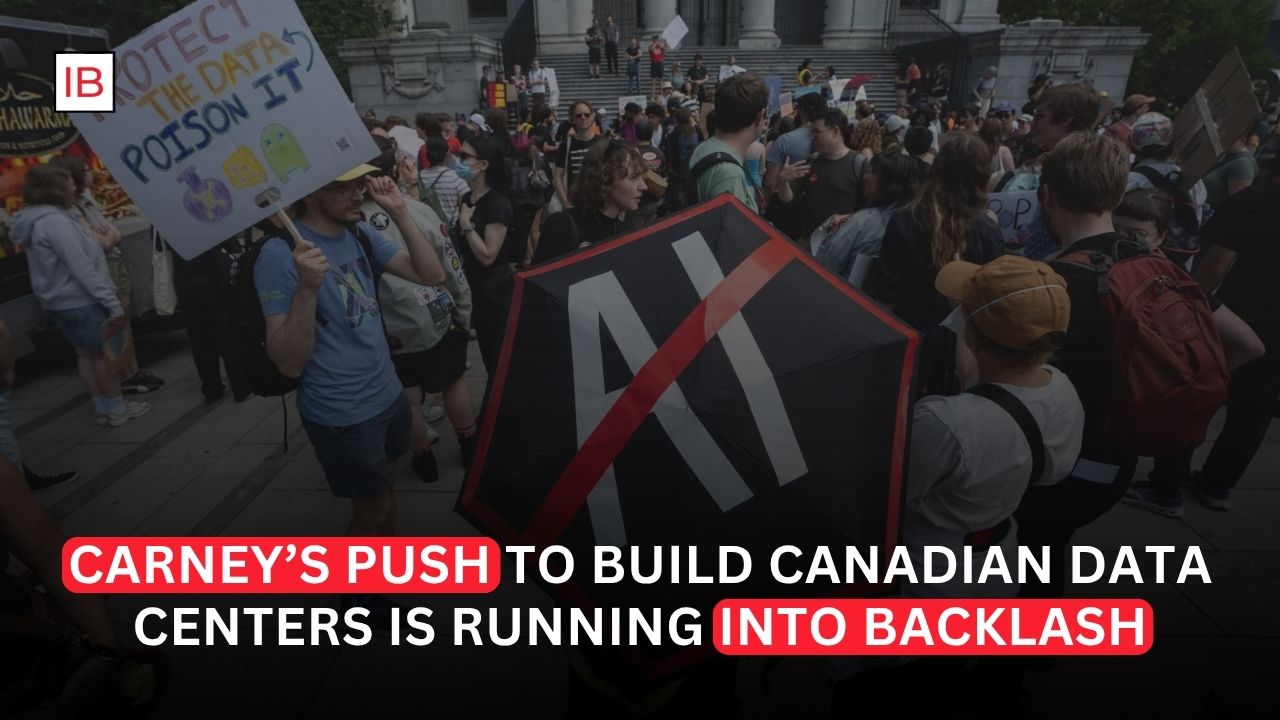
Communities Raise Concerns Over Electricity, Water and the Rapid Expansion of AI Infrastructure. Canadian Prime Minister Mark Carney’s push to expand the country’s data-center capacity is facing growing resistance from local communities concerned about the environmental and economic impact of the artificial intelligence boom.
The federal government sees new data centers as an important part of Canada’s plans to strengthen its digital infrastructure and compete in the global race for artificial intelligence. But residents in communities across the country are increasingly questioning where the facilities will be built, how much electricity and water they will consume, and whether ordinary Canadians could ultimately bear some of the costs.
AI Expansion Meets Local Opposition
Plans for large-scale data-center projects have triggered opposition in several Canadian communities, from British Columbia and Alberta to Ontario.
Residents have raised concerns about the enormous amount of power required by AI-focused facilities, as well as potential noise, water consumption and environmental effects. Proposed projects have become increasingly controversial as Canada’s data-center industry prepares for a significant expansion.
The opposition reflects a broader problem facing governments around the world: while national leaders see data centers as critical infrastructure for the AI economy, the consequences of building them are often felt most directly by local communities.
Canada Plans Major Expansion
Canada currently has relatively limited AI data-center capacity compared with the scale of projects now being proposed.
Government documents have identified more than 20 gigawatts of potential capacity in projects that are being planned or developed, although officials have stressed that this figure does not represent the amount they expect will ultimately be built.
Carney’s government has promoted domestic data infrastructure as part of a broader effort to strengthen Canada’s technological independence and ensure that the country does not become overly dependent on foreign computing capacity.
Electricity Costs Become a Major Concern
One of the biggest questions surrounding the expansion is who will pay for the electricity infrastructure required to support huge new facilities.
AI data centers can consume enormous amounts of power, requiring new generation capacity and major investments in transmission systems. Residents and local officials fear that rapid development could place additional pressure on electricity grids and eventually contribute to higher utility costs.
The federal government’s framework for future projects includes a principle that data centers should avoid shifting infrastructure costs onto ordinary Canadians, but the guidelines are voluntary and the federal government does not control many of the key approval decisions.
Water and Environmental Concerns Grow
Communities are also raising concerns about water consumption and the environmental footprint of large data centers.
Many of the facilities require substantial amounts of energy for computing and cooling, creating questions about emissions, local water supplies and the long-term sustainability of the AI infrastructure boom.
Critics argue that governments need clearer rules before approving large numbers of projects, while supporters say new technology and renewable-energy investments can reduce the environmental impact.
The growing opposition in Canada mirrors a wider international backlash against the rapid expansion of AI data centers, with communities increasingly demanding greater transparency and stronger environmental protections.
Ottawa Attempts to Address Concerns
The federal government has responded by introducing a national framework outlining principles for responsible data-center development.
The proposals call on companies to provide lasting benefits to local communities, reduce environmental impacts, limit water use and be transparent about the effects of their projects.
However, the framework is voluntary, and provinces and municipalities retain significant control over where projects can be approved and how they are regulated.
That division of responsibility could make it more difficult for Ottawa to push forward with a national strategy while local governments face growing pressure from residents.
Political Risk for Carney’s Government
The backlash could become an increasingly important political issue as the number of proposed projects grows.
Data centers have become a visible symbol of wider concerns about artificial intelligence, including fears over job losses, environmental damage and the growing influence of major technology companies.
Supporters of the projects argue that Canada risks falling behind in the global AI race if it does not rapidly expand its computing infrastructure. Opponents, however, say the country should not sacrifice local communities and environmental protections in the name of technological competition.
Canada Faces a Difficult Balancing Act
For Carney, the challenge will be finding a balance between building the infrastructure needed for Canada’s AI ambitions and maintaining public support for the projects.
The government wants more domestic computing capacity, investment and technological independence. But the rapid growth of data centers is creating new concerns about power grids, water resources and whether local communities will receive enough benefits in return.
For now, Canada’s data-center push is moving forward, but the growing public backlash suggests that building the infrastructure behind the AI economy may prove politically and socially more difficult than simply securing investment and approving new projects.