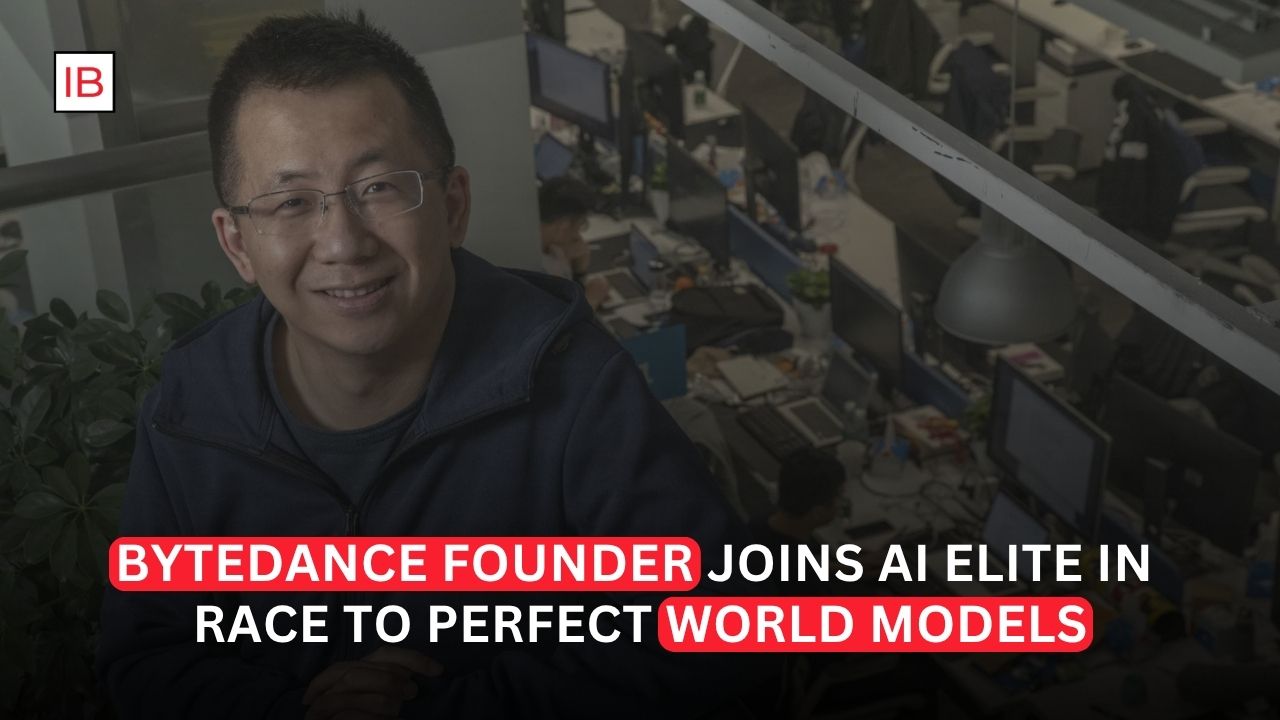
ByteDance founder Zhang Yiming is stepping deeper into the global artificial-intelligence race as the entrepreneur pushes the company toward increasingly ambitious models designed to understand and simulate the world rather than simply generate text or images.
Zhang, who stepped down from ByteDance’s day-to-day leadership several years ago, has become increasingly involved in the company’s AI strategy. His renewed focus comes as ByteDance prepares to compete with leading US and Chinese AI developers in a race that is shifting from conventional chatbots toward systems capable of reasoning across complex environments, predicting events and interacting with the physical world.
The concept of a “world model” is broader than the large language models that powered the first wave of generative AI. Instead of focusing primarily on predicting the next word, world models seek to build internal representations of how environments behave, allowing AI systems to anticipate what could happen after an action. The technology is viewed as potentially important for autonomous vehicles, robotics, industrial automation and AI agents that must operate in dynamic physical environments.
For ByteDance, the effort represents an expansion of its already significant AI ambitions. The company established its Seed AI research organization in 2023 and has developed models spanning language, video, image generation and other areas. Its work on AI-generated video has also positioned it among China’s most closely watched technology companies as competition with US laboratories intensifies.
ByteDance is now reportedly pursuing a model on a scale approaching Anthropic’s most advanced systems. The Financial Times has reported that the company is training a model that could reach an enormous parameter count, highlighting the resources that Chinese technology groups are prepared to commit to frontier AI despite restrictions on access to the most advanced US-made semiconductors.
The scale of the effort also reflects Zhang’s changing philosophy toward AI development. In August, Reuters reported that Zhang had instructed ByteDance employees not to rely on model distillation to improve the company’s AI systems, even if avoiding the technique meant sacrificing some short-term progress. Distillation involves using outputs from a more capable model to train a smaller or competing system and has become a contentious issue in the international AI industry.
Zhang’s decision to reject that shortcut underscores the importance he places on developing proprietary capabilities. Rather than attempting to replicate the behavior of competing models, ByteDance is seeking to build its own research base, data pipelines and computing infrastructure.
That strategy could become increasingly expensive. Frontier AI development requires enormous quantities of computing power, high-quality training data and specialized researchers. US restrictions on advanced semiconductor exports have also complicated China’s access to Nvidia’s latest processors, forcing Chinese companies to combine domestic chip development with alternative approaches to computing efficiency.
At the same time, China’s AI industry is becoming more competitive. ByteDance faces established technology giants such as Alibaba, Tencent and Baidu as well as a growing group of specialist AI companies. Chinese chipmakers are also working to reduce dependence on Nvidia, creating a broader domestic ecosystem around AI infrastructure.
ByteDance’s advantage is the enormous amount of data generated by its global consumer platforms and its experience in recommendation systems, video and computer vision. Those capabilities could prove useful for training AI systems that need to understand visual environments and human behavior rather than simply process written instructions.
The race for world models also puts ByteDance in competition with some of the world’s most prominent AI researchers. The field has attracted attention from companies and laboratories pursuing systems that can reason about physical environments, predict consequences and eventually control robots or autonomous machines.
Yet there is a major gap between building a larger model and creating a reliable world model. More parameters do not automatically translate into better physical reasoning or an accurate understanding of cause and effect. Researchers continue to debate what architecture, training methods and data are required to produce systems that genuinely model the underlying world rather than reproduce patterns found in their training material.
For Zhang, the challenge is therefore both technological and strategic. ByteDance has already demonstrated its ability to build consumer products at enormous scale. Its next test is whether that same engineering culture can produce frontier AI capable of competing with the best systems developed in Silicon Valley and elsewhere.
The stakes are high. If world models become a foundation for robotics, autonomous agents and physical AI, the companies that master them could gain influence well beyond the chatbot market. Zhang’s return to the center of ByteDance’s AI ambitions suggests that the founder believes the next major technology battle will be fought not simply over who has the smartest chatbot, but over who can build AI that understands how the world works.