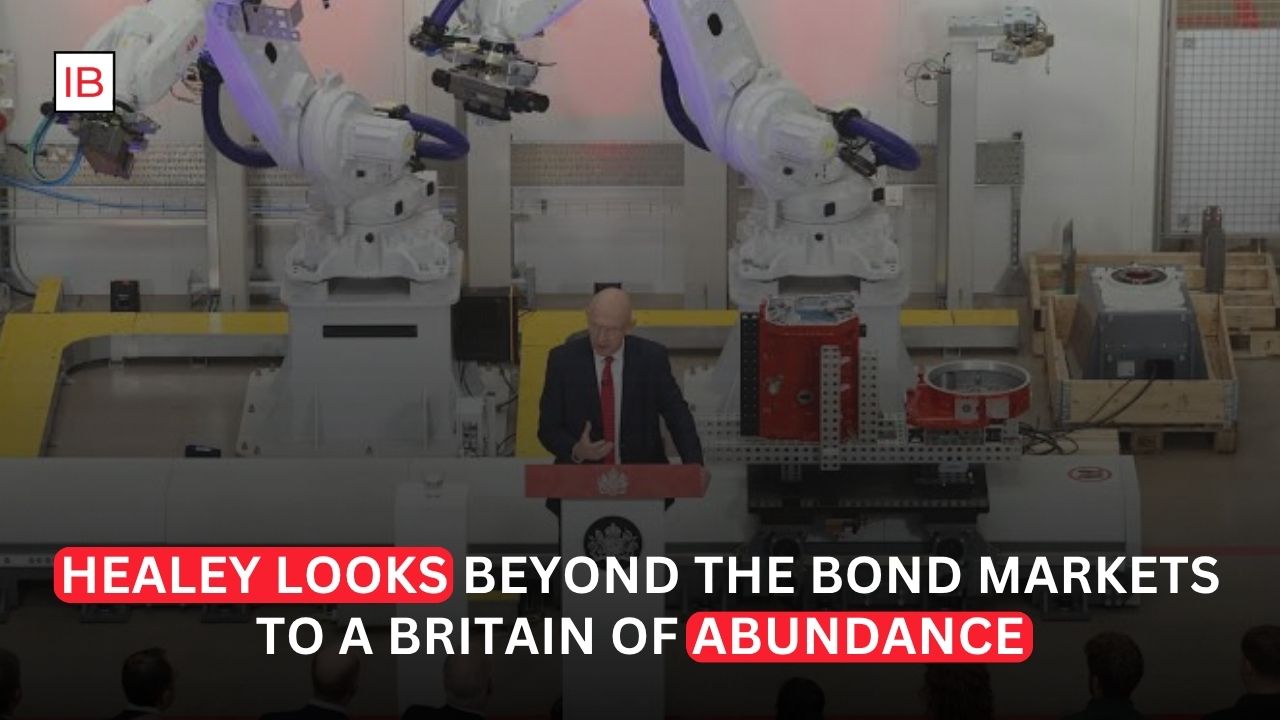
Britain’s new Chancellor John Healey is attempting to shift the country’s economic conversation away from the immediate constraints of government borrowing and toward a longer-term vision of stronger investment, productivity and living standards, but his ambition faces an unforgiving test from financial markets. In his first major economic speech, Healey argued that Britain can become a faster-growing, more productive economy by giving businesses greater room to invest while devolving economic powers to regions outside London.
Healey’s message comes only weeks before his first Budget on October 28, when investors will judge whether the government’s promises can coexist with tight public finances. UK borrowing costs have risen sharply, with 10-year gilt yields recently reaching their highest level since 2008 amid a global bond selloff intensified by the economic consequences of the Iran war. The pressure leaves the Chancellor with considerably less room for error than the language of his growth agenda might suggest.
The Chancellor is presenting growth as the route out of that constraint rather than simply treating fiscal consolidation as the main objective. His speech emphasized Britain’s scientific and research strengths, deep capital markets and strong stock-market performance, while promising reforms intended to make it easier for companies to invest and expand. He also announced £150 million through the British Business Bank for fast-growing businesses in northern England.
A major part of the strategy is decentralization. Healey wants city regions and local authorities to have greater control over investment decisions, arguing that economic growth has been too concentrated geographically. The government has outlined a roadmap for devolving investment powers, part of a broader effort by Prime Minister Andy Burnham’s administration to reverse decades of economic centralization and strengthen regional economies.
The approach represents an attempt to reconcile two competing political pressures. Burnham’s government wants to increase investment in housing, infrastructure, social care and regional development, while investors are demanding evidence that public spending will remain consistent with credible fiscal rules. Healey has therefore repeatedly stressed discipline alongside investment, seeking to reassure bond markets that the government will not repeat the mistakes associated with Britain’s 2022 market crisis.
Markets have so far shown little enthusiasm for a dramatic change in economic direction. Sterling was broadly stable against the dollar after Healey’s speech, while analysts said the proposals largely remained consistent with policies inherited from former Chancellor Rachel Reeves. The pound’s limited reaction suggests investors are waiting for more concrete evidence, particularly from the October Budget, rather than responding strongly to the rhetoric of a new economic era.
That caution reflects the scale of the fiscal challenge. Healey is inheriting an economy with high debt costs and limited budgetary headroom while also facing demands for additional spending. The government has major commitments involving housing, social programs and defense, and analysts have warned that maintaining fiscal credibility could require spending reductions, tax increases or a combination of both.
The bond market is therefore likely to remain the ultimate constraint on the government’s ambitions. Investors have become particularly sensitive to any sign that British policymakers intend to increase borrowing without a convincing explanation of how debt will eventually stabilize. Long-dated gilt yields have already risen substantially, increasing the cost of servicing the national debt and making every additional spending commitment more expensive.
Healey’s argument is that focusing exclusively on debt reduction risks overlooking the economic damage caused by weak productivity and insufficient investment. A larger economy would generate more tax revenue and potentially make today’s debt burden easier to manage. But that proposition depends on investment producing tangible improvements in productivity, wages and business activity rather than simply increasing government expenditure.
There is also a political calculation. Burnham came to power promising to reverse what he describes as decades of economic decline, while Healey has been tasked with turning that political vision into a credible fiscal strategy. The Chancellor’s emphasis on business investment, technology, regional growth and regulatory reform is intended to show that the government’s ambitions are not limited to expanding the public sector.
Yet the hardest decisions have been postponed until the Budget. Healey has declined to rule out tax increases, while insisting that the government will respect its fiscal rules. That leaves households and businesses waiting for clarity on how the government intends to finance its investment agenda at a time when borrowing costs remain elevated.
The result is a delicate balancing act. Healey wants Britain to look beyond the bond market and toward an economy defined by investment, innovation and greater regional prosperity. But until the government demonstrates that this vision can be financed without undermining confidence in British public finances, the bond market will continue to have the final word. The October Budget will determine whether Healey’s promise of a more abundant Britain represents a credible economic strategy or simply another ambitious political narrative constrained by fiscal reality.