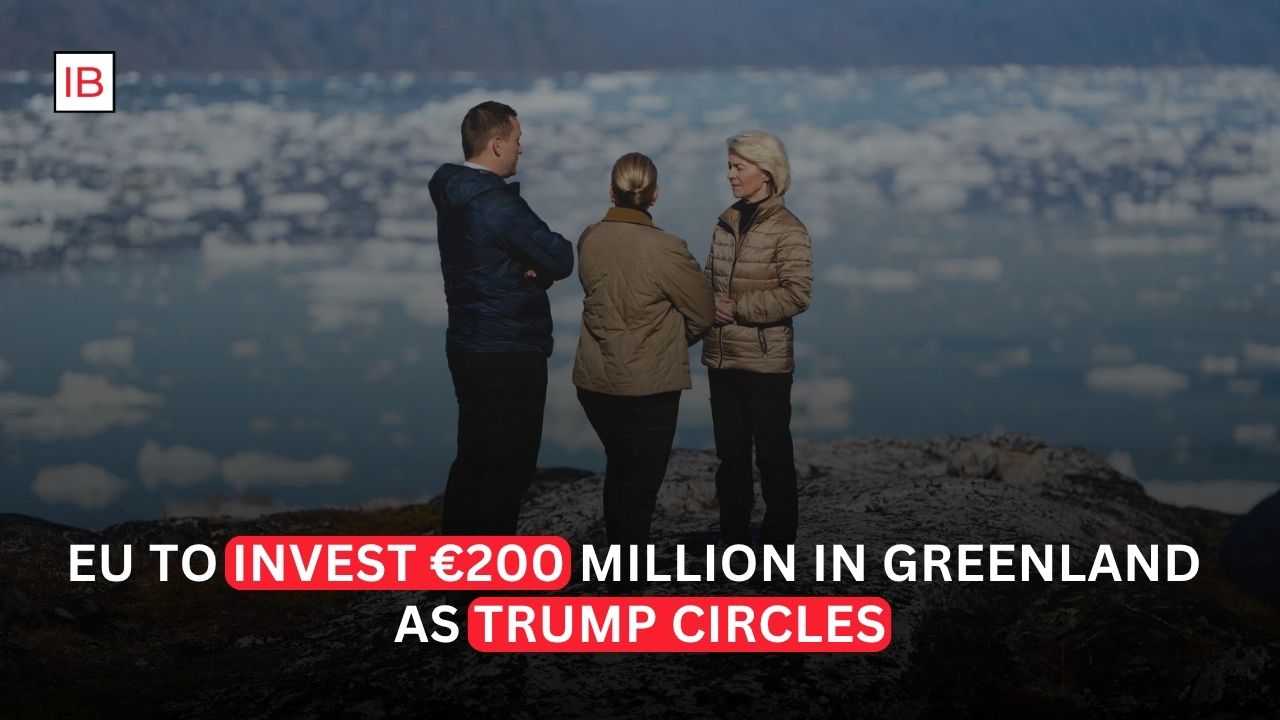
The European Union has pledged €200 million ($232.5 million) in new investment for Greenland as Brussels moves to deepen its political and economic relationship with the strategically important Arctic territory amid renewed pressure from US President Donald Trump for greater American control of the island.
European Commission President Ursula von der Leyen announced the package during a two-day visit to Greenland, where she met Greenlandic and Danish leaders and signed a renewed partnership agreement. The funding will be deployed during 2026 and 2027 and will target areas including digital connectivity, sustainable mining, energy, tourism, education, fisheries and housing.
The investment represents a significant expansion of the EU’s engagement with Greenland at a time when the Arctic island has become increasingly important in global strategic competition. Greenland is an autonomous territory within the Kingdom of Denmark and is not part of the European Union, having left the European Communities in 1985. Its residents nevertheless retain Danish and EU citizenship, while Brussels has maintained financial and political ties with Nuuk.
Von der Leyen’s visit sends a clear message that Europe intends to remain a long-term partner for Greenland as the United States, Russia and China compete for influence across the Arctic. The EU has already proposed substantially increasing its future support, with a plan for €530 million in funding for Greenland during the 2028-2034 budget period. The new €200 million package comes on top of €225 million allocated under the EU’s existing 2021-2027 budget.
The timing is particularly significant because of Trump’s repeated demands for US control of Greenland. The US president has argued that Greenland is important to American national security because of its location and the wider strategic importance of the Arctic. Denmark and Greenland have firmly rejected the idea of transferring sovereignty, while European governments have backed Copenhagen and Greenland’s right to determine its own future.
The EU cannot provide Greenland with the same military security guarantees as NATO, but Brussels can use investment and economic cooperation to strengthen its relationship with the territory. The new package is designed to do exactly that, with critical minerals, renewable energy, satellite communications and other infrastructure among the areas identified as priorities.
Critical minerals are particularly important. Greenland has deposits of resources that could become increasingly valuable as Europe attempts to reduce its dependence on China and diversify supplies of materials needed for batteries, renewable-energy technologies and advanced manufacturing. Developing those resources, however, will require infrastructure, financing and reliable transportation links, areas where Greenland remains constrained by its remote geography and harsh Arctic conditions.
The EU also sees Greenland as a potential gateway to an Arctic region undergoing rapid environmental and geopolitical change. Melting sea ice is opening new shipping possibilities while increasing interest in previously difficult-to-access resources. At the same time, Russia’s military presence in the Arctic and China’s growing economic interest have encouraged European governments to pay greater attention to the region’s security and infrastructure.
Von der Leyen’s visit coincided with NATO’s Arctic Shield military exercise, involving forces from 10 countries. Denmark has also increased its investment in Arctic defense and surveillance, while NATO has strengthened its regional activities. The combination of military cooperation and EU economic investment reflects a broader European effort to increase its presence in a region that was once viewed largely through the lens of environmental policy.
For Greenland, the European offer could also support its long-term ambition for greater economic independence from Denmark. Greenland’s economy remains heavily dependent on fishing and on financial transfers from Copenhagen. Expanding tourism, mining, energy and digital infrastructure could provide additional sources of revenue, although large-scale resource development remains politically and environmentally sensitive.
The challenge for Brussels will be turning financial commitments into projects that deliver tangible benefits for Greenland’s relatively small population. Greenlandic officials have previously expressed frustration at the slow pace of foreign investment, meaning the credibility of the EU’s strategy will depend not only on the size of the funding package but also on how quickly projects can be implemented.
The investment therefore represents more than an economic program. It is part of Europe’s attempt to establish itself as a reliable Arctic partner at a moment when Greenland has become a focal point of geopolitical competition. While the €200 million package is modest compared with the potential scale of investment required to transform Greenland’s infrastructure and resource industries, it gives Brussels a concrete economic presence as the strategic contest over the Arctic intensifies.