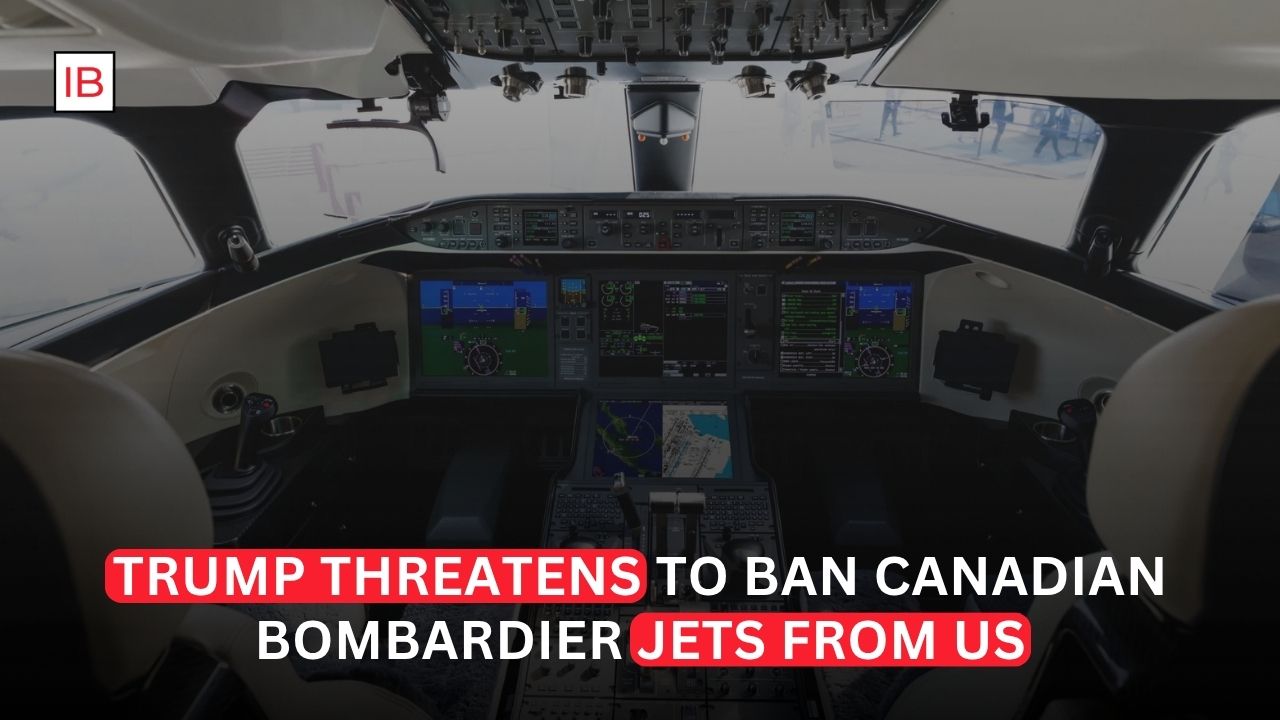
President Donald Trump has threatened to shut Canadian aircraft manufacturer Bombardier out of the U.S. market unless the company begins manufacturing aircraft in the United States, escalating an already bitter trade confrontation with Canada and putting one of the world’s largest business-jet makers under fresh pressure. Trump made the threat Monday in a social-media post, accusing Bombardier of taking advantage of the American market while criticizing Canada’s treatment of U.S. companies.
Trump said Bombardier would no longer be allowed to sell its aircraft in the United States unless it moved production into the country. He also criticized the quality of Bombardier’s products and argued that the company should manufacture locally if it wants continued access to American customers. Bombardier had not immediately responded to requests for comment.
The statement represents a significant escalation because the United States is Bombardier’s most important market. Trump claimed that more than half of the company’s revenue comes from the United States, while American buyers, companies and airports form an important part of Bombardier’s commercial ecosystem. A prolonged restriction on sales could therefore affect not only new aircraft deliveries but also the company’s broader aftermarket and service business.
For now, however, the threat should not be confused with a formal prohibition. The White House has not provided details on how the proposed restriction would be implemented, what legal authority would be used or whether existing aircraft orders would be affected. Reuters described Trump’s statement as a demand that Bombardier manufacture in the United States, while other reporting noted that no enforceable sales ban had yet been announced.
The threat is the latest episode in a dispute that has already targeted Bombardier’s access to the U.S. aviation market. Earlier this year, Trump threatened to impose a 50% tariff on aircraft manufactured in Canada and said the United States would decertify Bombardier’s Global Express business jets unless Canada’s aviation regulator approved aircraft made by U.S. rival Gulfstream. Those measures were not ultimately implemented, and Canada subsequently certified several Gulfstream aircraft.
The aviation dispute has become intertwined with a much broader breakdown in U.S.-Canada trade relations. Washington and Ottawa have been imposing increasingly aggressive tariffs and retaliatory measures, with Canada preparing additional tariffs as the two governments struggle to resolve disagreements over market access and trade policy. The confrontation has moved beyond traditional tariff negotiations into specific industries and individual companies.
Trump’s demand that Bombardier build in the United States also reflects his administration’s broader push to use access to the American market as leverage for domestic manufacturing. The strategy is intended to encourage foreign companies to locate production inside the United States rather than relying on imports. For Bombardier, however, shifting major aircraft production would be a complicated undertaking because its manufacturing network is deeply integrated across Canada, the United States and other countries.
Bombardier already has a significant U.S. industrial presence, including a defense facility in Kansas, even though its principal aircraft manufacturing operations are based in Canada. The company also depends heavily on American suppliers, customers and infrastructure, making the relationship between the two countries more economically intertwined than Trump’s comments might suggest.
The timing is particularly sensitive because Bombardier has been strengthening its Canadian manufacturing capabilities. On September 1, the company announced that it would acquire a Canadian factory from Mitsubishi Heavy Industries in Mississauga, Ontario. The facility produces wings for Bombardier’s Global 5500 and 6500 business jets, allowing the company to bring additional production in-house and gain greater control over its supply chain.
The company therefore faces a difficult strategic choice if Washington turns the threat into concrete policy. Building additional production capacity in the United States could protect access to its largest market but would require substantial investment and potentially alter the economics of its global manufacturing network. Alternatively, Bombardier could seek exemptions or rely on political and commercial pressure to prevent a full market exclusion.
The dispute also benefits Bombardier’s American competitors. Gulfstream, owned by General Dynamics, is the most obvious rival in the large-cabin business-jet market. Trump’s earlier confrontation with Canada over Gulfstream certification already demonstrated how aviation regulation can become part of the wider U.S.-Canada trade relationship.
For Canada, the Bombardier dispute is another indication that its traditionally close economic relationship with the United States is entering a more confrontational phase. Prime Minister Mark Carney has continued to signal a willingness to negotiate, but has also criticized Washington’s approach and insisted that Canada cannot accept terms that undermine its economic interests.
For now, Bombardier’s biggest risk is uncertainty. Customers, investors and suppliers have little clarity over whether Trump’s threat will become tariffs, certification restrictions, procurement barriers or an outright prohibition. Until the administration provides an implementation mechanism, the immediate impact is largely political. But if the threat becomes policy, the consequences could be substantial for Bombardier, the business-jet industry and the increasingly strained economic relationship between the United States and Canada.