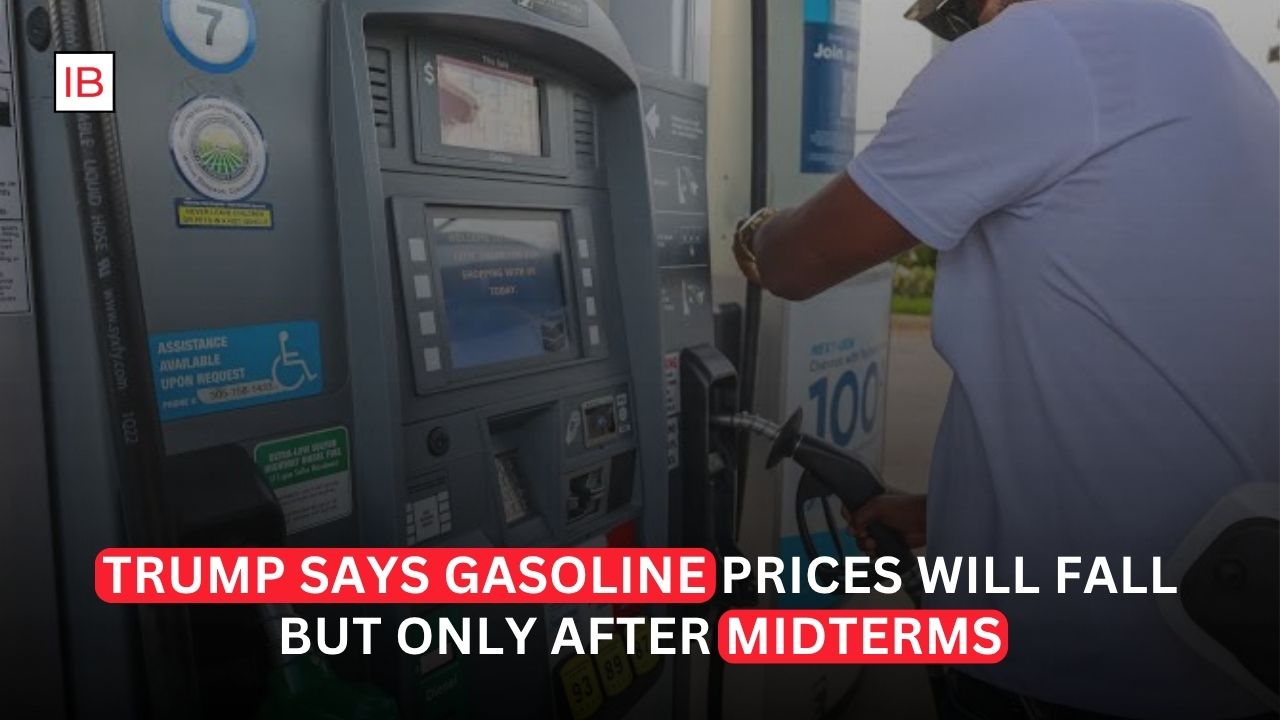
President Donald Trump says Americans should expect gasoline prices to fall sharply after the November midterm elections, linking the anticipated decline to an eventual end to the war with Iran. His prediction comes as the opposite is happening in energy markets: crude oil has surged above $100 a barrel and US gasoline prices have climbed to their highest levels of the year.
Speaking to reporters Wednesday before traveling to Dallas for the Republican Party’s first midterm convention, Trump said oil prices would begin “tumbling downward” after the election. He predicted the conflict with Iran would end immediately afterward, arguing that Tehran would eventually be unable to sustain the war under economic pressure.
Trump’s comments place the timing of lower fuel prices directly against the political calendar. The US midterm elections are scheduled for Nov. 3, meaning millions of voters will make decisions about control of Congress while household budgets are being squeezed by higher energy costs. Gasoline has become an increasingly sensitive political issue because fuel prices affect not only drivers but also transportation, food distribution, airline costs and a wide range of consumer goods.
The immediate market backdrop is particularly difficult for the administration. Brent crude climbed above $100 a barrel Wednesday for the first time since July as fighting between the US and Iran intensified. Reuters reported that Brent had risen about 25% since the previous month, while supply disruptions linked to the conflict have already removed millions of barrels of oil per day from global markets.
US consumers are already feeling the impact. The national average price of regular gasoline has reached about $4.22 a gallon, while diesel has risen to a record roughly $5.94, according to reporting based on current fuel-price data. Gasoline prices are now about 42% higher than before the war began.
The administration has argued that prices can eventually fall as domestic production increases and seasonal gasoline demand declines. Energy Secretary Chris Wright said earlier this month that the end of the summer driving season, combined with regulatory changes allowing refiners to produce more gasoline and diesel using existing equipment, should put downward pressure on prices.
But the oil market is being driven by forces that Washington cannot easily control. The Strait of Hormuz remains severely disrupted, while attacks on tankers and energy infrastructure have reduced exports from the Middle East. The conflict has also affected Saudi energy facilities, adding to concerns about how much spare supply remains available if additional production is lost.
The US Energy Information Administration has raised its 2026 oil-price forecasts because global inventories are being rapidly depleted. The agency estimates that worldwide oil stocks have fallen by roughly 400 million barrels this year and expects production disruptions to remain substantial into the fourth quarter. It forecasts average Brent prices of about $91 a barrel for 2026, although the latest market spike has temporarily pushed prices well above that level.
Trump’s forecast also depends on a major assumption: that the war will actually end shortly after the election. The conflict has already lasted seven months, substantially longer than the president initially suggested. Trump now says Iran will eventually relent, but Vice President JD Vance has avoided making a firm prediction about when the fighting will end.
Even if hostilities stop, gasoline prices would not necessarily collapse immediately. Crude oil must move through disrupted transportation routes, refineries need time to adjust their operations and global inventories must be rebuilt. The relationship between crude prices and retail gasoline prices also varies according to refining margins, taxes, seasonal demand and regional supply conditions.
There is nevertheless a plausible path toward lower prices if the conflict ends. Earlier this week, Treasury Secretary Scott Bessent suggested that oil could eventually fall as low as $40 to $50 a barrel if geopolitical disruptions ease and previously constrained supplies return to the market. Energy industry executives have similarly pointed to the possibility of substantial additional supply becoming available if Russian and Middle Eastern production and refining operations normalize.
The political problem is that consumers are paying today’s prices, not the prices projected for a postwar market. Republicans are gathering in Dallas with inflation and the cost of living already among the central concerns surrounding their midterm strategy. Rising fuel costs could make it harder for candidates to argue that the administration’s economic policies are delivering immediate relief.
Trump’s promise therefore offers a straightforward political message: endure higher prices now and expect cheaper fuel once the conflict ends. Whether that promise becomes reality will depend less on the election itself than on what happens in Iran, the Strait of Hormuz and global oil markets. For American drivers, the critical question is not simply whether gasoline becomes cheaper after November, but whether the geopolitical supply shock can actually be resolved before high energy costs become entrenched in the wider economy.