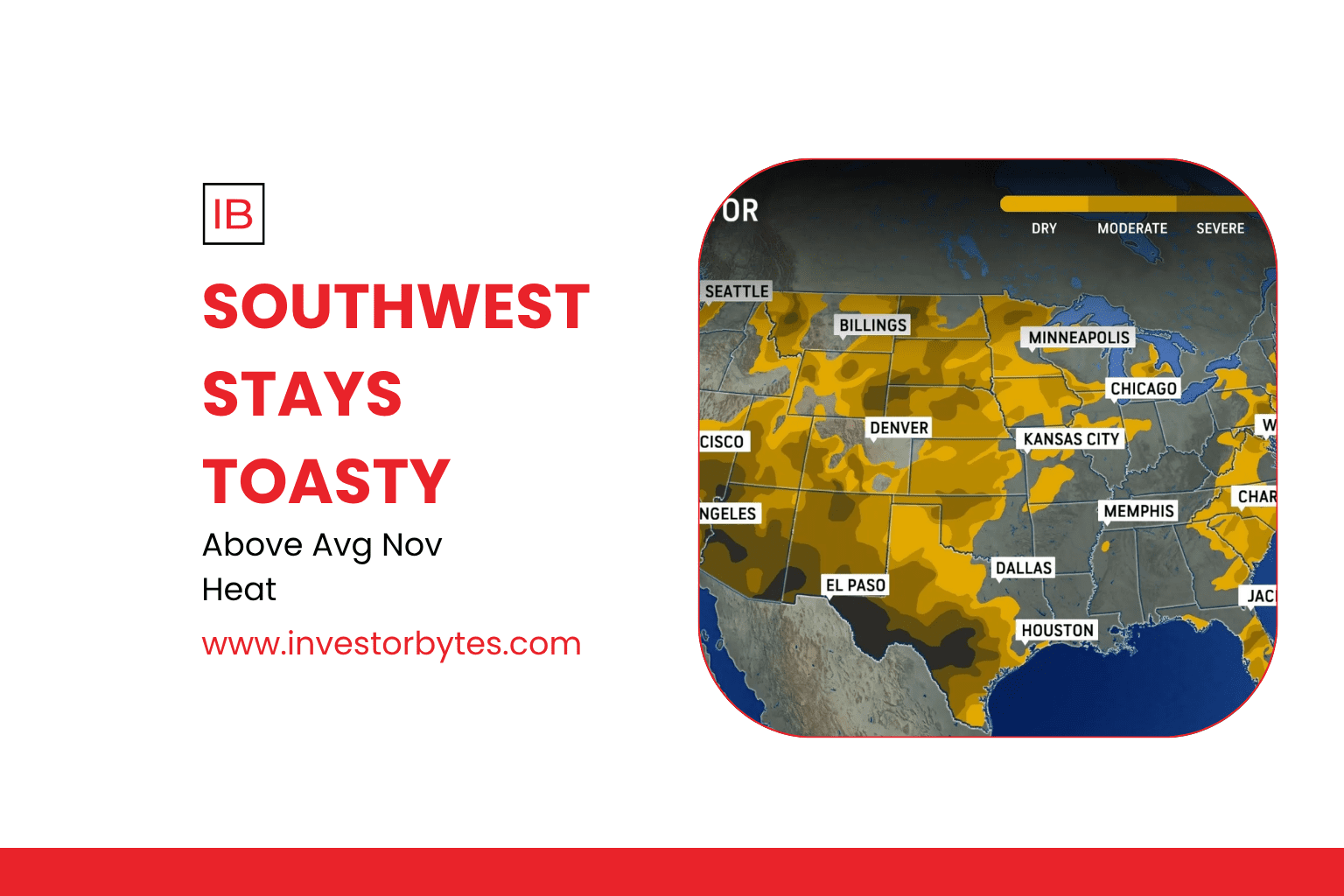
The Desert Southwest sizzles under a relentless thermal dome, with November 2025 temperatures soaring 6–12°F above historical averages from Tucson’s Sonoran flats to Las Vegas’s neon canyons, as La Niña’s entrenched pattern starves the region of Pacific moisture and entrenches drought across 78% of Arizona and 82% of Nevada, per NOAA’s November 5 update. Phoenix clocks highs of 88°F on November 18—tying the latest 85°F reading since 1895—while Death Valley’s Furnace Creek flirts with 95°F, extending the valley’s 100+ day streak to 162, the longest since 1913.
La Niña’s equatorial chill retracts the subtropical jet, funneling storm tracks into the Pacific Northwest and leaving the Four Corners parched: Albuquerque’s precipitation tally stalls at 0.12 inches—18% of normal—while Lake Mead’s elevation sinks to 1,074 feet, 2.1 feet below November 2024 and triggering Tier 2 shortages for 2026. The Climate Prediction Center’s 84% La Niña lock-in favors this warm-dry archetype, with ensemble models projecting top-decile heat through February and soil moisture at 22% of capacity in the Mojave, priming 14% heightened wildfire risk across 28 million acres.
Santa Ana winds whip the basin: 55 mph gusts on November 14 ignite the Sand Fire near Palm Springs, scorching 12,000 acres in 36 hours before containment, with CAL FIRE’s November 8 risk matrix flagging “extreme” danger for 62% of Southern California. Relative humidity plunges to 8% in San Diego County, evaporating 1.1 million gallons daily from municipal reservoirs and forcing Stage 3 water restrictions on 4.2 million residents. Farmers’ Almanac’s split-snow forecast holds: East Coast totals trim 22%, but the Southwest basks sunnily, with zero measurable precip in Yuma for 68 consecutive days.
Energy grids strain: Arizona Public Service peaks at 8,200 MW on November 10—12% above 2024—powered by solar arrays humming at 94% capacity yet spiking wholesale rates to $112/MWh during evening ramps. Tourism pivots: Grand Canyon South Rim visitation dips 18% as midday heat indexes hit 102°F, but night-sky programs surge 34% under clearer, drier skies. Vegetation stress cascades: saguaro mortality climbs 11% in organ-pipe cacti, per NPS transects, while invasive buffelgrass coverage expands 22% in fuel loads.
This persistence unveils not sun’s fleeting glare, but heat’s durable dance—veiled veils of 6–12°F surges from drought’s dry dominion, where climate’s artistry yields reinvention’s radius across the Southwest’s shimmering sands.