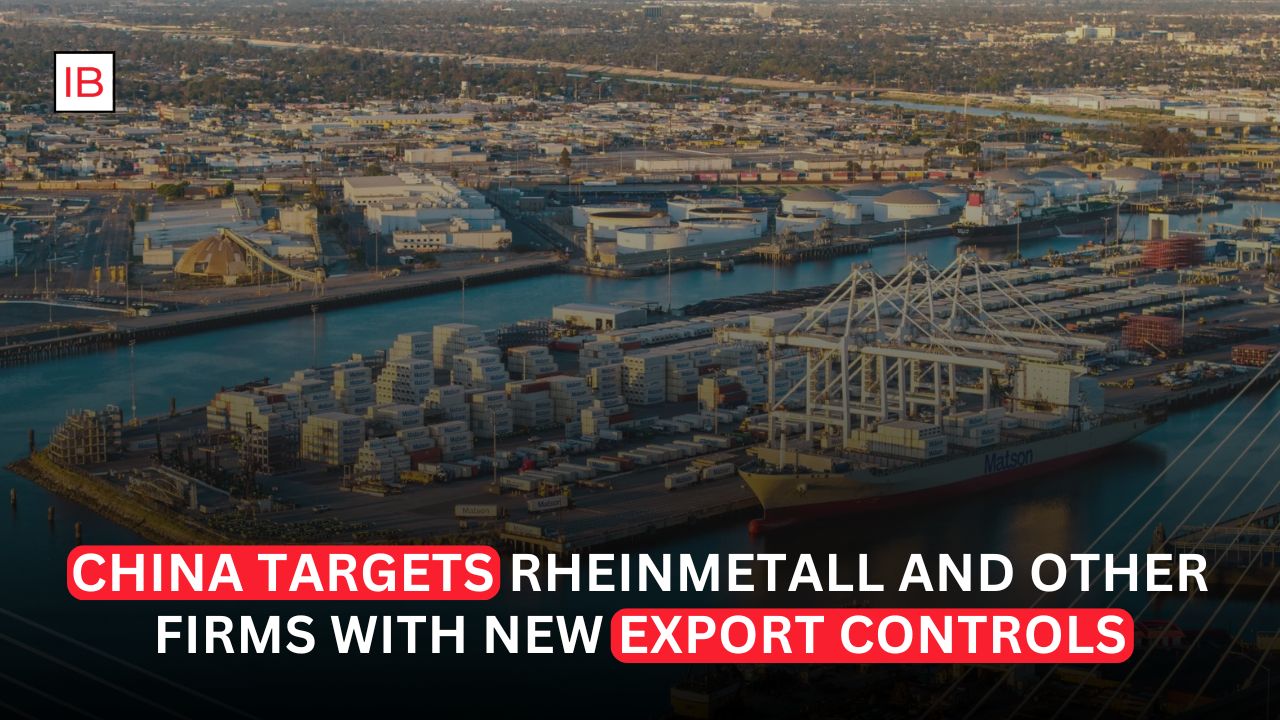
Beijing Expands Trade Countermeasures After EU Sanctions, Escalating Tensions With Europe
China has imposed new export restrictions on several European companies, including German defense giant Rheinmetall, in retaliation for the European Union’s latest sanctions against Chinese firms accused of supporting Russia’s military industry. The move marks a significant escalation in trade tensions between Beijing and Brussels, highlighting how geopolitical disputes are increasingly affecting global supply chains and commercial relations.
The restrictions were announced shortly after the European Union adopted its 21st package of sanctions against Russia, which also added several Chinese and Hong Kong-based companies to its export control list. Beijing said the new measures are designed to protect China’s national security and interests while responding to what it considers unfair actions by the EU.
Export Curbs Target European Companies
China’s Commerce Ministry placed 14 European entities on its export control list, preventing them from receiving Chinese dual-use goods without special government approval.
Among the affected companies are:
- Rheinmetall (Germany).
- Vigo Photonics (Poland).
- Several industrial and technology firms from France, Italy, the Netherlands, and other European countries.
The restrictions also prohibit foreign organizations and individuals from transferring China-origin dual-use products to the listed companies unless specific authorization is granted.
Dual-Use Goods at the Center of Dispute
The export controls primarily affect dual-use products—items that have both civilian and military applications.
These include:
- Advanced electronic components.
- Specialized industrial materials.
- Certain rare earth products.
- Semiconductor-related technologies.
- Drone manufacturing components.
Such materials are increasingly important for defense production, advanced manufacturing, and high-technology industries, making the restrictions particularly significant for companies involved in aerospace and military equipment.
EU-China Trade Frictions Intensify
The latest measures reflect worsening economic relations between China and the European Union.
Recent disputes have included:
- EU sanctions targeting Chinese companies linked to Russia.
- European investigations into Chinese industrial subsidies.
- Chinese export controls on critical minerals.
- Reciprocal trade restrictions.
- Growing disagreements over market access and security issues.
Both sides remain major trading partners, but political and economic tensions have increased significantly over the past several years as strategic competition has expanded beyond traditional trade disputes.
Impact on European Industry
The inclusion of Rheinmetall has attracted particular attention because the company is one of Europe’s largest defense manufacturers.
Industry analysts say the restrictions could:
- Complicate procurement of specialized components.
- Increase supply chain risks.
- Raise production costs.
- Encourage companies to diversify suppliers.
- Accelerate efforts to reduce dependence on Chinese materials.
While companies may apply for export licenses in exceptional cases, uncertainty surrounding approvals could create additional operational challenges.
Growing Geopolitical Competition
The dispute highlights how geopolitical tensions are increasingly influencing global trade.
Businesses operating across Europe and Asia are facing:
- More export controls.
- Greater regulatory uncertainty.
- Increased compliance requirements.
- Supply chain diversification.
- Rising geopolitical risk.
Many multinational companies are now reassessing sourcing strategies to reduce exposure to future trade restrictions.
Looking Ahead
China’s latest export controls represent another step in the deepening economic rivalry between Beijing and the European Union. By targeting European companies in response to EU sanctions, China has demonstrated its willingness to use trade measures as part of broader geopolitical disputes.
Although both sides continue to emphasize the importance of maintaining commercial ties, the latest actions suggest that trade relations are becoming increasingly influenced by national security concerns and international politics. Unless diplomatic progress is made, businesses on both sides are likely to face continued uncertainty as export controls and sanctions become a more common feature of global commerce.