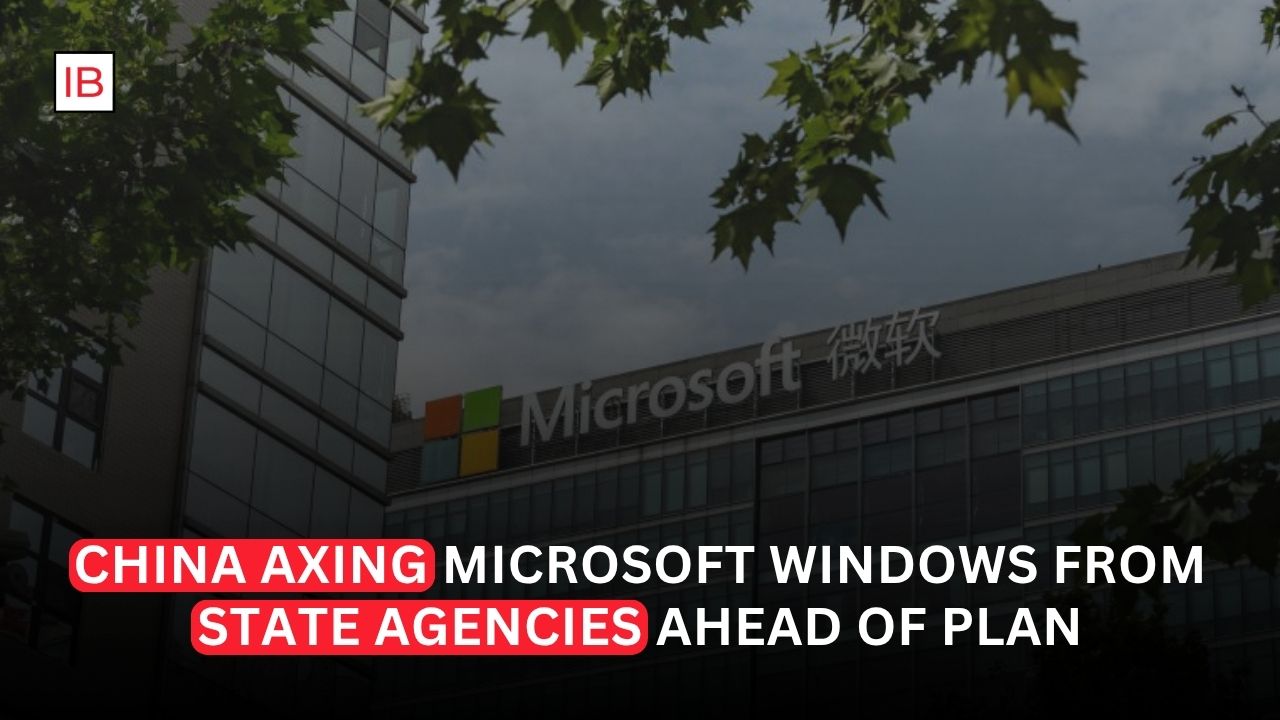
China is accelerating efforts to reduce its dependence on foreign technology, with government agencies increasingly moving away from Microsoft Windows as Beijing pushes domestic software for security and technological self-reliance.
The shift is another sign that the technology relationship between China and the US is becoming increasingly fragmented. What was once primarily a commercial relationship is now being shaped by national-security concerns, export controls and Beijing’s push for technological sovereignty.
The move does not mean Windows is suddenly disappearing from every Chinese computer. Instead, the most immediate pressure is concentrated in government and other sensitive institutions, where procurement rules increasingly favor Chinese-developed operating systems and software.
Security Is at the Center of the Policy
Beijing’s argument is largely about security.
Chinese authorities have spent years expressing concern about dependence on foreign technology, particularly software controlled by US companies.
Those concerns intensified after revelations about US surveillance programs and have grown further as Washington and Beijing have imposed technology restrictions on each other.
China has increasingly promoted the idea that critical government systems should rely on technology that can be controlled domestically.
That makes Windows a particularly sensitive product.
An operating system sits at the foundation of a computer system, controlling files, applications, security functions and communications. For government agencies, dependence on a foreign operating system can therefore be viewed as a strategic vulnerability.
China Has Been Moving in This Direction for Years
The current shift is not entirely new.
China has encouraged government agencies to use domestic software since at least the 2010s, and its procurement policies have increasingly emphasized products considered “safe and reliable.”
Microsoft even developed a customized Windows 10 China Government Edition through a partnership with a Chinese state-owned technology group.
The initiative allowed Microsoft to address some of Beijing’s security concerns, but it never became the long-term solution the company had hoped for.
Reuters’ review of Chinese government procurement guides published between 2023 and 2026 found that most did not recommend Microsoft, while one that included the government edition imposed additional management requirements.
Domestic Operating Systems Are Becoming More Competitive
China’s strategy would be much harder to implement if domestic alternatives were poor.
That is changing.
Chinese operating systems based on Linux and other open-source technologies have developed significantly, with companies and government-backed organizations building alternatives designed specifically for local users.
Products associated with China’s domestic software ecosystem, including systems such as Kylin, are increasingly positioned as alternatives to Windows for government and enterprise environments.
This gives Beijing an important advantage.
It can reduce foreign dependence without necessarily forcing agencies to sacrifice all of the functionality they previously received from Western software.
Microsoft Has Already Reduced Its China Footprint
The Windows issue is happening alongside a broader retrenchment by Microsoft.
The company has closed at least 15 offices and joint ventures in China over the past five years, reflecting a wider reduction in its local operations. Microsoft reportedly considered a full withdrawal from China in 2023 but ultimately decided to maintain a presence.
The reasons are straightforward.
China has become a more difficult market for US technology companies.
Beijing is pushing domestic alternatives.
Washington’s export controls restrict access to some advanced technologies.
And geopolitical tensions make long-term investment decisions increasingly difficult.
Microsoft has therefore shifted toward areas where it can still generate value.
Microsoft Still Has a Reason to Stay
It would be wrong to interpret China’s Windows push as meaning Microsoft is abandoning China completely.
The company continues to serve Chinese businesses that operate internationally.
Some Chinese companies rely on Microsoft’s Azure cloud services to manage global operations and comply with regulations outside China.
Microsoft also benefits from China’s deep pool of engineering talent.
The company has maintained a significant research and development presence in China for decades, and its research ecosystem has helped produce engineers and researchers who later became important figures in China’s technology industry.
So Microsoft faces a difficult calculation:
China is becoming less attractive as a domestic market, but it remains valuable as a source of customers, talent and international business opportunities.
The AI Factor Makes the Situation More Complicated
Artificial intelligence is adding another layer to the relationship.
Microsoft’s cloud and AI businesses have potential customers in China, but US export restrictions make advanced AI technology difficult to provide at the same scale available elsewhere.
At the same time, China’s domestic AI industry has developed rapidly.
Chinese companies are building increasingly capable models that can be cheaper and easier to deploy within China’s regulatory environment.
That reduces the advantage of relying on Western AI providers.
If Chinese businesses can combine domestic AI models with domestic operating systems and cloud infrastructure, the role of Microsoft could shrink further.
This Is Bigger Than Microsoft
The most important point is that the Windows story is part of a much broader trend.
China is seeking greater control over critical technology infrastructure.
The strategy extends across:
- Operating systems
- Semiconductors
- Cloud computing
- Artificial intelligence
- Databases
- Cybersecurity
- Industrial software
- Telecommunications equipment
The goal is not necessarily to eliminate every foreign product.
Rather, Beijing wants to ensure that critical systems can continue operating without depending on technology that could be restricted by another country.
That distinction matters.
China can continue buying some foreign technology while simultaneously reducing its dependence on it.
US Companies Face a Shrinking Strategic Space
For American technology companies, this creates an increasingly difficult environment.
They face two different pressures.
From Washington, export controls and national-security restrictions limit what they can sell into China.
From Beijing, domestic procurement policies increasingly favor Chinese competitors.
That leaves US companies caught between two governments pursuing greater technological independence.
Microsoft is not alone.
Apple, Nvidia, Intel and other major US technology companies face similar questions about how much exposure they should maintain to the Chinese market.
The Economic Cost Could Be Significant
Technology decoupling has a cost.
Running separate technology ecosystems increases development expenses.
Companies may need different products for different markets.
Software developers may have to meet conflicting regulatory standards.
Cloud providers may need separate infrastructure.
Businesses can lose economies of scale.
Consumers and governments may also face higher costs if they are forced to maintain parallel systems.
But Beijing appears increasingly willing to accept some of those costs in exchange for greater technological control.
That is an important change in priorities.
The Bigger Geopolitical Shift
The deeper story is not simply that China is replacing Windows.
It is that technology is becoming part of national security policy.
For decades, software markets were largely driven by price, functionality and convenience.
Today, governments increasingly ask different questions:
Who controls the technology?
Where is the data?
Who can access the underlying systems?
Can the technology be disabled or restricted?
Can domestic companies replace it?
Those questions are reshaping global technology markets.
What It Means for Microsoft
For Microsoft, China is becoming a smaller and more complicated opportunity.
The company can still serve multinational Chinese businesses, provide cloud services and maintain engineering operations.
But the traditional model—selling Windows and other Western software throughout the Chinese economy—is becoming harder to sustain.
Recent reporting suggests Microsoft’s China-linked business has already shifted toward helping Chinese companies operate globally rather than serving China’s government as a major technology customer.
That is a fundamental change.
The Bottom Line
China’s push away from Microsoft Windows should not be viewed as an isolated procurement decision.
It is part of Beijing’s broader effort to build a technology ecosystem that is less vulnerable to US sanctions, export controls and geopolitical pressure.
For Microsoft, the immediate financial impact may be manageable because China represents only a small portion of its global revenue. But strategically, the development matters.
The world’s two largest technology ecosystems are increasingly moving in opposite directions.
China wants greater control over its digital infrastructure.
The US wants to restrict China’s access to strategically important technologies.
And companies such as Microsoft are being forced to operate between those two objectives.
The result is not an overnight technological divorce, but a gradual separation—and China’s retreat from Windows in government agencies is another important step in that process.