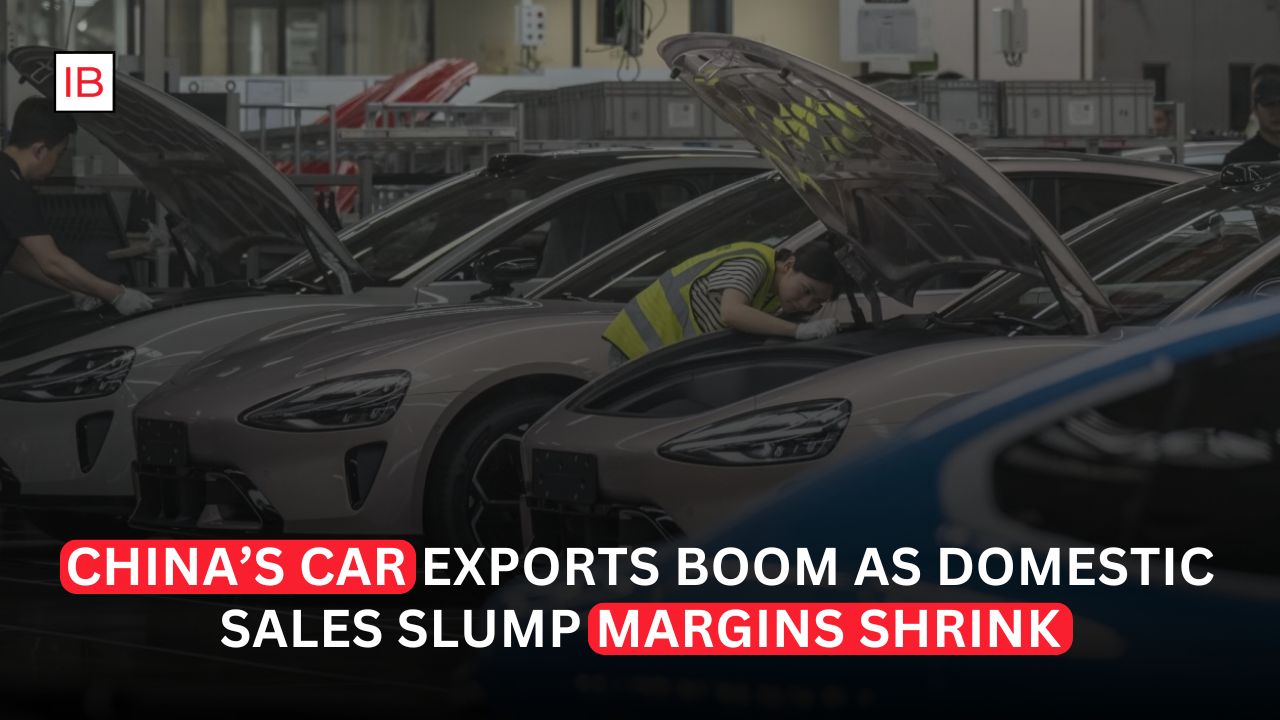
China’s auto industry is increasingly relying on overseas markets to compensate for a painful slowdown at home, creating a striking divide between booming exports and weakening domestic demand. Chinese automakers shipped a record volume of vehicles abroad in July, even as sales inside the country fell for a tenth consecutive month.
The shift is becoming more than a temporary response to weak consumer demand. For many Chinese manufacturers, overseas expansion is turning into a necessity as competition at home intensifies, prices remain under pressure and profit margins shrink.
According to the latest industry data, Chinese vehicle exports jumped 88.2% year over year in July to about 923,000 units, while domestic sales fell 21.1% to roughly 1.47 million vehicles. New-energy vehicle exports were particularly strong, increasing about 148% from a year earlier.
The figures highlight the extraordinary transformation taking place in China’s automobile industry.
Domestic Sales Are Becoming the Weak Point
China remains the world’s largest automobile market, but its domestic industry is facing a difficult period.
Domestic vehicle sales have now declined for ten straight months. Over the first seven months of 2026, sales were down approximately 20.5%, equivalent to about 2.65 million fewer vehicles compared with the same period a year earlier.
The decline is particularly significant because Chinese automakers spent years expanding production capacity on the assumption that domestic demand would continue growing.
Instead, manufacturers now have enormous production capabilities competing for a shrinking pool of buyers.
The result has been aggressive price competition.
Automakers have repeatedly cut prices, offered incentives and introduced new models to protect market share. While that can support sales volumes, it also puts pressure on profitability.
The industry is therefore confronting a difficult combination: fewer customers, excess capacity and lower prices.
Exports Are Providing an Escape Route
Overseas markets are becoming the most important source of growth.
Chinese automakers have increasingly turned toward Europe, Southeast Asia, Latin America and the Middle East as they search for customers outside China.
The export surge is not limited to traditional gasoline-powered cars.
Electric vehicles and plug-in hybrids are becoming a major component of China’s overseas expansion. New-energy vehicle exports rose roughly 148% in July, even while domestic sales of those vehicles fell 3.9%.
That divergence is especially important.
It suggests that Chinese electric-car manufacturers are finding demand abroad at a time when the domestic market is becoming increasingly difficult.
For companies that have invested heavily in battery technology, electric drivetrains and manufacturing capacity, international markets offer an opportunity to put that capacity to work.
China Has a Cost Advantage
Chinese automakers have developed significant advantages in manufacturing scale and supply chains.
The country has built a huge ecosystem covering batteries, electronics, components and vehicle assembly.
That allows manufacturers to produce cars relatively efficiently and launch new models quickly.
S&P Global Ratings expects Chinese passenger-vehicle exports to continue growing in 2026, although it also warns that trade protectionism, tariffs and geopolitical risks could limit overseas expansion. The agency says Chinese manufacturers increasingly need to move beyond simply exporting vehicles and establish local production in foreign markets.
That is a crucial distinction.
Exporting a vehicle from China can be relatively straightforward when tariffs are low.
But once governments impose tariffs or local-content requirements, shipping directly from China becomes less attractive.
That is why Chinese automakers are increasingly considering factories and partnerships abroad.
Higher Overseas Sales Do Not Automatically Mean Higher Profits
This is where the bullish export story becomes more complicated.
It would be easy to look at an 88% increase in exports and conclude that Chinese automakers have solved their domestic problems.
They have not.
More vehicles being exported does not automatically translate into dramatically higher profits.
Selling abroad involves transportation expenses, tariffs, dealership costs, marketing, regulatory compliance and investments in local distribution networks.
Automakers also face competition from established international manufacturers.
S&P Global Ratings expects profit margins and cash flow in China’s auto industry to remain under pressure despite the growth in exports.
The industry therefore has a volume problem and a margin problem at the same time.
Companies need to sell more cars overseas, but they also need to ensure that those additional sales generate acceptable returns.
BYD and Other Chinese Brands Are Going Global
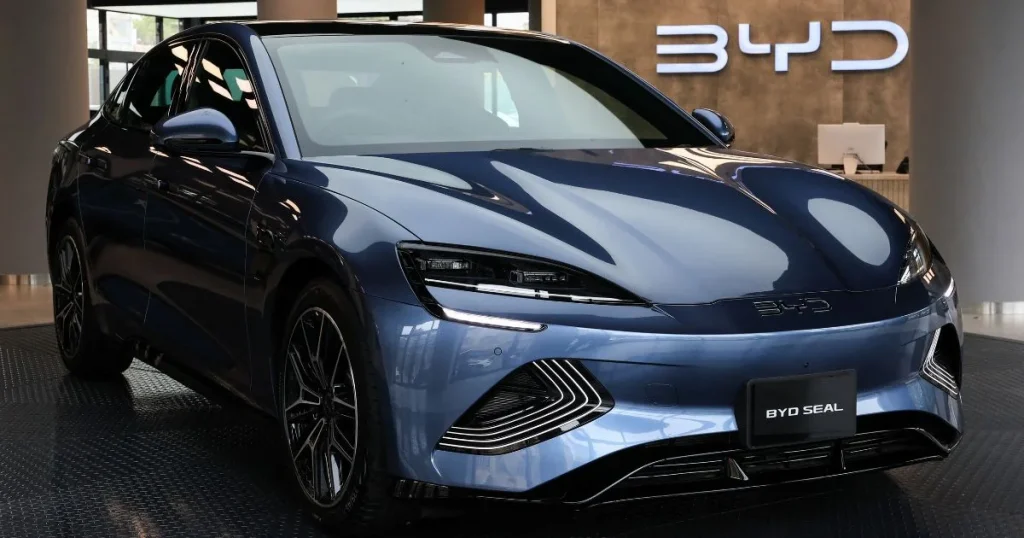
The most prominent example is BYD.
BYD has expanded aggressively outside China, building distribution networks and increasing its presence in major international markets.
Other manufacturers, including Geely, Chery and SAIC, are also accelerating their international strategies.
Geely has been particularly aggressive in overseas markets. Industry data cited by China Daily showed its June exports rising sharply, while Chery also recorded major year-over-year export growth.
This competition means China is no longer simply exporting individual car models.
It is exporting entire automotive brands.
That represents a major change in the global automobile industry.
Europe Is an Important Battleground
Europe is one of the most strategically important markets for Chinese automakers.
European consumers have significant demand for electric vehicles, while Chinese manufacturers can often compete aggressively on price and technology.
But Europe is also one of the markets where Chinese automakers face the strongest regulatory barriers.
The European Union has already imposed additional duties on Chinese battery-electric vehicles, making it more expensive for manufacturers to rely entirely on exports from China.
That is encouraging companies to consider local manufacturing.
A factory inside Europe can reduce some of the disadvantages associated with importing vehicles from China.
The strategy is more expensive initially, but it can become essential for long-term market access.
The US Is a Different Story
The United States presents an even more difficult challenge.
High tariffs and geopolitical tensions make direct Chinese vehicle exports to the US extremely difficult.
As a result, Chinese manufacturers are focusing more heavily on markets where regulatory barriers are lower or where demand for affordable electric vehicles is growing rapidly.
Southeast Asia, Latin America, the Middle East and parts of Europe have therefore become important targets.
This geographic diversification could help Chinese automakers reduce their dependence on any single overseas market.
But it also creates additional complexity.
Every country has different safety regulations, taxes, consumer preferences and political conditions.
The Domestic Price War Is the Bigger Problem
Despite the export boom, the biggest challenge for Chinese automakers may still be inside China.
The domestic market is crowded with manufacturers.
Dozens of companies have invested heavily in electric vehicles, while traditional automakers are simultaneously trying to defend their market share.
That has created intense competition.
New models are arriving constantly, forcing manufacturers to discount existing products.
Consumers have also become increasingly price-sensitive.
This creates a vicious cycle.
Lower prices can encourage consumers to buy, but if companies keep cutting prices, their margins deteriorate.
Lower margins make it harder to fund research, marketing and international expansion.
The companies that survive may ultimately be those with the strongest balance sheets, technology and brand recognition.
Smaller Automakers Face Greater Risk
The export boom is therefore likely to benefit Chinese automakers unevenly.
Large companies with strong brands, established supply chains and sufficient capital can afford to expand internationally.
Smaller companies may struggle.
They need to spend money establishing dealerships, complying with foreign regulations and building brand awareness before they can generate meaningful overseas revenue.
That creates a significant financial burden.
If domestic sales remain weak for an extended period, some manufacturers may not have enough cash to sustain aggressive expansion.
The industry could therefore experience further consolidation.
Overseas Production Is Becoming More Important
Chinese automakers are increasingly recognizing that the long-term solution is not simply to ship more cars from China.
They need to build production capacity closer to customers.
S&P Global Ratings says the industry’s overseas strategy is shifting from pure exports toward local production, with localization of technology, manufacturing and supply chains becoming increasingly important.
This approach can reduce tariffs and shipping costs while helping manufacturers demonstrate commitment to local markets.
It also creates jobs and investment in host countries, potentially reducing political resistance.
But building factories abroad is expensive.
Automakers therefore need confidence that overseas demand will remain strong enough to justify those investments.
Global Competition Is Changing

The rise of Chinese automakers is forcing established global manufacturers to reconsider their strategies.
Companies that once dominated emerging markets now face Chinese competitors offering increasingly sophisticated vehicles at competitive prices.
The pressure is particularly intense in electric vehicles.
Chinese manufacturers have developed strong capabilities in batteries and EV production, giving them an advantage as global consumers shift away from internal-combustion engines.
Traditional automakers therefore face pressure to reduce costs, accelerate EV development and improve their software capabilities.
The Export Boom Has a Limit
There is also a broader risk.
If every Chinese automaker tries to solve domestic oversupply by exporting more vehicles, foreign markets could eventually face their own supply pressures.
That could trigger additional tariffs, quotas or other trade restrictions.
Governments in Europe, North America and elsewhere are already concerned about the competitive impact of China’s industrial scale.
The more successful Chinese manufacturers become internationally, the greater the political pressure could become.
That means China’s export boom may itself create the conditions for stronger protectionism.
What Happens Next?
China’s automobile industry is entering a new phase.
The domestic market is no longer providing the growth engine that manufacturers once expected. July’s 21.1% decline in domestic sales, combined with an 88.2% jump in exports, captures that transformation unusually clearly.
The immediate winners will probably be companies capable of combining strong domestic technology with international distribution and financial strength.
But export growth alone will not solve the industry’s problems.
Manufacturers must improve margins, control costs and establish sustainable businesses overseas.
They also have to navigate tariffs, trade restrictions and increasingly complicated geopolitical relationships.
For consumers around the world, the expansion of Chinese automakers could mean more affordable electric vehicles and greater competition.
For established automakers, it represents a major strategic challenge.
And for China itself, the export boom offers a way to absorb excess production capacity—but it cannot permanently replace healthy domestic demand.
The real test will be whether Chinese automakers can turn their extraordinary export growth into durable international businesses with sustainable profits.
For now, the numbers show a remarkable shift: China is selling fewer cars at home while sending dramatically more cars abroad.
That may help the industry survive its domestic slowdown, but it does not mean the underlying problems have disappeared.