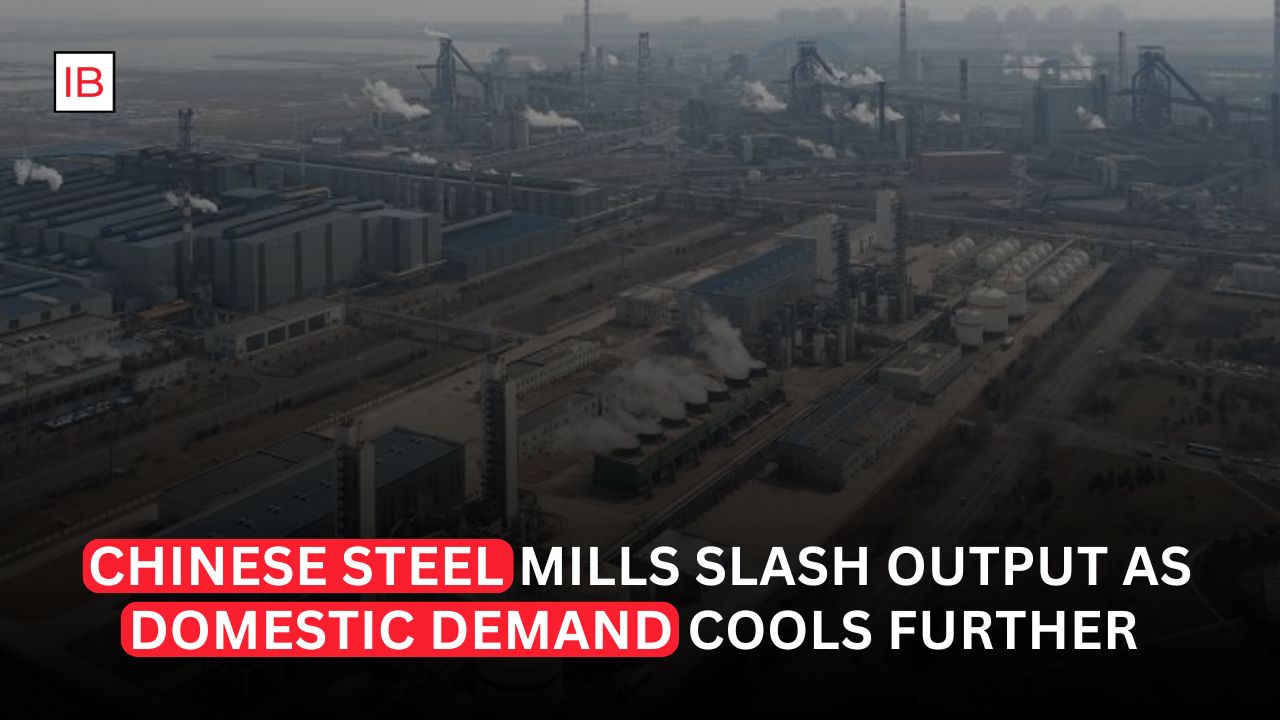
China’s steel industry is showing clearer signs of strain as weakening domestic demand and deteriorating economic conditions force producers to reduce output.
The decline is significant because steel is one of the most important industrial indicators in China. It connects directly to construction, property development, infrastructure, machinery, manufacturing and exports. When steelmakers cut production, it can therefore signal something broader than weakness in one commodity market.
Recent economic data point in the same direction. China’s industrial output grew just 4.5% year over year in July, down from 5.3% in June and below expectations. Retail sales increased only 0.6%, while fixed-asset investment fell 6.7% during the first seven months of the year.
Property Is Still the Biggest Problem
China’s property sector remains one of the largest sources of pressure on steel demand.
For years, residential construction was a major consumer of steel. Developers bought enormous quantities of rebar, structural steel and other products for apartment buildings and related infrastructure.
That model has weakened substantially.
Property investment has struggled, housing demand remains subdued and developers continue to deal with financial constraints.
For steel producers, the consequence is straightforward:
Fewer construction projects mean fewer steel orders.
This creates a difficult situation because China’s steel industry still has enormous production capacity.
Too Much Capacity, Not Enough Demand
The problem facing Chinese steelmakers isn’t simply falling production.
It is the imbalance between capacity and demand.
The OECD estimates that global excess steelmaking capacity could reach 745 million metric tons by 2028. China accounts for the largest share of that imbalance, with domestic demand weakened by slower infrastructure spending and the property downturn.
That means Chinese mills have an uncomfortable choice.
They can keep producing and accept lower prices and weaker margins, or reduce output and try to stabilize the market.
The recent production decline suggests more producers are choosing the second option.
Manufacturing Is Providing Only Partial Support
Manufacturing has prevented China’s steel demand from falling even more sharply.
Steel remains essential for automobiles, machinery, appliances, shipbuilding, energy infrastructure and other industrial products.
China’s manufacturing sector has also benefited from strong exports in several technology and industrial categories.
But manufacturing cannot completely replace the demand previously generated by property construction.
That distinction matters.
Even if exports of manufactured goods remain strong, the domestic economy can still struggle if construction and consumer demand remain weak.
Economic Data Are Sending a Clear Warning
July’s economic figures reinforce the pressure on steel.
Industrial production slowed to 4.5%, while retail sales growth dropped to just 0.6%. Fixed-asset investment declined 6.7% through July, worsening from the 5.7% decline recorded through June.
China’s manufacturing PMI also slipped into contraction territory in July.
These figures suggest that the weakness isn’t isolated to steel.
The broader industrial economy is losing momentum.
That makes it harder for steelmakers to expect a rapid recovery in domestic orders.
Exports Are Becoming More Important
When domestic demand weakens, Chinese steel producers naturally look abroad.
China exported a record 131 million metric tons of steel in 2025, according to the OECD, with exports rising 153% from 2020.
That has helped mills keep operating despite weak domestic consumption.
But relying on exports creates another problem.
Other countries increasingly view China’s excess steel capacity as a threat to their own producers.
That has encouraged governments to impose tariffs, quotas and other trade restrictions.
So China cannot simply export its way out of the domestic steel problem indefinitely.
Global Trade Tensions Could Get Worse
The international steel market is already dealing with significant overcapacity.
The OECD warns that excess Chinese production is putting downward pressure on international steel prices and displacing producers in importing countries.
That creates a political reaction.
If Chinese steel becomes cheaper because domestic mills are struggling to find buyers, foreign producers can lose market share.
Governments then have an incentive to protect domestic steel industries.
The result can be a cycle of:
Weak Chinese demand → more exports → lower global prices → foreign trade barriers → fewer export opportunities.
That is one of the biggest risks facing China’s steel sector.
Lower Production Could Eventually Help
There is a counterargument to the current weakness.
Falling steel production isn’t necessarily bad for the industry if it brings supply closer to demand.
China has struggled for years with excess industrial capacity.
If inefficient mills are forced to reduce output or shut down, the remaining producers could eventually gain pricing power.
The problem is that this adjustment can be painful.
Steel companies may cut jobs, reduce investment and accumulate losses before the market finally reaches a healthier balance.
Raw Materials Could Also Feel the Impact
Lower Chinese steel output has implications beyond steel prices.
Iron ore and coking coal are major inputs for steel production.
If mills reduce output for an extended period, demand for these raw materials could weaken.
That could place pressure on iron ore prices and mining companies around the world.
At the same time, lower steel production can reduce China’s demand for imported raw materials, affecting major exporters such as Australia and Brazil.
The steel slowdown therefore has consequences throughout the global commodity chain.
Beijing Faces a Difficult Policy Choice
Chinese policymakers have already signaled a desire to strengthen domestic demand.
The challenge is determining how much stimulus is required and where it should be directed.
Traditional infrastructure spending could support steel consumption, but relying on another construction-heavy stimulus cycle would risk extending the same overcapacity problem.
A more sustainable approach would require stronger household consumption, healthier property markets and productivity-enhancing investment.
That would support steel demand more naturally rather than simply creating additional supply.
The Bigger Problem Is the Economy
The most important takeaway is that China’s steel production decline should not be viewed in isolation.
The steel sector is reflecting broader economic weakness.
Property remains under pressure, consumers are spending cautiously, fixed investment is contracting and industrial growth is slowing.
At the same time, China’s steel industry still possesses enormous capacity.
That combination makes a quick recovery difficult.
What to Watch
Steel output: Further production cuts would indicate that mills expect weak demand to persist.
Property investment: A sustained recovery would provide the strongest boost to domestic steel demand.
Steel prices: Rising prices alongside lower production could signal successful capacity adjustment.
Exports: Higher exports could increase international trade tensions.
Iron ore prices: Weakening Chinese steel demand could pressure global raw-material markets.
Government stimulus: New measures aimed at consumption and infrastructure could change the demand outlook.
The Bottom Line
China’s declining steel production is more than a commodity story.
It is a sign that the country’s enormous industrial system is confronting a difficult transition: too much productive capacity is meeting weaker domestic demand.
For years, construction and property helped absorb China’s steel output.
That engine is no longer powerful enough.
Manufacturing and exports can provide support, but they cannot fully compensate without stronger domestic demand.
The key question now is whether China’s production cuts become part of a genuine restructuring of the steel industry—or merely a temporary response to worsening economic conditions.
If capacity eventually falls enough to match demand, the industry could emerge healthier.
If production remains structurally higher than consumption, China will continue pushing excess steel into global markets, increasing pressure on prices and provoking more trade barriers.
For China’s steel sector, the next phase is less about producing more and increasingly about deciding how much production the economy can actually absorb.