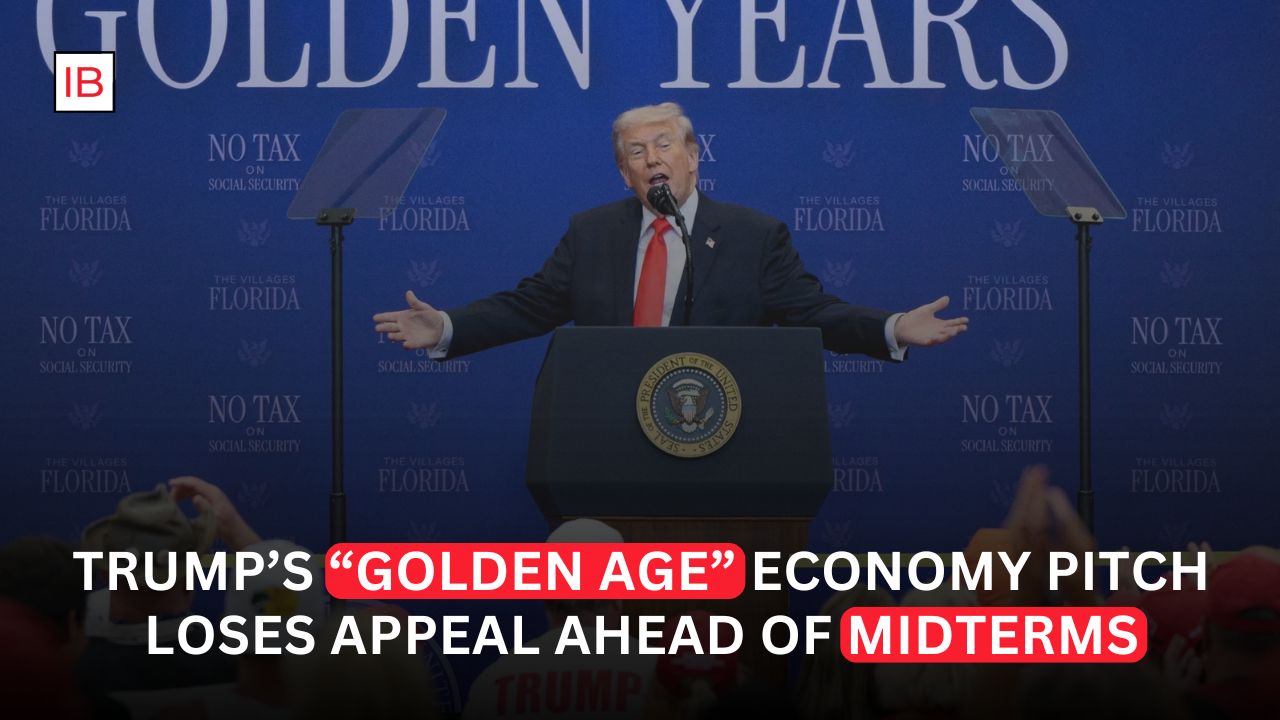
Rising Costs, Weak Job Growth and Economic Frustration Are Undermining the President’s Message as Republicans Prepare for November
President Donald Trump is finding it increasingly difficult to convince voters that the US economy is performing as strongly as his administration claims, creating a political problem for Republicans as the 2026 midterm elections approach.
Trump has made economic performance a central part of his political message, emphasizing growth, investment, tax policy and his efforts to reshape trade. But for many Americans, the economy is being judged less by headline indicators and more by the prices they face every day.
That disconnect is becoming increasingly important.
Recent polling shows widespread dissatisfaction with the economy and Trump’s handling of it. A Pew Research Center survey released in July found that only 34% of Americans approved of Trump’s overall job performance, while 64% disapproved.
Affordability Remains the Biggest Problem
The central weakness in Trump’s economic message is the continued concern over affordability.
Although inflation has moderated from its earlier peaks, consumers are still dealing with prices that remain substantially higher than they were several years ago.
Food, housing, insurance, transportation and other essential expenses continue to weigh on household budgets.
For voters, slower price increases do not necessarily mean that life has become cheaper.
That distinction is creating a political challenge for the administration.
Trump campaigned heavily on the promise of improving Americans’ economic lives, particularly for working- and middle-class households. But voters increasingly appear to be asking whether their personal finances have actually improved.
Jobs Are Becoming Another Concern
The labor market is also showing signs of losing momentum.
US employers unexpectedly cut 23,000 jobs in July, according to recently released data, while revisions reduced employment gains reported for May and June by a combined 103,000. The unemployment rate fell to 4.1%, but part of that decline reflected people leaving the labor force rather than a surge in employment.
The weakness matters politically because employment is one of the most visible measures of economic health.
A labor market that stops producing jobs at a strong pace can quickly change how voters view the broader economy.
It also creates a difficult environment for Republicans, who have traditionally benefited when voters trust the party more than Democrats to manage economic policy.
Republicans Are Losing Their Traditional Advantage
Economic management has historically been one of the Republican Party’s strongest political arguments.
But that advantage appears to be weakening.
Recent polling and analysis suggest that voters are becoming less confident in Republicans’ ability to address inflation and the cost of living. The Wall Street Journal reported that the GOP is losing ground on economic issues as voters remain frustrated by high prices and slowing growth.
That shift could become particularly important in competitive congressional districts.
Republicans hold narrow majorities, meaning relatively small changes among independent voters, suburban voters or economically frustrated members of their own coalition could have significant consequences.
The Economy Looks Better on Some Measures
The administration can point to several indicators that support its argument that the economy remains resilient.
Consumer spending has remained relatively strong, while financial markets have benefited from enthusiasm surrounding artificial intelligence and technology companies.
The economy is still expanding rather than contracting.
But the political problem is that those indicators do not necessarily match how households perceive their financial situation.
A rising stock market is particularly limited as a political selling point because millions of Americans have little or no direct exposure to equities.
For households struggling with rent, groceries or mortgage payments, stock-market gains may feel distant.
Inflation Remains a Political Liability
Inflation continues to be one of Trump’s biggest economic vulnerabilities.
Even as price pressures have eased in some areas, consumers continue to remember the rapid increases that occurred during and after the pandemic.
That creates what economists sometimes describe as a price-level problem rather than simply an inflation-rate problem.
If prices rise more slowly, households may still feel financially squeezed because the higher prices established during previous inflationary periods do not disappear.
Recent polling reflects that frustration. Brookings researchers have found that inflation, stagnant wages and rising costs are particularly affecting Black and Latino voters, including some voters who moved toward Trump in 2024 because of economic concerns.
Trump’s Tariff Strategy Adds Uncertainty
Trump’s aggressive trade policies are another source of economic uncertainty.
The administration has promoted tariffs as a way to protect American industries, increase domestic production and pressure foreign governments into changing trade policies.
But tariffs can also increase costs for businesses that depend on imported goods and components.
Those costs can eventually reach consumers.
The political challenge for Trump is therefore straightforward: voters may support the idea of protecting American industry while simultaneously becoming frustrated if tariffs contribute to higher prices.
Iran War Has Complicated the Economic Message
The administration’s economic argument has also been complicated by geopolitical developments.
The war with Iran has contributed to volatility in energy markets, increasing concerns about fuel prices and inflation.
That makes it harder for Trump to present the economy as entirely under his administration’s control.
The administration has argued that some of the economic difficulties are temporary and linked to external developments.
But voters typically judge the president based on what they experience rather than the underlying cause of a price increase.
The Federal Reserve Adds Another Challenge
Monetary policy is also becoming politically sensitive.
The Federal Reserve faces a difficult balance between inflation that remains above its target and a labor market that is showing signs of weakness.
Recent data has strengthened arguments within the Fed for maintaining restrictive policy, even as some officials see less need for further tightening.
Trump has repeatedly pushed for lower interest rates.
But if inflation remains elevated, the central bank may be reluctant to ease policy aggressively.
That creates another potential conflict between the administration’s economic ambitions and the realities of monetary policy.
Voters May Decide Based on Personal Finances
The most important question heading into the midterms may not be whether the US economy is technically growing.
It may be whether voters feel better off.
Political history shows that voters often evaluate economic conditions through their own household experiences.
A person who has a job but cannot comfortably afford housing or groceries may still view the economy negatively.
That perception can become more powerful than GDP growth figures or Wall Street performance.
Democrats See an Opening
The changing economic mood gives Democrats an opportunity to reclaim an issue that has often favored Republicans.
Democrats can focus their campaign messaging on affordability, wages, housing and healthcare costs.
Recent research suggests that economic frustration could be particularly important among voters who previously supported Trump because they believed he would improve their financial circumstances.
However, Democrats also face challenges.
The party’s own approval ratings remain weak in many surveys, meaning dissatisfaction with Trump does not automatically translate into enthusiasm for Democratic candidates.
Republicans therefore remain capable of recovering if economic conditions improve before November.
Time Is Running Short
The timing of the economic debate is crucial.
The 2026 midterm elections are approaching, leaving the administration only a limited period to change voters’ perceptions.
A meaningful improvement in inflation, employment and household purchasing power could strengthen Trump’s economic argument.
A continued slowdown, however, could make the economy one of Republicans’ biggest liabilities.
The White House will likely continue emphasizing investment, manufacturing, deregulation and other areas where it believes its policies are producing results.
The opposition will focus on what voters pay at the checkout counter.
Looking Ahead
Trump’s economic pitch is running into a fundamental political problem: the administration can point to economic growth and financial-market strength, but many voters remain focused on high prices, affordability and weakening job growth.
That disconnect could become one of the defining issues of the 2026 midterm elections.
Recent data show that the labor market has lost momentum, while surveys continue to show widespread dissatisfaction with the economy.
For Republicans, the danger is that economic dissatisfaction could erode the party’s traditional advantage on economic management.
The biggest challenge may be convincing voters that an improving inflation rate actually means an improving standard of living.
Trump’s administration can argue that economic conditions are stronger than public sentiment suggests, and there are indicators supporting that case.
But elections are ultimately decided by voters’ perceptions.
If Americans continue to feel that their paychecks are not keeping pace with everyday expenses, the administration’s economic achievements may struggle to translate into political support.
The economy could therefore become less of a Republican strength and more of a battleground heading into November.
For Trump, the months ahead will be crucial.
A stronger labor market, easing prices and improved household confidence could revive his economic message.
But if voters continue to feel squeezed, Republicans may face a difficult election campaign in which the president’s central economic argument fails to persuade the people he most needs to convince.