Deere Faces a Slower Agricultural Recovery
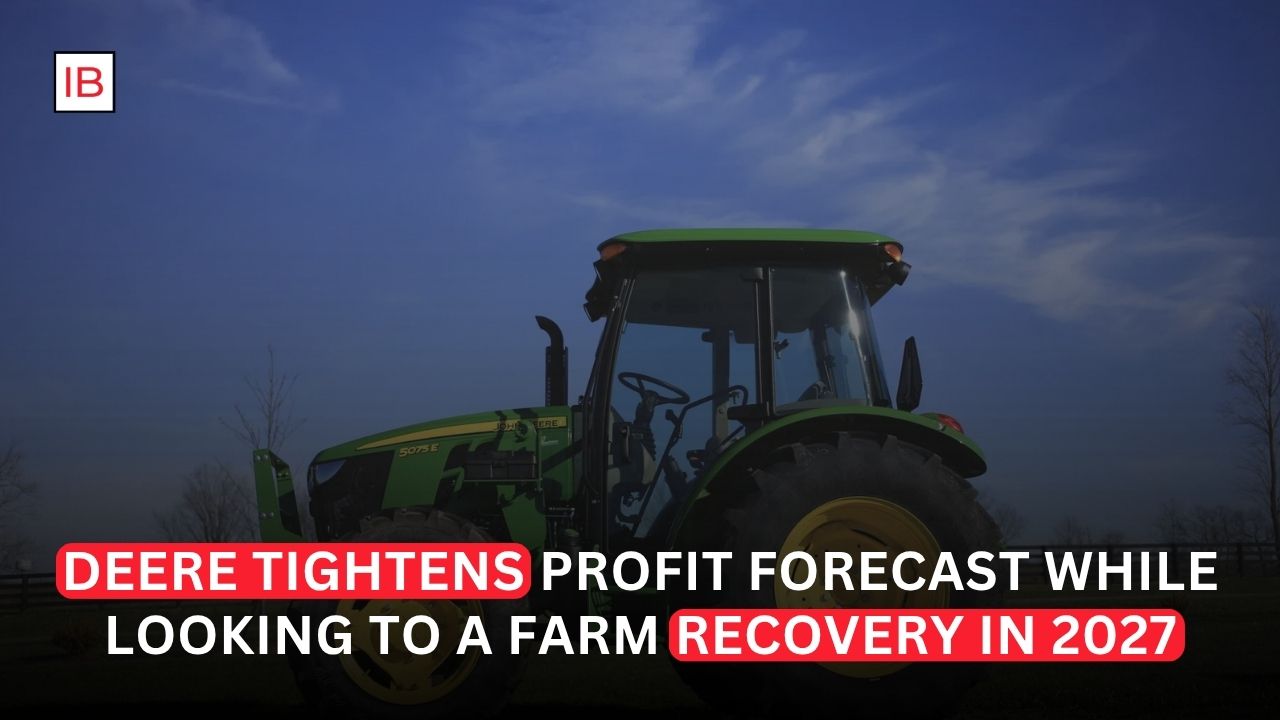
Deere & Co. has narrowed its profit outlook as the agricultural equipment maker continues to navigate weak farm conditions and cautious customer spending. The company expects pressure on demand to persist in the near term, while signs of a broader recovery in the farm economy are increasingly being pushed toward 2027.
Deere Raises the Lower End of Its Profit Forecast
Deere’s latest results showed that some parts of its business are improving even as its core large-scale agriculture segment remains under pressure.
The company reported fiscal third-quarter earnings of $5.10 per share, up from $4.75 a year earlier, while revenue increased about 6% to $11 billion. Deere also raised the lower end of its full-year net income forecast and now expects profit of between $4.75 billion and $5 billion.
The revised forecast represents a narrowing of the company’s previous outlook rather than a major change in its overall expectations. Deere is seeing stronger demand for smaller tractors, construction machinery and forestry equipment, helping offset continued weakness in the market for large agricultural machines.
Large Farm Equipment Demand Remains Weak
Deere’s Production and Precision Agriculture division, which includes many of its large tractors and harvesting machines, continues to face a difficult environment.
Third-quarter sales in the segment fell 6.4% to around $4 billion, largely because of lower shipment volumes. Farmers have remained cautious about making major equipment purchases as crop prices, production costs, interest rates and broader uncertainty continue to affect farm profitability.
The weakness is particularly important for Deere because large agricultural equipment has traditionally been one of the company’s most significant businesses.
When farm incomes are strong, farmers are more willing to replace aging machinery and invest in advanced equipment. But when margins tighten, expensive purchases such as tractors and combines are often delayed.
Deere had previously warned that demand for large agricultural equipment in the US and Canada would remain subdued in 2026, with industry sales expected to decline significantly compared with the previous year.
Construction and Smaller Equipment Provide Support
While large agriculture remains weak, other parts of Deere’s business are helping stabilize overall results.
Construction and Forestry sales increased 18% to $3.62 billion during the quarter, while Small Agriculture and Turf sales rose 12% to $3.38 billion.
Demand for construction equipment has benefited from infrastructure spending and investment in large projects, including the expansion of data centers and other industrial facilities. Small tractors and equipment have also performed better than the large agricultural machinery market.
This diversification has become increasingly important for Deere.
Instead of depending entirely on the farm economy, the company can rely on construction, forestry, smaller agricultural equipment and financial services to offset weakness in one part of its business.
The contrast between the segments also shows that the broader equipment market is not moving in a single direction. While large-scale farmers remain cautious, construction activity and smaller equipment purchases are providing stronger demand.
Deere Sees 2026 as the Bottom of the Farm Cycle
One of the most important signals from Deere’s outlook is management’s belief that 2026 could represent the low point of the current agricultural equipment cycle.
The company and analysts have pointed to several factors that could support a recovery in the years ahead. Dealer inventories have improved, used equipment markets have become healthier and the average age of machinery in use has increased, creating potential demand for replacement equipment when farm conditions improve.
However, Deere appears to believe that a meaningful recovery will take time.
A more pronounced improvement in agricultural equipment demand is increasingly expected in 2027, when stronger farm economics could encourage customers to resume larger machinery purchases.
That means 2026 may be a transition year rather than the beginning of a major rebound.
Farm Income and Crop Prices Will Remain Critical
The future of Deere’s agricultural business will depend heavily on the financial health of farmers.
Farmers make major equipment purchases based on their expected income and confidence in future commodity markets. Higher prices for corn, soybeans and other crops can improve cash flow and encourage investment.
At the same time, costs for fertilizer, fuel, labor and financing can reduce profitability.
Deere has previously noted that farmer sentiment remains cautious despite some improvement in agricultural commodity prices. High and volatile input costs and elevated interest rates have continued to limit confidence.
Any improvement in these conditions could help accelerate the recovery.
If crop prices strengthen while fertilizer, energy and financing costs stabilize, farmers may become more willing to replace aging equipment. But continued volatility could delay the recovery further.
Technology Could Give Deere an Advantage
Even during a weak agricultural cycle, Deere continues to invest heavily in technology.
The company has focused on automation, autonomous equipment, precision agriculture and digital tools designed to help farmers increase productivity and reduce operating costs.
These technologies could become increasingly important when the agricultural market eventually recovers.
Farmers facing labor shortages and rising production costs are looking for equipment that can improve efficiency. Deere’s investment in automation and precision systems could help the company capture additional demand when customers begin increasing capital spending again.
The strategy also allows Deere to generate value beyond simply selling more tractors.
Digital services, software, automation and precision tools could strengthen customer relationships and provide additional long-term revenue opportunities.
Investors Focus on the 2027 Recovery
Deere’s latest results suggest that investors are beginning to look beyond the current weakness in large agricultural equipment.
The company delivered its first quarterly profit increase in nearly three years, supported by stronger sales outside its core large-farm machinery business.
The key question is whether 2027 will bring the stronger agricultural recovery that Deere and investors are expecting.
Several positive conditions are already developing. New and used equipment inventories have improved, machinery fleets are aging and some agricultural commodity prices have strengthened. These factors could create pent-up demand for replacement equipment.
However, the timing remains uncertain.
Farm equipment is a cyclical business, and farmers may continue delaying purchases if interest rates remain high or input costs rise sharply. Global trade conditions and commodity markets could also influence the speed of the recovery.
Deere’s Diversified Business Provides a Buffer
Deere’s performance during the current downturn demonstrates the importance of its diversified operations.
The company is best known for its green and yellow agricultural machinery, but its Construction and Forestry and Small Agriculture and Turf divisions are now playing an important role in supporting earnings.
Construction equipment demand has been particularly strong, benefiting from infrastructure projects and increased industrial investment.
This has allowed Deere to maintain relatively strong profitability even while its large agriculture business experiences declining sales.
The company’s ability to manage costs and adjust production has also helped protect margins during the downturn. Earlier in 2026, Deere cited cost-cutting measures as one reason it was able to improve its financial outlook despite continued pressure on agricultural equipment demand.
A Recovery May Be Coming, but Patience Is Required
The agricultural equipment market appears to be stabilizing, but Deere does not expect an immediate return to strong growth.
The company’s narrowed profit forecast and improving results in several divisions suggest that the worst of the downturn may be passing. However, large-scale agricultural machinery demand remains weak, and a stronger recovery is increasingly expected to take shape in 2027.
For farmers, the next year will depend heavily on commodity prices, production costs, interest rates and overall farm income.
For Deere, the challenge will be to maintain profitability during the remaining period of weak demand while preparing for the eventual return of large equipment purchases.
The company appears well positioned for such a recovery because inventories are improving, equipment fleets are aging and Deere continues to invest in advanced technology.
Looking Ahead
Deere’s latest earnings provide a mixed but increasingly encouraging picture.
The company has narrowed its full-year profit outlook to $4.75 billion to $5 billion after reporting stronger third-quarter earnings and its first year-over-year quarterly profit increase in nearly three years. Growth in construction, forestry and smaller agricultural equipment helped offset continued weakness in the large-farm machinery business.
The most important development, however, may be Deere’s view of the agricultural cycle.
With 2026 increasingly seen as the bottom of the downturn, the company and investors are now looking toward 2027 for a more meaningful recovery in farm equipment demand.
Whether that recovery arrives on schedule will depend on improving farm profitability and greater confidence among agricultural customers.
For now, Deere is benefiting from its diversified business model. Stronger demand in construction and smaller equipment is helping support the company while its largest agricultural customers wait for better economic conditions.
If farm markets improve as expected, Deere could enter the next cycle with healthier inventories, a more advanced technology portfolio and significant potential demand from farmers who have delayed replacing aging machinery.