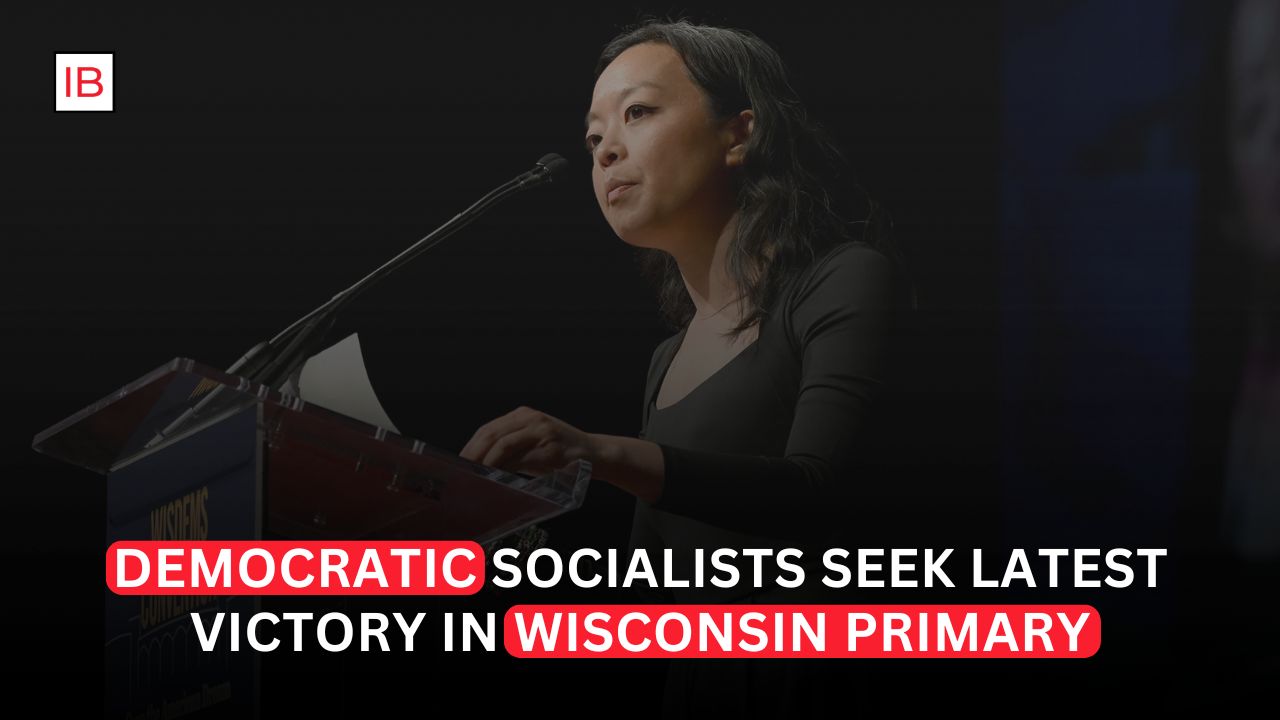
Wisconsin’s Democratic gubernatorial primary is emerging as an important test of whether the Democratic Socialists of America and the broader progressive movement can translate recent electoral momentum into success in a closely contested Midwestern swing state.
Voters are heading to the polls on August 11 to choose the Democratic nominee for governor, with state Rep. Francesca Hong, a democratic socialist from Madison, competing against a field that includes Milwaukee County Executive David Crowley, Lt. Gov. Sara Rodriguez, state Sen. Kelda Roys and other candidates.
The race has attracted national attention because Wisconsin is very different from the heavily Democratic cities where progressive candidates have recently achieved some of their most visible victories.
A Hong victory would therefore represent a more consequential test of the movement’s ability to appeal beyond its traditional urban base.
A Progressive Candidate Gains Momentum
Hong has built her campaign around a strongly progressive platform that includes expanded social programs, universal childcare, free school meals and a halt to new data-center construction. She has also called for abolishing Immigration and Customs Enforcement.
Her campaign reflects the broader effort by progressive Democrats to push the party toward policies focused on economic inequality, labor rights, immigration and public investment.
The question facing Wisconsin Democrats is whether those positions can win a statewide election in a politically competitive state.
Hong’s rise has already created anxiety among some Democratic strategists, who argue that her ideological positions could make the party more vulnerable in the general election.
But her supporters see the race differently.
They argue that progressive policies can mobilize voters who are frustrated with the political establishment and that a more ambitious agenda could increase Democratic turnout.
Wisconsin Is a Serious Test
Wisconsin is not an easy state for either party.
It has become one of the country’s most closely watched battlegrounds, with elections frequently decided by narrow margins.
That makes the gubernatorial primary particularly significant.
Democrats need a candidate capable of appealing to voters in Milwaukee and Madison while also competing in suburban and rural areas.
Hong’s strongest support is expected to come from progressive voters, particularly in Madison and other Democratic strongholds.
Her challenge is demonstrating that this coalition can expand beyond those areas.
A candidate who wins the Democratic primary with a strongly progressive message will then face the much broader electorate in November.
The Democratic Establishment Has a Preferred Alternative
Gov. Tony Evers, who is not seeking another term, endorsed Crowley, giving the Milwaukee County executive a significant establishment advantage.
Crowley has positioned himself as a more pragmatic alternative and has emphasized electability.
His argument is straightforward: Democrats need a nominee who can win a competitive statewide race rather than simply energize the party’s progressive base.
That creates the central strategic disagreement of the primary.
Should Democrats prioritize ideological enthusiasm or broader electoral appeal?
Hong’s supporters believe the distinction is overstated.
Her opponents believe it could determine whether Democrats retain the governorship.
Recent Progressive Wins Are Raising Expectations
The Wisconsin contest comes after a series of notable progressive victories elsewhere.
Those wins have encouraged Democratic socialists and progressive organizations to believe that voters may be more receptive to left-wing candidates than conventional Democratic strategists assume.
But Wisconsin presents a different challenge.
Many recent progressive breakthroughs have occurred in cities or districts where Democrats already hold substantial electoral advantages.
Wisconsin’s statewide electorate is much more competitive.
That means a candidate can be highly successful in a Democratic primary while still facing a difficult general-election environment.
This is precisely why Hong’s potential victory is attracting national attention.
The Republican Side Adds Another Dimension
Republicans are also watching the Democratic contest closely.
Republican Rep. Tom Tiffany, a Trump ally, is seeking the GOP nomination and is running without a major primary challenge.
Republicans have obvious incentives to portray Hong as too far to the left for Wisconsin.
If she wins the Democratic nomination, the general election could quickly become a national campaign.
Democrats, meanwhile, would have to decide whether to embrace her platform or moderate some of her positions in an effort to appeal to swing voters.
That debate could become almost as important as the primary itself.
Hong’s Policy Agenda Creates Both Opportunities and Risks
Hong’s campaign is built around policies designed to address household costs and expand public services.
Universal childcare and free school meals, for example, are issues that can appeal to working families regardless of ideological identity.
Her opposition to new data-center construction also taps into concerns about energy use, infrastructure and the impact of rapidly expanding technology projects on local communities.
But some of her past positions have generated controversy.
Opponents have pointed to statements involving policing and other issues as evidence that she could struggle to appeal to moderate voters in November.
The effectiveness of those attacks will depend on whether voters see them as relevant to the current campaign or as attempts to define Hong through old controversies.
The Electability Argument Is Not Settled
The strongest argument against Hong is that Wisconsin is simply too competitive for a candidate with an explicitly socialist identity.
That argument has intuitive appeal, but it is not necessarily conclusive.
Wisconsin voters have repeatedly demonstrated that they do not fit neatly into national ideological categories.
Progressive economic policies can perform well in parts of the state even when voters remain skeptical of national Democratic messaging.
The real question is therefore not simply whether Wisconsin is “too moderate” for Hong.
It is whether she can combine progressive policies with a campaign that addresses the concerns of voters outside Madison and Milwaukee.
A Bigger Battle Over the Democratic Party
The primary also reflects a broader struggle over the future direction of the Democratic Party.
One faction argues that Democrats need to move left on economic and social issues to rebuild enthusiasm among younger and working-class voters.
Another argues that the party’s priority should be winning competitive districts and states, which requires candidates capable of appealing to independents and moderate voters.
Wisconsin provides a useful laboratory for that debate.
If Hong wins and then performs strongly in the general election, progressive Democrats will have a powerful example that their approach can work in a battleground state.
If she wins the primary but struggles badly in November, establishment Democrats will have ammunition for their argument that ideological purity can come at an electoral cost.
The Race Could Influence 2028
The implications extend beyond Wisconsin’s governor’s mansion.
The 2026 midterms are already being viewed as an early indicator of the political environment heading toward the 2028 presidential election.
Wisconsin is especially important because it is likely to remain a major battleground.
A strong Democratic performance could demonstrate that progressive economic policies can mobilize voters in the Upper Midwest.
A Republican victory could strengthen arguments that Democrats need a more moderate strategy in swing states.
That makes the primary more than a contest between individual candidates.
It is also a fight over what kind of Democratic coalition can win nationally.
What Voters Are Deciding
The immediate decision for Wisconsin Democrats is straightforward: which candidate should represent them in November?
But the underlying choice is more complicated.
Hong represents the party’s progressive insurgency.
Crowley and other candidates represent a more conventional approach focused heavily on statewide electability.
The winner will inherit a politically competitive state and face a Republican opponent backed by a strong national conservative movement.
That makes the November election a serious test regardless of who wins the primary.
A Turning Point for Democratic Socialists?
The Wisconsin primary could become one of the most important tests yet for the Democratic socialist movement.
A victory for Hong would show that progressive candidates can compete not only in safely Democratic urban areas but also in a major swing state.
It would not prove that every progressive candidate can win statewide.
But it would weaken the argument that democratic socialism is inherently incompatible with competitive Midwestern politics.
Conversely, if establishment Democrats defeat Hong, it could reinforce the view that progressive candidates still face substantial limits when they move beyond deep-blue territory.
Either outcome will provide useful evidence.
For now, Wisconsin voters are deciding whether the Democratic Party’s next chapter should be defined by a more aggressive progressive agenda or by a candidate focused primarily on broad electoral appeal.
The result could offer an early answer to a question Democrats across the country are asking: How far left can the party move and still win in America’s political battlegrounds?