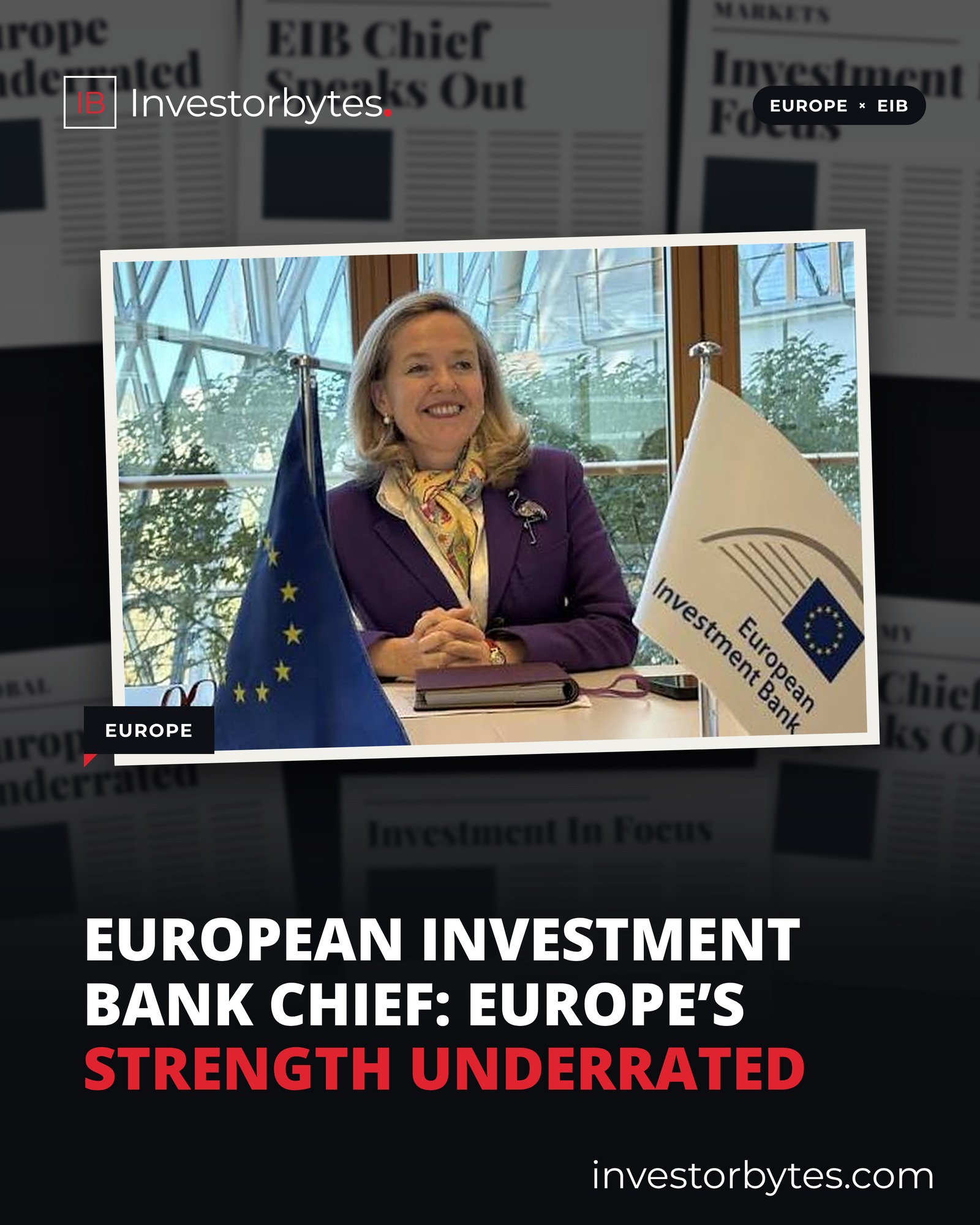
For much of the past decade, the dominant story about Europe has been one of decline: slow growth, ageing populations, dependence on foreign energy and an inability to keep pace with American and Chinese technology. Nadia Calviño, president of the European Investment Bank, wants to rewrite that narrative. In a recent commentary, the head of the EU’s lending arm argues that the continent is entering a period of genuine self-belief, and that investors and policymakers who keep betting against it are misreading the evidence.
Calviño frames her case around the Munich Security Conference, where she says the overriding message was not anxiety but trust in Europe’s capacity to act. Her argument is that the bloc has become a serious force in technology, trade and industry, and that its resilience has been consistently underestimated during a period of fast-moving geopolitical change.
Clean Energy as Industrial Strategy
The most concrete example she offers comes from the Baltic Sea. Off Poland’s northern coast, 233 turbines, each close to the height of the Eiffel Tower, are being installed. What makes the project symbolic is its supply chain: rotors from Germany, foundations from Denmark, and cables from Poland and Greece. According to Calviño, the development should create thousands of jobs and provide clean power to an additional 5.5 million households.
This matters because it shows the energy transition being treated as an industrial project rather than only a climate commitment. Alongside new generation, Europe is building cables and interconnectors to link its northern seas with the Mediterranean, a network she likens to a superhighway for an economy that will increasingly run on electricity. Better grid connections are central to lowering power costs and reducing exposure to price shocks, which hit European industry hard after 2022.
The investment numbers support the point. Calviño says EU spending on the energy transition reached a record in 2025, approaching €400bn, with projects ranging from hydropower in Austria and railways in Czechia to efficiency upgrades for small Croatian firms and clean technology for heavy industry in Portugal. She also notes that the combined market value of European renewable energy companies climbed by more than half over the past year.
The European Investment Bank’s Role in Mobilising Capital
The European Investment Bank sits at the centre of this effort. Owned by the EU’s member states, it is one of the world’s largest multilateral lenders, and its model relies on using public guarantees, including those backed by the EU budget, to attract private capital that would not otherwise flow into riskier or longer-term projects. Calviño says the EIB Group backed close to 900 investment projects last year.
That approach reflects a broader shift in European policy. Governments face tight budgets and high debt, so public money increasingly acts as a catalyst rather than the main source of funding. Whether this crowding-in model can scale fast enough to close Europe’s investment gap remains one of the key questions for the bloc’s economic future.
Defence, Security and a New Venture Ecosystem
Security has become a second pillar of Calviño’s argument. She points to European capabilities ranging from Dutch fibre-optic sensors on the seabed and Belgian satellite networks to French and Spanish radar systems and Finnish work on AI-enabled 6G communications. Europe, she says, is moving quickly in strategic areas such as drones.
Markets have noticed. European defence stocks have roughly tripled in value over three years, and a venture capital scene focused on security and defence has developed at speed. Calviño also claims that Europe’s output in some critical categories, including artillery shells, now exceeds that of the United States, and that the continent is steadily and irreversibly ending its reliance on Russian gas.
A Record of Bouncing Back
To support her view that Europe tends to rise to a crisis, Calviño revisits recent history. In 2020, a European biotech firm developed a Covid-19 vaccine within months, and EU leaders agreed a large recovery programme financed through jointly issued debt, a step many had considered politically impossible. In 2022, despite the energy price spike that followed Russia’s full-scale invasion of Ukraine, she notes that eurozone GDP grew faster than that of both China and the US that year.
She adds more recent signals. European equities beat US markets in 2025, unemployment sits near record lows, and Spain and Poland are among the stronger growth stories. Opinion polls, she says, show record public support for the EU and the euro, while international surveys suggest that many people around the world now see the EU as a great power comparable to the US and China.
A Different Kind of Superpower
Calviño describes the EU as a superpower of a different type, one that relies on rules, values and multilateral cooperation rather than military dominance. With an economy worth around $22trn and a single market of nearly 500 million people, the bloc remains the world’s leading trading power, holds an extensive web of free trade agreements, and is the largest provider of financial and military support to Ukraine. It is also the biggest source of humanitarian aid and development finance, funding work from vaccination campaigns to water supply projects in cities such as Amman and Karachi.
She roots this model in the history of European integration, which began almost 80 years ago in the aftermath of two world wars, and in values such as equal opportunity, intellectual freedom, peace and the rule of law. The full argument is set out in Calviño’s commentary in World Finance, which reads as both an economic case and a political manifesto.
What Europe Still Needs to Do
Confidence is not the same as complacency, and Calviño’s prescriptions implicitly acknowledge Europe’s weaknesses. She calls for deeper integration, particularly of capital markets, which remain fragmented along national lines and push many fast-growing European companies to seek funding or listings in the US. She wants more large-scale investment in infrastructure and strategic capabilities, simpler EU rules to make the bloc more agile, and more mutually beneficial partnerships to diversify supply chains and open new markets.
These priorities echo long-running debates in Brussels about competitiveness, regulatory burden and the slow progress of the capital markets union. Critics would point out that productivity growth still trails the US and that energy costs remain higher than in competing economies. Calviño’s message is that the momentum now favours reform.
Conclusion
Calviño’s essay is a deliberate counterweight to years of pessimism about Europe. The evidence she assembles, from record clean energy investment to booming defence stocks and resilient labour markets, suggests the continent has more strength than its critics allow. Whether that turns into lasting outperformance will depend on whether leaders deliver the integration and investment she describes, with the European Investment Bank positioned as a key engine of that agenda.