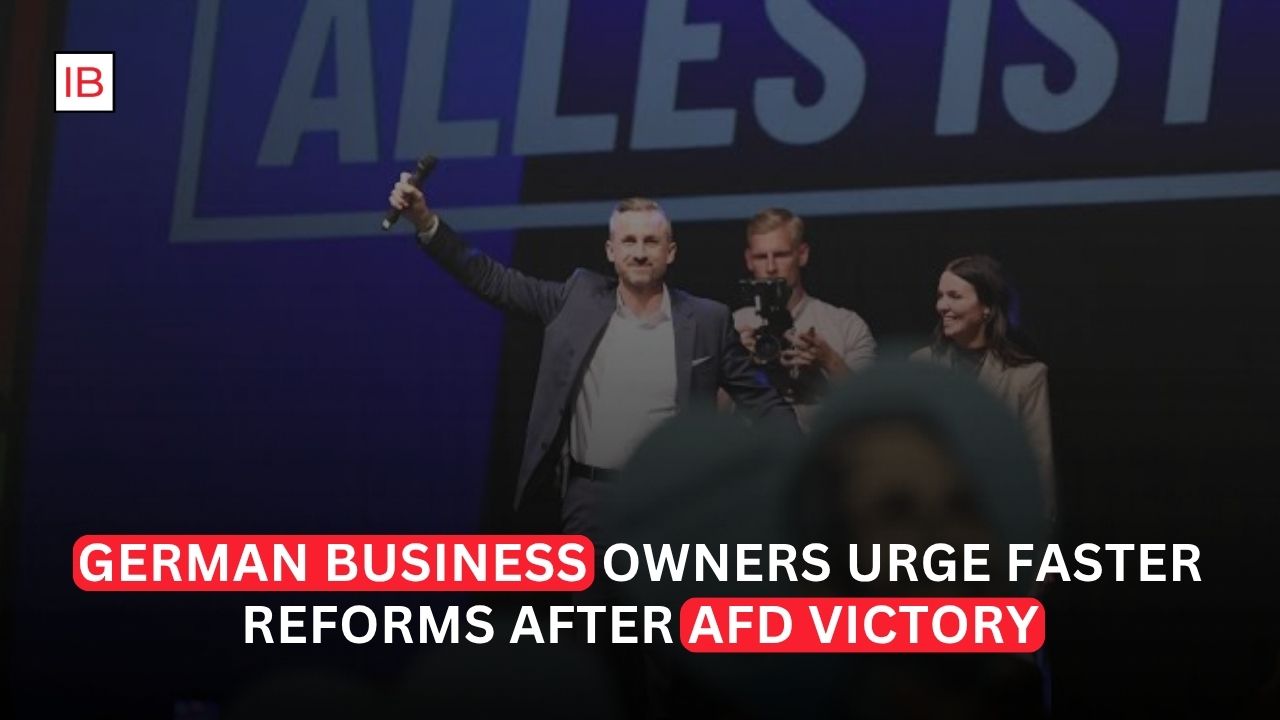
German business owners are pressing Chancellor Friedrich Merz’s government to move faster on economic reforms after the far-right Alternative for Germany, or AfD, scored a historic victory in Sunday’s state election in Saxony-Anhalt. The result has intensified concerns among companies that years of weak growth, high costs and political frustration are creating fertile ground for the far right.
The AfD won about 44% of the vote in Saxony-Anhalt, more than doubling its previous performance and becoming the first far-right party to lead a German state election since World War II. Merz’s Christian Democratic Union suffered a dramatic setback, falling to roughly 17% to 18%. The AfD stopped short of an outright majority, but its result demonstrated the depth of dissatisfaction with Germany’s political establishment.
For business leaders, however, the election is not simply a political story. It reflects growing frustration with the country’s economic performance and the difficulty companies face operating in Germany. Manufacturing, traditionally the backbone of the economy, has been hit by high energy costs, weaker external demand, Chinese competition, labor shortages and rising regulatory burdens.
German companies have already begun cutting jobs and reducing investment in several major industrial sectors. The automotive industry has faced intense competition from Chinese manufacturers, while machinery and other export-oriented businesses have struggled to maintain their traditional advantages. Recent reporting has highlighted how Chinese producers are increasingly competing with German companies on both price and quality, forcing businesses to reconsider production strategies and overseas partnerships.
That economic pressure is becoming politically significant. The AfD has built support in eastern Germany by combining opposition to immigration with criticism of the established political parties and their economic policies. The party’s breakthrough in Saxony-Anhalt suggests that economic dissatisfaction is no longer simply producing protest votes but is translating into a substantial electoral base.
Business owners are consequently calling for faster action on longstanding structural problems. Among the priorities are reducing bureaucracy, accelerating permits, lowering energy costs, improving infrastructure and creating conditions that encourage companies to invest rather than move production abroad.
Germany’s governing coalition has already announced a broad reform agenda covering taxation, pensions, labor-market rules, innovation and bureaucracy reduction. The government has argued that these measures are necessary to restore competitiveness and strengthen economic growth. But the scale of the AfD’s victory has increased pressure on Berlin to demonstrate that reforms can produce visible results.
The challenge for Merz is that Germany’s economic problems cannot be solved through a single package of tax cuts or regulatory changes. Industrial companies require reliable and affordable energy, faster infrastructure development, skilled workers and access to global markets. At the same time, Germany faces pressure to invest heavily in defense, digital infrastructure and the transition toward cleaner energy.
The political environment makes that task more complicated. Mainstream German parties have maintained a political firewall against cooperation with the AfD, which German authorities classify as a right-wing extremist organization. That means the AfD’s electoral strength does not automatically translate into governing power, even after its historic performance.
In Saxony-Anhalt, the party won nearly half of the vote but fell short of the seats required to govern alone. Other parties have ruled out cooperation with the AfD, leaving coalition negotiations potentially complicated. The result could therefore produce an unusual situation in which the strongest party has limited ability to implement its platform.
For investors and company executives, the uncertainty surrounding Germany’s political direction is increasingly important. Economy Minister Katherina Reiche has previously warned that the AfD’s rise could discourage investment, while the government is seeking to attract trillions of euros in private capital over the coming decades. A prolonged period of political uncertainty could make that goal harder to achieve.
At the same time, Germany’s business community faces a difficult choice. Companies want political stability, but many also believe the existing system has been too slow to address structural weaknesses. The election result has therefore strengthened the argument that reform cannot simply be announced; it must be implemented quickly enough for businesses and households to notice improvements.
The AfD’s success is ultimately a warning sign for Germany’s established political parties as much as it is an electoral victory for the far right. Economic stagnation, expensive energy, bureaucracy and industrial decline have become closely linked to public dissatisfaction. If the government fails to respond effectively, the political consequences could extend well beyond Saxony-Anhalt.
For German business owners, the message following the election is increasingly straightforward: restoring competitiveness is becoming an urgent political necessity. Faster reforms could help address the economic grievances driving voter frustration, while delays could give the AfD further opportunities to turn economic discontent into political momentum.
The Saxony-Anhalt result therefore marks more than a breakthrough for Germany’s far right. It is also a test of whether Merz’s government can convince businesses and voters that the country’s economic model can be modernized before political frustration becomes even harder to reverse.