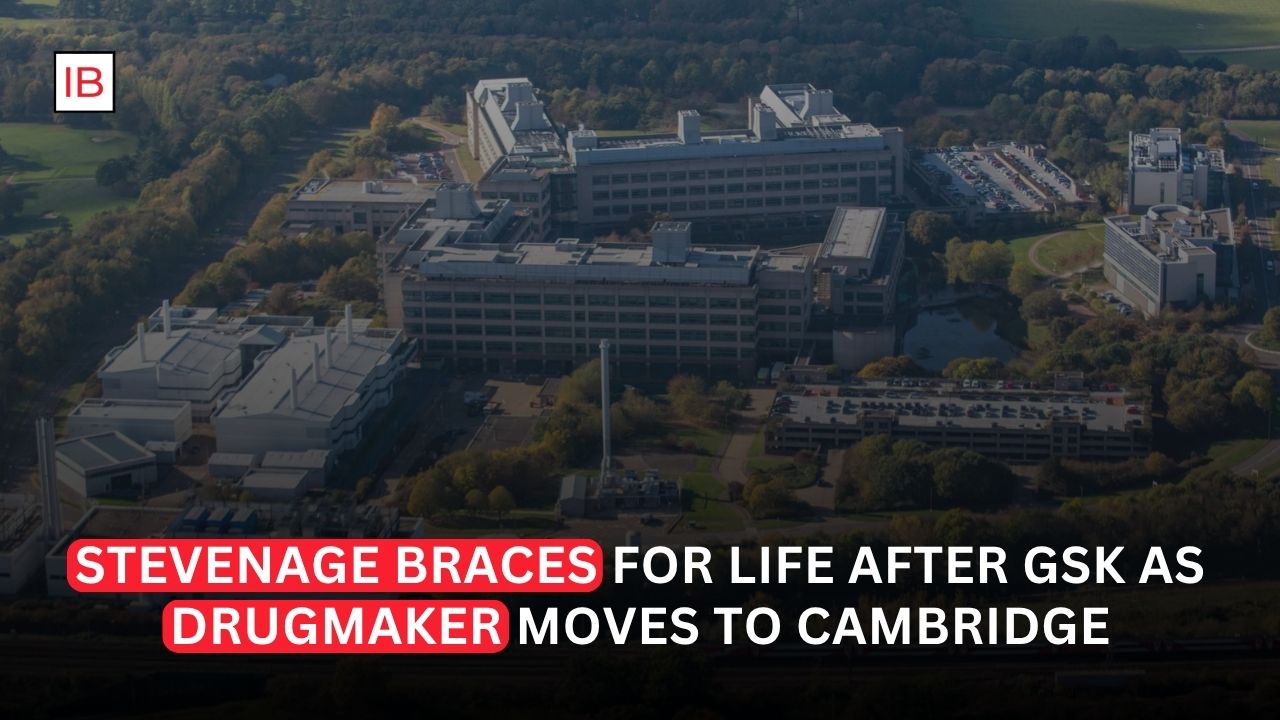
GSK’s decision to move its main research and development operation from Stevenage to Cambridge is creating uncertainty for a town that has spent years trying to establish itself as one of Britain’s leading biotechnology hubs.
The pharmaceutical giant plans to vacate its Stevenage R&D site through a phased relocation of employees by 2029 and establish a new flagship research center at the Cambridge Biomedical Campus. GSK says the move is designed to place its scientists closer to leading universities, hospitals and biotechnology companies, while strengthening collaboration and accelerating drug development.
For Cambridge, the decision represents another major boost to an already powerful life-sciences ecosystem.
For Stevenage, however, the situation is much more complicated.
The town has invested heavily in building a biotechnology cluster around GSK. The company’s departure therefore raises questions about jobs, investment, local businesses and whether Stevenage can maintain its ambitions as a major center for pharmaceutical research.
Stevenage Built Its Biotech Ambitions Around GSK
GSK has operated its research facility in Stevenage for decades, making the pharmaceutical company deeply connected to the local economy.
The site has been an important source of highly skilled employment and has helped attract other businesses to the area.
Stevenage’s wider strategy was to develop a life-sciences ecosystem that could bring together pharmaceutical companies, biotechnology startups, researchers and investors.
GSK was central to that vision.
The company’s departure therefore creates a difficult problem: can the surrounding ecosystem continue growing without its biggest anchor?
That is the question local authorities, property developers and businesses will now have to answer.
GSK Is Betting on Cambridge’s Science Ecosystem
GSK’s argument for moving is straightforward.
Cambridge has developed one of the world’s strongest life-sciences clusters.
The Cambridge Biomedical Campus brings together universities, hospitals, research institutions and biotechnology companies, creating opportunities for collaboration that are difficult to replicate elsewhere.
GSK plans to establish a new flagship R&D center there as part of a broader £400 million investment over three years.
The company believes proximity to academic researchers and other pharmaceutical and biotech organizations can help scientists develop medicines more efficiently.
The Cambridge ecosystem offers access to:
- Leading academic research
- Specialist scientific talent
- Hospitals and clinical expertise
- Biotechnology startups
- Research institutions
- Investors
- Technology companies
- Potential commercial partners
For a pharmaceutical company competing globally for scientific talent, that concentration can be extremely valuable.
More Than 1,000 Scientists Are Expected to Move
The relocation is not simply a property decision.
It involves people.
More than 1,000 scientists are expected to move from Stevenage to Cambridge as part of the transition. The relocation will happen gradually, with the full move expected by 2029.
For employees, the decision could mean longer commutes, relocation costs or difficult choices about whether to remain with GSK.
Some workers may choose to leave rather than move.
That creates another challenge for GSK.
The company wants to bring its research operations closer together, but maintaining scientific talent during a major organizational transition can be difficult.
Stevenage Faces the Loss of an Economic Anchor
The biggest concern for Stevenage is the economic impact.
A large research facility supports more than its direct employees.
Scientists and other highly paid workers spend money in local shops, restaurants and services.
The facility also creates demand for contractors, laboratories, suppliers, professional services and other businesses.
Removing a major employer can therefore have a multiplier effect.
The Times reported that the loss could amount to around £80 million a year for the local economy, while describing the relocation as a significant setback to Stevenage’s ambition of becoming a major biotech cluster.
That does not mean the town’s life-sciences ambitions are finished.
But the strategy will have to change.
Stevenage Has Already Invested in a Biotech Future
The timing makes the decision particularly uncomfortable because Stevenage has already invested heavily in creating a biotechnology ecosystem.
The town has attracted significant development aimed at supporting life-sciences companies and startups.
One major project is the Elevate Quarter, while a separate £900 million life-sciences development backed by UBS and Reef Group has also been planned.
The problem is that attracting enough companies to fill new facilities has proven difficult.
Some businesses are expanding successfully, but parts of the surrounding commercial space remain underused.
GSK’s departure could therefore create additional pressure on developers and policymakers.
The Site Could Still Have a Future
The end of GSK’s presence does not necessarily mean the end of Stevenage’s biotechnology ambitions.
In fact, the existing site could potentially become an opportunity.
The laboratories, scientific infrastructure and trained workforce already present in the area could be attractive to other pharmaceutical or biotechnology companies.
The challenge is finding an anchor tenant or several companies capable of replacing enough of GSK’s economic contribution.
That will require more than simply advertising empty laboratory space.
Stevenage needs to convince businesses that the town can offer a competitive scientific ecosystem even without GSK at its center.
GSK Is Not Abandoning Hertfordshire Completely
One important detail is that GSK is not leaving Hertfordshire altogether.
Alongside the Cambridge move, the company plans to upgrade its existing R&D laboratories at Ware.
Some employees will move there, creating what GSK describes as an integrated drug-development and commercial-manufacturing scale-up capability.
That means the company’s future UK footprint will be more concentrated around several specialized locations rather than simply moving everything to Cambridge.
London will also remain GSK’s global headquarters.
So the change is primarily about reorganizing research rather than abandoning the UK.
Cambridge Is Becoming Even More Important to UK Pharma
GSK’s decision strengthens Cambridge’s position as one of Britain’s most important pharmaceutical and biotechnology centers.
AstraZeneca already has its global headquarters at the Cambridge Biomedical Campus, making GSK’s planned arrival particularly significant for the region.
The concentration of major pharmaceutical companies can create a powerful network effect.
When large companies establish research operations in the same area, they attract:
- Scientists
- Startups
- Venture capital
- Universities
- Specialized suppliers
- Technology companies
- Clinical researchers
That can encourage further investment.
Cambridge therefore stands to benefit from GSK’s move beyond the direct jobs and investment involved.
The UK Government Wants an Oxford-Cambridge Corridor
The relocation also fits into a broader British ambition to strengthen the country’s science and technology economy.
The Oxford-Cambridge corridor has long been viewed as a potential European equivalent of major global innovation regions.
Greater concentration of pharmaceutical, biotechnology and technology companies could help Britain compete internationally for research investment.
From that perspective, GSK’s move could be seen as positive for the UK overall.
But that national benefit comes with a regional trade-off.
Cambridge gains while Stevenage loses an important economic institution.
The Biggest Risk Is Losing the Local Cluster
The real danger for Stevenage is not simply losing GSK employees.
It is losing the network that developed around GSK.
Biotechnology clusters often depend on close relationships between large pharmaceutical companies and smaller firms.
Big companies provide experienced workers, partnerships, funding opportunities and commercial expertise.
If GSK’s departure weakens those connections, startups may find Stevenage less attractive.
That could create a negative cycle.
The potential sequence is:
GSK leaves
→ fewer researchers
→ weaker business ecosystem
→ fewer startups
→ less investment
→ weaker attraction for future companies.
Stevenage’s challenge is to prevent that cycle from becoming reality.
There Is Still a Chance to Reinvent Stevenage
The town could use GSK’s departure as a catalyst rather than simply treating it as a loss.
Instead of attempting to recreate the exact ecosystem that existed before, Stevenage could focus on attracting a broader range of life-sciences businesses.
That might include:
- Biotechnology startups
- Drug-manufacturing companies
- Medical technology firms
- AI-focused healthcare companies
- Clinical research organizations
- Specialized laboratories
- Pharmaceutical suppliers
The future may therefore involve a more diversified life-sciences economy rather than dependence on one major employer.
GSK’s Decision Reflects a Broader Pharma Trend
The relocation also illustrates how pharmaceutical companies are changing their research strategies.
Drug development is becoming increasingly dependent on advanced technologies, data analysis, artificial intelligence and collaboration between disciplines.
Companies want scientists working alongside computational specialists, universities, clinicians and biotech entrepreneurs.
That makes scientific clusters more valuable.
GSK’s investment in Cambridge is therefore not simply about office space.
It reflects a belief that physical proximity to a dense research ecosystem can improve innovation.
The Cost of the Move Matters Too
GSK is making this transition while also pursuing a broader effort to reduce costs and improve efficiency.
The company has announced a £1.9 billion cost-cutting program intended to free resources for investment in future growth.
That makes the £400 million Cambridge investment particularly significant.
GSK is effectively choosing to spend heavily in one location while reducing its footprint in another.
The company believes the long-term scientific benefits will justify the cost.
Investors will ultimately judge whether the new structure helps produce medicines more efficiently and strengthens the company’s pipeline.
What Happens to Stevenage Now?
The next few years will be crucial.
Local authorities will need to attract new businesses before the GSK transition is complete.
That means marketing the existing scientific infrastructure, improving transport links, supporting startups and making the area attractive to skilled workers.
The worst outcome would be a long period in which GSK’s facilities gradually empty while replacement businesses arrive too slowly.
The best outcome would be a transition in which new companies use the available infrastructure and build a more diversified biotechnology cluster.
Conclusion
GSK’s decision to move its main R&D operation from Stevenage to Cambridge is a major strategic change for both the company and the communities involved.
For GSK, the logic is clear: Cambridge offers access to a world-class concentration of universities, hospitals, biotechnology companies and scientific talent. The company plans to invest £400 million over three years in its new R&D structure while completing the phased relocation by 2029.
For Cambridge, the move strengthens an already powerful life-sciences ecosystem and could attract additional talent, investment and partnerships.
For Stevenage, however, the consequences are much harder.
The town has spent years building its identity around biotechnology, with GSK playing a central role. Losing such an important research employer creates a real risk that investment and talent could move elsewhere.
But Stevenage’s story is not necessarily over.
Its existing laboratories, scientific workforce and life-sciences infrastructure could still attract new companies if local leaders successfully reposition the area.
The critical question is whether Stevenage can replace dependence on GSK with a broader ecosystem of pharmaceutical, biotech and technology companies.
GSK’s departure is therefore both a setback and a test.
Cambridge is receiving another powerful boost in its rise as a global life-sciences center.
Stevenage now has to prove that its biotech future can survive without the company that helped build it.